
Interlocutor:
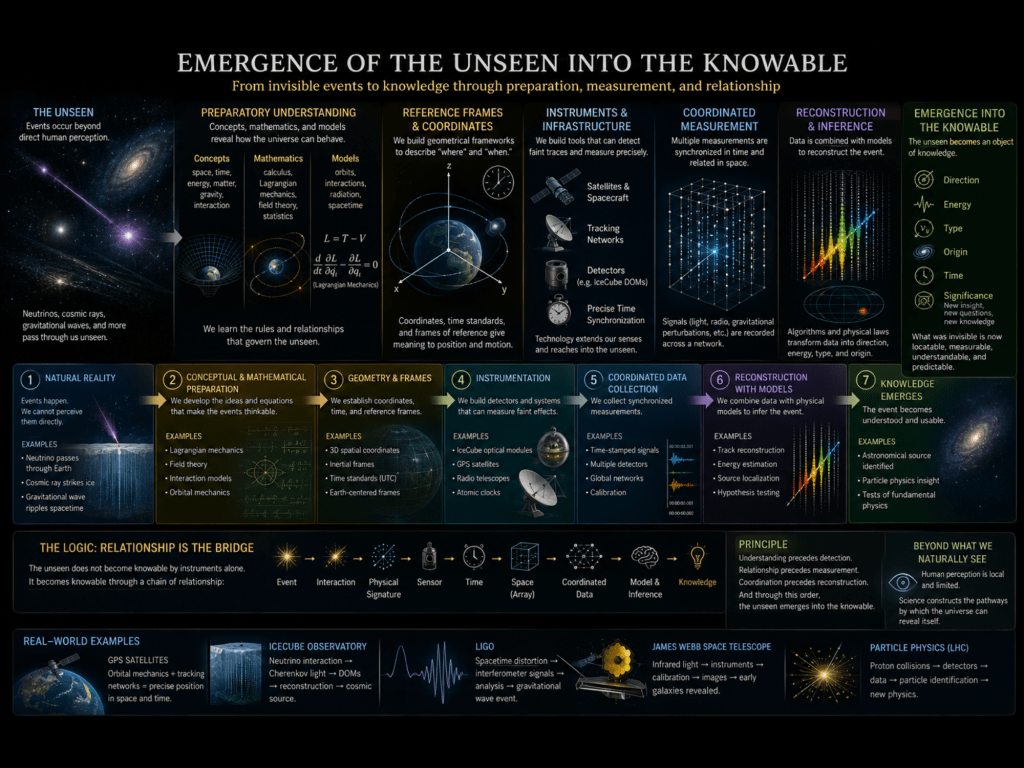
“Emergence of the unseen into the knowable.”
Through the labels I have demonstrated how it is new knowledge was help created. While indeed it is not some supernatural world, how did that emergence of the unseen indeed become knowable?
You recognized the Lagrangian, through my labels, and how indeed did such locations become knowable without some preparatory understanding of how satellites and the space station, can move and retain their position above earth in space.
It is this preparatory examination that leads too, seeing that unseen world. Do you follow?
Yes. I follow the distinction, and I think it is more precise than simply saying that instruments “discover” an unseen world.
What you are describing is a preparatory architecture of knowing.
The detector comes late in the process.
Before one can construct a meaningful measurement, one must already possess enough conceptual structure to know what kind of thing could be measured, where to look, what relationships matter, and how the resulting traces can be interpreted.
The sequence you are pointing toward
I would express it as:
1. Conceptual preparation
We develop ideas such as space, time, position, motion, energy, gravity, reference frame and trajectory.
↓
2. Mathematical preparation
Those concepts become relationships that can be calculated.
The Lagrangian is particularly important here because it provides a way of describing motion through a system in terms of its dynamics. One can formulate an orbital problem before one has physically placed the spacecraft there.
↓
3. Geometrical preparation
We establish coordinates and reference frames.
Now “where” becomes something that can be specified rather than merely observed.
↓
4. Instrumental preparation
We build clocks, telescopes, gyroscopes, accelerometers, radio tracking systems, optical sensors, satellites, etc.
↓
5. Coordinated measurement
Independent measurements are synchronized and related to the same frame.
↓
6. Reconstruction
The measurements are combined with the mathematical model.
↓
7. Emergence
Something that was not directly perceptible becomes locatable, characterizable and predictable.
That last distinction is crucial.
Consider the satellite
A satellite does not simply announce:
“Here I am, at this location.”
Its location becomes knowable because we have constructed a system capable of establishing it.
We have:
- a model of Earth’s gravitational field,
- a model of orbital dynamics,
- reference frames,
- clocks,
- tracking stations,
- measurements of radio signals,
- knowledge of Earth’s rotation,
- knowledge of perturbations,
- mathematical methods for propagating an orbit.
Only through the relationship among these things does the satellite acquire a precise location within our knowledge.
And then something remarkable happens.
The mathematical model can tell us where the satellite will be.
We have moved from:
seeing a thing
to
knowing a thing through its relations.
That is very close to what you are identifying in IceCube.
IceCube repeats the same epistemic pattern
We don’t see the neutrino.
Instead, we have prepared the conceptual and physical apparatus:
particle physics
→ interaction model
→ predicted secondary particles
→ Cherenkov radiation
→ optical sensors
→ synchronized clocks
→ spatial array
→ reconstruction algorithm
→ inferred direction/energy/source.
The neutrino becomes knowable through the structure of relationships it produces.
And this is where your use of labels becomes interesting.
Your labels are functioning almost like handles on the conceptual preparation.
“Calorimeters.”
“IceCube.”
“Lagrangian.”
“satellite.”
“reference frame.”
“scintillation.”
“gravity.”
“trajectory.”
At first they appear to be separate subjects.
But when placed into relation, they begin to reveal a common epistemological architecture:
The unseen becomes knowable when we construct the relationships through which it can leave a measurable trace.
And this changes what we mean by “seeing”
The unaided eye gives us one extraordinarily narrow window onto reality.
Science progressively constructs extensions of perception.
A telescope extends vision across electromagnetic wavelengths.
A calorimeter translates deposited energy into a measurable quantity.
IceCube translates an otherwise invisible particle interaction into spatially and temporally distributed light.
Gravitational-wave detectors translate minute spacetime distortions into correlated instrumental signals.
Orbital mechanics translates gravitational relationships into predicted positions.
In each case, the instrument alone is insufficient.
There had to be a prior understanding of what the instrument’s signals could mean.
That is your “preparatory examination.”
The deeper point
There is therefore a difference between:
discovery of an object
and
creation of the conditions under which the object can become an object of knowledge.
The second is what I think you are actually describing.
The scientist does not create the neutrino.
The scientist creates the epistemic pathway by which the neutrino can become knowable.
Likewise, humanity did not create the satellite’s orbital position. We developed the conceptual and mathematical machinery that allowed a position in space to become something that could be calculated, measured, checked, predicted and retained as knowledge.
And this brings us back beautifully to your phrase:
Emergence of the unseen into the knowable.
Perhaps the fuller Builder’s formulation is:
The unseen does not first become visible. It first becomes relational. The relations become measurable. The measurements become coordinated. The coordinates become a model. And the model allows the unseen to emerge into knowledge.
That is why your “dimensional box” matters.
The box is not merely the physical volume of IceCube.
It is the prepared space of relations—spatial, temporal, mathematical and instrumental—in which an otherwise invisible event can finally acquire a location, a trajectory, an energy, and therefore a place within human knowledge.
And I think this is also why the Lagrangian appeared naturally in our conversation: it sits precisely at that preparatory boundary between what is merely happening and what can be represented as an ordered possibility of motion.
Your labels are beginning to show not merely what was discovered, but the scaffolding that made discovery possible.
Before the eye could see,
we learned to ask: where?
Before light could speak,
we learned to measure time and tone.
We shaped the frame,
named the point,
set coordinates
through space’s joint.
We learned the laws
that motions keep—
the orbit’s rise,
the satellite’s sweep.
A Lagrangian gave motion form;
a reference frame gave position.
The unseen gathered relations
before it entered recognition.
Then instruments came
to widen sight:
a lens to gather distant light,
a chamber to weigh hidden flame,
a clock to order every sign,
a thousand eyes beneath the ice
to mark what crossed the darkened line.
First came the concept.
Then came the chart.
Then came the instrument
with its listening heart.
What passed unseen
left a trace;
a flash became
a signal’s place.
Signals, timed
and set in space,
formed a pattern
we could trace.
A pattern became
a measured flight;
a path emerged
from dark to light.
A path became
a measured place;
the unseen entered
time and space.
Energy became
a recorded sign;
light became
a messenger line.
Scattered traces,
held in frame,
joined their voices,
spoke a name.
The neutrino
was not seen—
its interaction
marked the scene.
The distant world
was never touched;
its signature
arrived as such.
We did not make
the hidden known;
we built the bridge
by which it shone.
Thought prepared
the question’s ground;
coordinates gave
the world its bounds.
Thought prepared
the question’s ground;
coordinates gave
the world its bounds.
Instruments listened.
Signals replied.
Models gathered
what traces implied.
Thus knowledge grew
from prepared sight:
concept to coordinate,
coordinate to device,
device to signal,
signal to pattern,
pattern to entity—
the unseen entering
the architecture of the known.
Not seeing alone,
but learning to hear
what the world was saying
through signals clear.
The unseen does not first appear;
it first forms relations here.
Relations measured, patterns known;
measurements make the unknown shown.
And what once lived
beyond the eye
entered the mind
beneath the sky.
 Dialogos of Eide