-
Predictive History
In Foundation (1951), famed mathematician and psychologist Hari Seldon has developed the science of psychohistory, which uses sophisticated mathematics and statistical analysis to predict future trends on a galactic scale. He has predicted the unavoidable and relatively imminent fall of the Galactic Empire, and intends to establish the Foundation, “a repository of crucial, civilization-preserving knowledge” that will enable society to…
-
Daimon vs Daemon
Is daimon and daemon the same thing? Yes — but with an important historical distinction. The Greek word was δαίμων (daimōn). In ancient Greek thought, especially in the world of Socrates and Plato, a daimōn was not originally an “evil demon” in the later Christian sense. A daimōn could mean: When Socrates spoke of his…
-
Thucydides Explanation Put Forth Again
The diagram presents a historical interpretation of what political scientist Graham Allison called the “Thucydides Trap,” derived from the ancient Greek historian Thucydides. The central thesis is that when a rising power threatens to displace an established ruling power, fear, insecurity, and rivalry often increase the likelihood of war. The chart outlines sixteen historical case…
-
Socrate’s Daimon and the Paradox of Authority
-
When Socrates spoke of his Daimonion
Yes — if one presses Socrates carefully, tension appears. When Socrates spoke of his daimonion — the inner “sign” or divine warning voice described in Apology and elsewhere — he did indeed introduce something that cannot be publicly verified through ordinary dialectic. That creates a philosophical problem. For consider:Socrates demanded examination from others, yet invoked…
-
The Glass Kingdom
The power of the allegory is that it is not bound to one age. The cave changes form, but the structure remains: human beings mistaking shadows for reality, resisting painful illumination, and often distrusting those who return with wider sight. See Also: The Modern Allegory of the Cave Socrates and Plato on the Modern Allegory…
-
The House That Memory Keeps
Why this structure aids memory retention ————————————————————————————————— Why this structure aids memory retention The composition intentionally uses: These elements improve: The song is designed less as entertainment alone and more as mnemonic atmosphere — where meaning, repetition, and emotion reinforce one another neurologically and psychologically. See Also: AIDS in Memory Retention Memory as a Living…
-
Thucydides Trap of the Modern Age
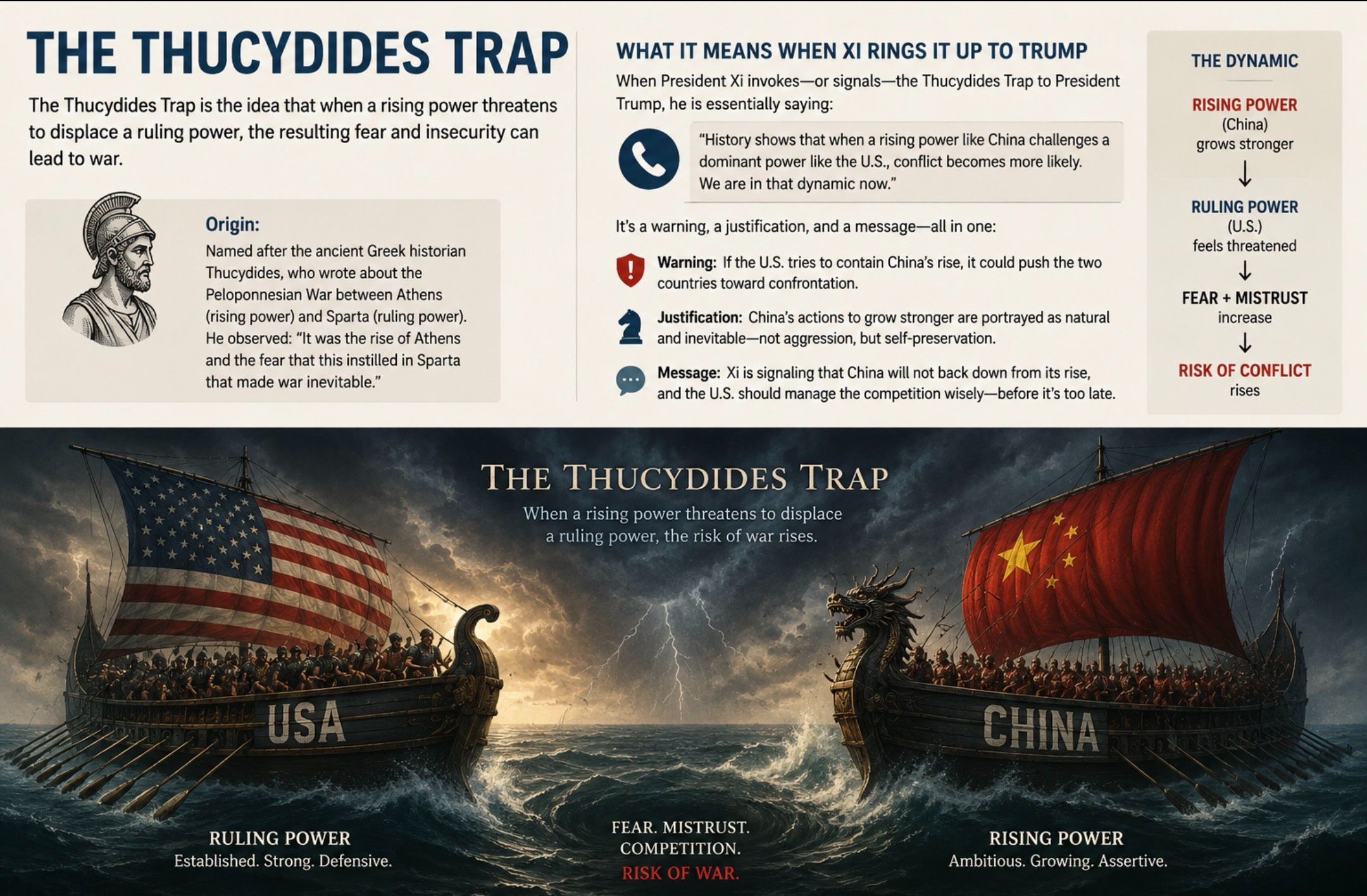
SOCRATES: Ah, our old companion Thucydides — that most careful of historians! He watched Athens and Sparta consume each other and asked not merely what happened, but why. Tell me, friend: this image before us shows two great ships bearing down upon one another. But I wonder — is it truly the ships that make war inevitable, or…
-
Socrates and Plato on the Modern Allegory of the Cave
SOCRATES: A remarkable document has been placed before us, Plato — and I confess, reading it produces in me a peculiar sensation. It is like encountering a mirror that one did not know was a mirror. Tell me, do you recognize the cave described here? PLATO: I recognize its structure, Socrates, more readily than I recognize…
-
Modern Allegory of the Cave
The power of the allegory is that it is not bound to one age. The cave changes form, but the structure remains: human beings mistaking shadows for reality, resisting painful illumination, and often distrusting those who return with wider sight. Some modern parallels are especially striking. Social Media Feeds as the Cave In the allegory,…
-
US and China Digital Data Centers
How would Digital Data Centers come into play with these negotiations? The matter becomes clearer if we ask: What is a financial system in the digital age made of? No longer merely banks and paper ledgers.It is now increasingly composed of: And all these require immense computational infrastructure: the modern data center. Thus, when nations…