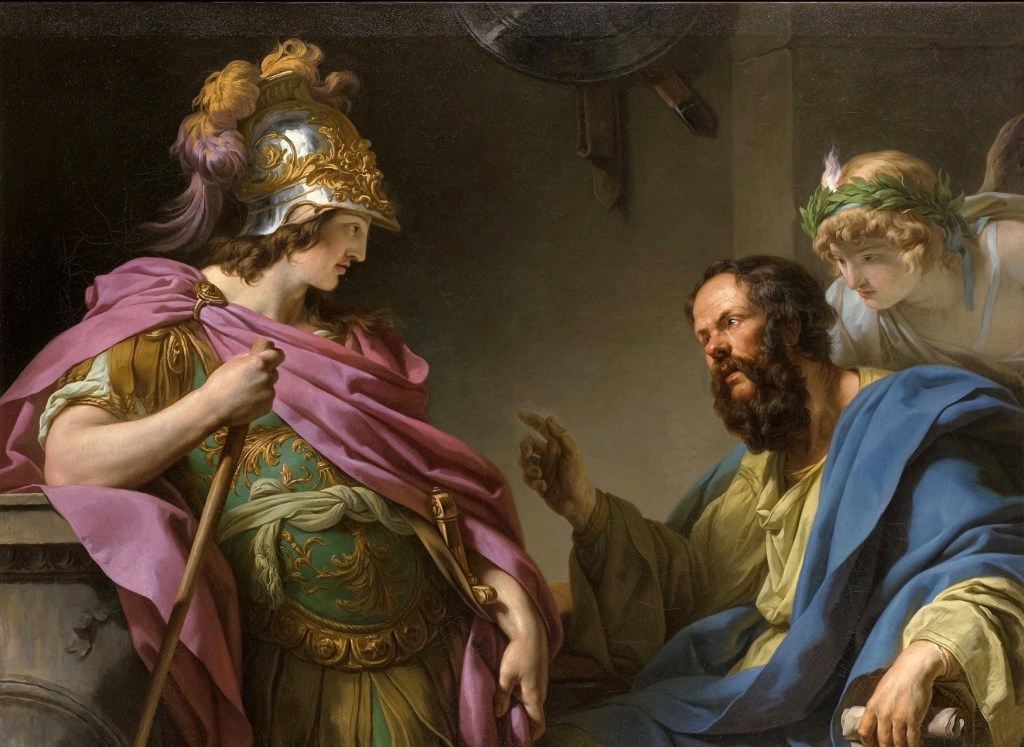
Socrates with Alcibiades and the Daimonion. Oil painting by François-André Vincent, 1776, in the Musée Fabre, Montpellier
Is daimon and daemon the same thing?
Yes — but with an important historical distinction.
The Greek word was δαίμων (daimōn). In ancient Greek thought, especially in the world of Socrates and Plato, a daimōn was not originally an “evil demon” in the later Christian sense.
A daimōn could mean:
- a guiding spirit,
- an intermediary between gods and humans,
- an inner voice,
- a force of destiny or character,
- or a divine prompting.
When Socrates spoke of his daimonion, he described it less as a being commanding him and more as a warning presence — an inner sign that restrained him from certain actions. In Apology, this “divine sign” interrupts him when he is about to proceed wrongly.
Later, when Greek texts were translated into Latin and then into Christian cultures, daimōn became rendered as daemon. Over centuries, especially in medieval Christianity, the word shifted toward the meaning of a malicious spirit or demon.
Thus:
- Daimon → closer to the original Greek philosophical meaning.
- Daemon → the Latinized form, later associated with demons in religious tradition.
Yet the words share the same root.
Interestingly, modern language partially recovered the older sense:
- In psychology, thinkers like Carl Jung used related ideas to describe deep inner forces.
- In computing, a “daemon” process is a background guiding process — quietly working unseen — which unintentionally echoes the ancient meaning more than the medieval one.
So the difference is not origin, but historical transformation of meaning.
Could Daimon of Socrates also be referred to as his conscience?
Yes — many modern readers interpret the daimonion of Socrates as something close to conscience. But the comparison is only partly accurate.
A conscience, in the modern sense, is usually:
- an inner moral awareness,
- a faculty for judging right and wrong,
- shaped by reason, ethics, culture, and empathy.
Socrates’ daimonion behaved differently in several ways.
In Apology, he describes it primarily as:
- a negative warning sign,
- something that restrained him,
- not a voice giving detailed instruction,
- not a rational argument,
- and not exactly his own deliberate thought.
It did not tell him what to do.
It told him when not to proceed.
That distinction mattered greatly to him.
One might say:
- conscience evaluates morality,
- while the Socratic daimonion functioned more like an intuitive prohibition or divine check.
Yet there is overlap. Both:
- arise inwardly,
- interrupt action,
- stand against impulse or public pressure,
- and orient a person toward a higher form of integrity.
Some later thinkers interpreted the daimonion symbolically:
- as intuition,
- moral conscience,
- higher reason,
- subconscious wisdom,
- or spiritual insight.
Others took Socrates literally, believing he truly experienced a divine intermediary.
The ambiguity is part of why the idea endured for over two millennia.
Could it be said that since this ambiguity exists, the intuitive expression would have been thought of as being not logical in the one sense but rational in another?
Yes, that distinction reaches into one of the deepest tensions in philosophy.
What appears “non-logical” is not necessarily irrational.
For Socrates, the daimonion did not arise through syllogism, deduction, or explicit argument. In that sense, it stood outside formal logic. He could not “prove” it mathematically or publicly demonstrate its operation.
Yet he did not treat it as madness or chaos.
Rather, he regarded it as aligned with a deeper order of truth and right action. Thus:
- not logical in the procedural sense,
- but rational in the sense of being consonant with wisdom, harmony, and the good.
This distinction later became very important in philosophy.
The Greeks themselves had several layers of what we now compress into “reason”:
- logos — structured discourse, argument, intelligibility;
- nous — direct intellectual intuition or apprehension;
- phronesis — practical wisdom or judgment.
The daimonion seems closer to nous or phronesis than to formal logos.
A modern analogy might be this:
A mathematician sometimes “sees” the truth of a theorem before proving it.
The proof is logical.
The insight preceding it is intuitive.
Yet the intuition is not irrational merely because it came first.
Likewise, conscience often acts before analysis fully catches up.
Later thinkers explored this boundary:
- Immanuel Kant distinguished pure rational structure from practical moral reason.
- Blaise Pascal wrote, “The heart has its reasons which reason does not know.”
- Carl Jung explored intuition as a legitimate mode of apprehending reality.
- Martin Heidegger questioned whether calculative logic exhausts human understanding.
So one could indeed say:
The Socratic daimonion occupied a realm where intuition and rationality were not enemies, but different expressions of orientation toward truth.
Its ambiguity is precisely what prevents it from fitting neatly into either “mere emotion” or “strict logic.”
See Also:
 Dialogos of Eide