
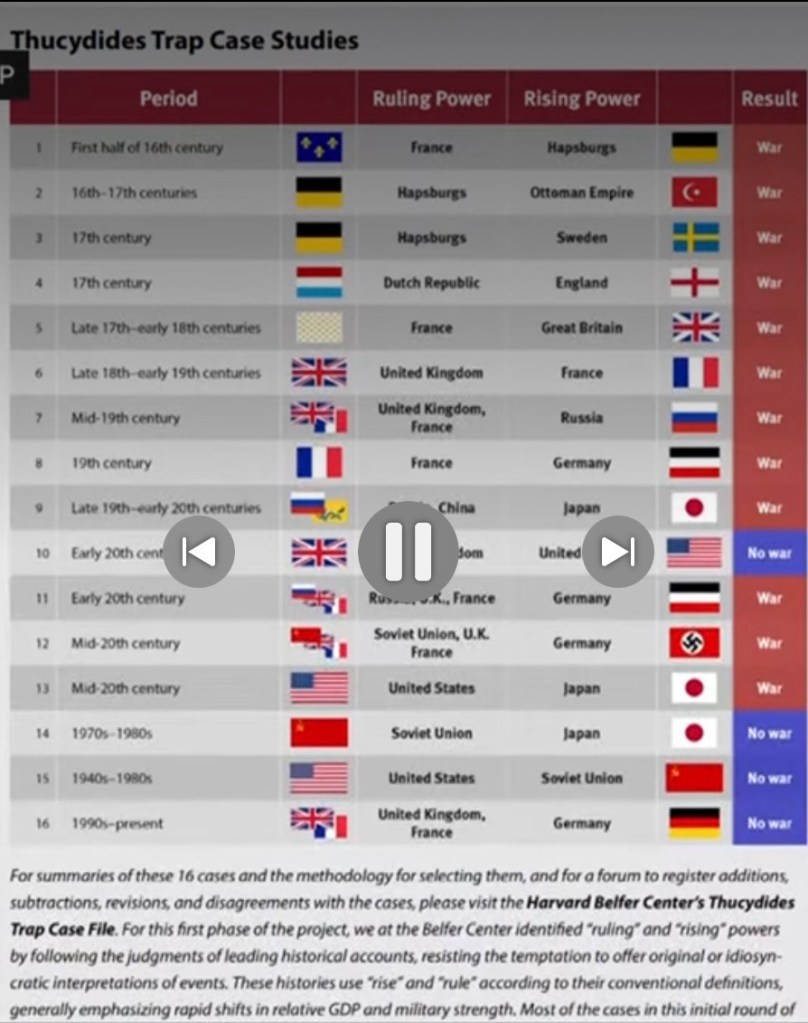
The diagram presents a historical interpretation of what political scientist Graham Allison called the “Thucydides Trap,” derived from the ancient Greek historian Thucydides. The central thesis is that when a rising power threatens to displace an established ruling power, fear, insecurity, and rivalry often increase the likelihood of war.
The chart outlines sixteen historical case studies spanning from the 16th century to the present. In each case, an established dominant state confronted the rise of another ambitious power. The study argues that in twelve of the sixteen examples, the rivalry ultimately resulted in war, while four transitions avoided direct military conflict.
The sequence begins in early modern Europe, where powers such as France, the Habsburgs, England, and the Dutch Republic struggled for supremacy. As one state expanded economically, militarily, or politically, the dominant power often reacted defensively, producing cycles of mistrust and confrontation. These rivalries frequently culminated in major wars that reshaped the balance of power across Europe.
The diagram then moves into the 18th and 19th centuries, showing the rise of Great Britain, France, Russia, Germany, and Japan. The pattern repeats: rising industrial or military powers challenge established systems, provoking strategic anxiety among ruling states. According to the chart, many of these tensions contributed directly to the wars surrounding European imperial competition and the global conflicts of the 20th century.
Several cases are highlighted as exceptions where war was avoided. One example is the transition between the United Kingdom and the United States during the early 20th century. Despite America’s rapid rise, the two powers maintained enough cultural alignment, diplomatic flexibility, and strategic cooperation to avoid direct conflict. Another example is the Cold War between the United States and the Soviet Union, where intense rivalry persisted for decades without escalating into full-scale war between the two nuclear superpowers.
The final case references the modern period, suggesting parallels between the contemporary rise of China and the position historically held by dominant Western powers. The implication is not that war is inevitable, but that unmanaged fear, nationalism, economic competition, and military escalation can create conditions where conflict becomes more likely.
The broader philosophical lesson of the diagram is that history often reveals recurring patterns in human behavior: ambition in the rising power, insecurity in the ruling power, and mutual suspicion between them. The “trap” itself is not destiny, but a warning that civilizations must exercise wisdom, restraint, diplomacy, and self-knowledge if they wish to escape repeating the tragedies of the past.
See Also:
 Dialogos of Eide