
Generalizations of the cube to dimensions greater than three are called hypercubes or measure polytopes. This article focuses on the 4D hypercube, the tesseract.
In a square, each vertex has two perpendicular edges incident to it, while a cube has three. A tesseract has four. Canonical coordinates for the vertices of a tesseract centered at the origin are (±1, ±1, ±1, ±1), while the interior of the same consists of all points (x0, x1, x2, x3) with -1 < xi < 1. This structure is not easily imagined but it is possible to project tesseracts into three or two dimensional spaces. Furthermore, projections on the 2D-plane become more instructive by rearranging the positions of the projected vertices. In this fashion, one can obtain pictures that no longer reflect the spatial relationships within the tesseract, but which nicely illustrate the connection structure of the vertices. The following examples are provided:
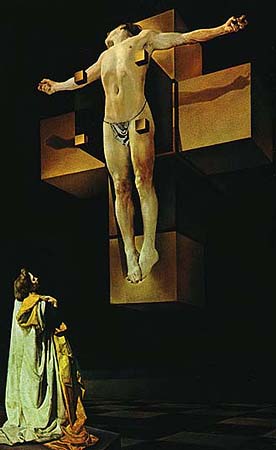
I would have thought artists like Dali and like Escher tried to develope and expand perspective capabilties of mind? To incorporate as much a “higher understanding” of the solid things, as we expect to understand all things around us?:)
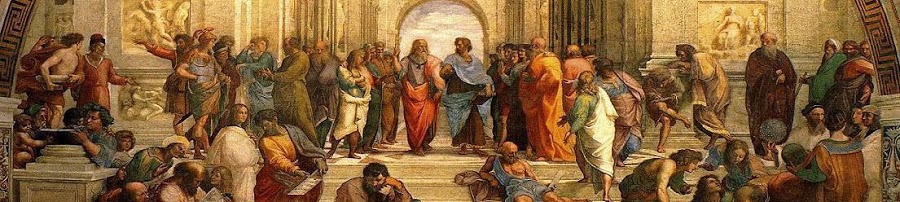
Plato was pointing up for a reason, yet he believed in solid geometrical forms?

 Dialogos of Eide