I was over visiting Clifford’s blog called Asymptotia this morning and notice a blog entry called, Heretics of Alexandria. Of course, what first came to mind is the “Library of Alexandria.”

Clifford writes and paraphrases:
This full length drama, set in Alexandria Egypt, 415 A.D. features the infamous Philosopher Hypatia, who has come into possession of a document that threatens the very basis of the new religion called Christianity; a document that some would do anything to destroy. Hypatia and a powerful Christian Bishop wage a fierce struggle for the soul of a young priest and for a document which tells a very different version of the life — and death — of Jesus. A true story.
The writing was excellent as was the cast, and Bastian should be extremely proud of himself. (It is a mistake to call it “a true story”, though. It is a story based around historical events, which should absolutely not be confused with being a “true story”. Writers of synopses should not encouarge people to mix up the two.
So I started to do some research on the link offered by Clifford. All of a sudden I could see the many connections bringing “Hypatia of Alexandria” into the fold.

Hypatia was the daughter of Theon, who was also her teacher and the last fellow of the Musaeum of Alexandria. Hypatia did not teach in the Musaeum, but received her pupils in her own home. Hypatia became head of the Platonist school at Alexandria in about 400. There she lectured on mathematics and philosophy, and counted many prominent Christians among her pupils. No images of her exist, but nineteenth century writers and artists envisioned her as an Athene-like beauty.
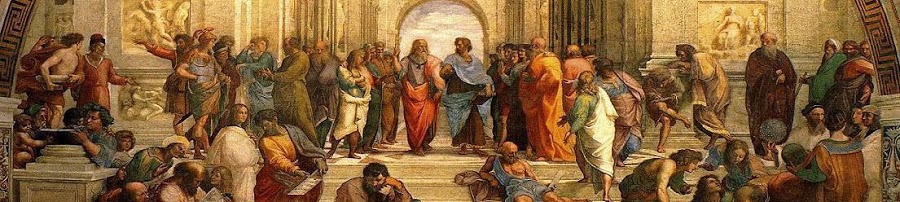
Many of you who visit here know how much the “School of Athens” picture means to me?
That there was only one woman here named “Hypatia of Alexandria” of course sent me off to have a look. AS well, “more of the meaning” with regards to the Library of Alexandria.

9.Francesco Maria I della Rovere or Hypatia of Alexandria and Parmenides
The frescoe of the “School of Athens” has been a haunting reminder of the many things that Raphael “enclosed in meaning.”

That I could then give numbers and names to person’s within the picture was equally exciting. I started to dissect parts of this picture quite a while back, opening of course with the “very centre of that painting.” The labels supplied on this post entry should give links to farther posts about this.

I now realize that with one comment entry gone( maybe both) that I really was not so out of tune. What was Plato’s influence on Hypatia of Alexandria?
Letters written to Hypatia by her pupil Synesius give an idea of her intellectual milieu. She was of the Platonic school, although her adherence to the writings of Plotinus, the 3rd century follower of Plato and principal of the neo-Platonic school, is merely assumed.
See also:
Euclid belonged to the persuasion of Plato and was at home in this philosophy; and this is why he thought the goal of the Elements as a whole to be the construction of the so-called Platonic figures. (Proclus, ed. Friedlein, p. 68, tr. Morrow)

 Dialogos of Eide