
“The soul is awestruck and shudders at the sight of the beautiful.” Plato

Leon Max Lederman (born July 15, 1922) is an American experimental physicist and Nobel Prize in Physics laureate for his work with neutrinos. He is Director Emeritus of Fermi National Accelerator Laboratory (Fermilab) in Batavia, Illinois. He founded the Illinois Mathematics and Science Academy, in Aurora, Illinois in 1986, and has served in the capacity of Resident Scholar since 1998.
The lessons of history are clear. The more exotic, the more abstract the knowledge, the more profound will be its consequences.” Leon Lederman, from an address to the Franklin Institute, 1995
|
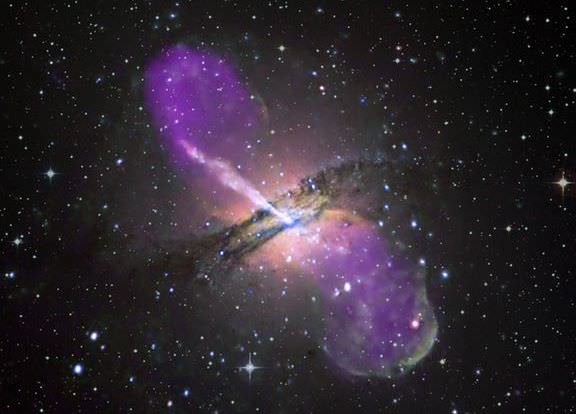
Centaurus A – one of the closest galaxies with an active galactic nucleus – although it is over 10 million light years away. If you are looking for a likely source of ultra-high-energy cosmic rays – you may not need to look further. Credit: ESO. |
Recent observations by the Pierre Auger Observatory have found a strong correlation between extragalactic cosmic rays patterns and the distribution of nearby galaxies with active galactic nuclei. Biermann and Souza have now come up with an evidence-based model for the origin of galactic and extragalactic cosmic rays – which has a number of testable predictions.
They propose that extragalactic cosmic rays are spun up in supermassive black hole accretion disks, which are the basis of active galactic nuclei. Furthermore, they estimate that nearly all extragalactic cosmic rays that reach Earth come from Centaurus A. So, no huge mystery – indeed a rich area for further research. Particles from an active supermassive black hole accretion disk in another galaxy are being delivered to our doorstep. See:Universe Today: Astronomy Without A Telescope – Oh-My-God Particles
The links that follow below are dated and may be open to corrections with current data.
On the evening of October 15, 1991, an ultra-high energy cosmic particle was observed over Salt Lake City, Utah. Dubbed the “Oh-My-God particle” (a play on the nickname “God particle” for the Higgs boson), it was estimated to have an energy of approximately 3 × 10²⁰ electronvolts, equivalent to about 50 joules—in other words, it was a subatomic particle with macroscopic kinetic energy, comparable to that of a fastball, or to the mass-energy of a microbe. It was most likely a proton travelling with almost the speed of light (in the case that it was a proton its speed was approximately (1 – 4.9 × 10⁻²⁴)c – after traveling one light year the particle would be only 46 nanometres behind a photon that left at the same time) and its observation was a shock to astrophysicists.
Since the first observation, by the University of Utah’s Fly’s Eye 2, at least fifteen similar events have been recorded, confirming the phenomenon. The source of such high energy particles remains a mystery, especially since interactions with blue-shifted cosmic microwave background radiation limit the distance that these particles can travel before losing energy (the Greisen-Zatsepin-Kuzmin limit).
Because of its mass the Oh-My-God particle would have experienced very little influence from cosmic electromagnetic and gravitational fields, and so its trajectory should be easily calculable. However, nothing of note was found in the estimated direction of its origin.


Can Centauros or Chirons be the first observations
of evaporating mini Black Holes?
Moreover, one could even claim that Quantum Gravity phenomena are already present in existing cosmic-ray data [6]. In the present paper we shall argue that the long-known Centauro-like events (CLEs) may be due to the formation and subsequent evaporation of mini black holes (MBHs), predicted in TeV-gravity models.
See:


 Dialogos of Eide