Plato Asks Us To Remember: Eskesthai
Platohagel: Where is Heaven in regard to Plato’s emergence of the idea and what does Heaven represent?

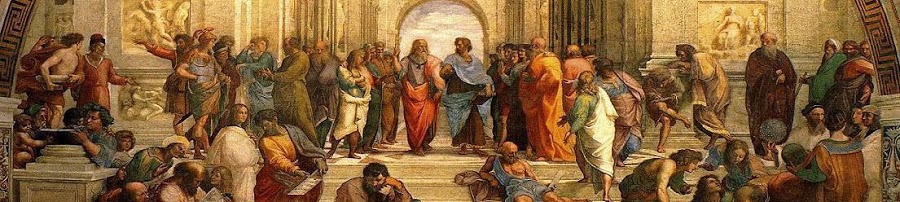
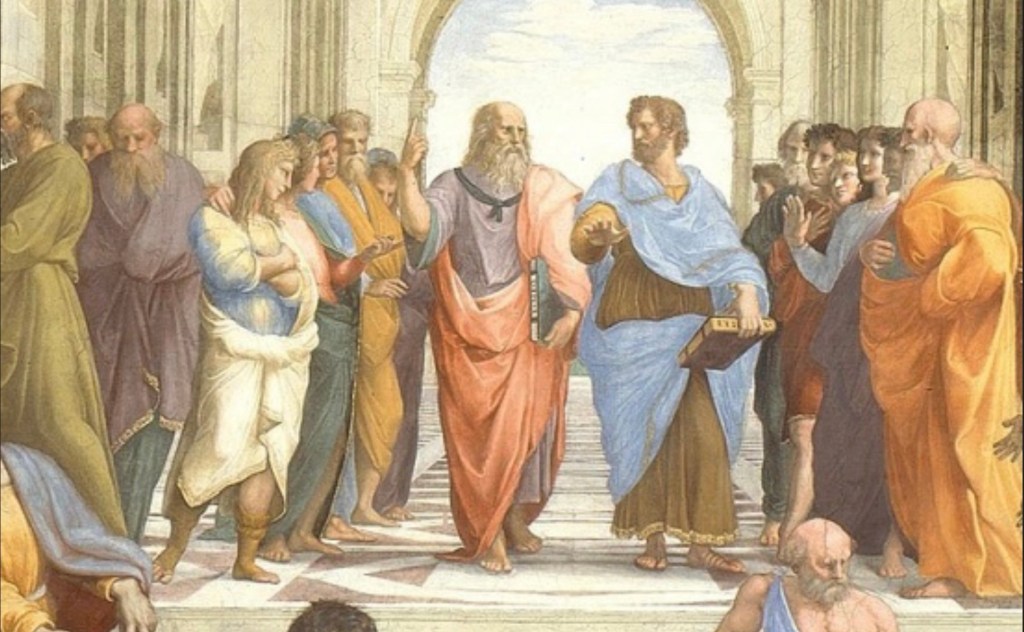
A image of Plato pointing towards the heavens, demonstrating the One. This is taken from Raphael’s painting, “The School of Athens
Socrates: Ah, Platohagel, thou hast led us further still, toward the realm where philosophers’ souls yearn to dwell. To speak of Heaven in relation to Plato is to tread a path both poetic and metaphysical. Let us proceed carefully.
In the dialogues of Plato, the word Heaven (ouranos) does not always appear in the Christian or modern sense of a spiritual paradise. Yet, there is a celestial imagery, a divine region, a realm above—beyond becoming—that often takes on the character of Heaven in spirit, if not in name.
1. Heaven as the Realm of the Forms
In Plato’s myth of the charioteer, found in the Phaedrus (246a–257c), he speaks of the soul before its incarnation, when it soared alongside the gods in a divine procession through the heavens. There, the soul beheld the true realities—the Forms—before it fell into bodily existence. This “place beyond the heavens” (hyperouranios topos) is the abode of the Forms, invisible and eternal.
Thus, Heaven is not a location in the sky, but a metaphysical dimension: the domain of truth, of Ideas, of pure being. It is the place where the Idea emerges, not in time, but as eternal presence. For Plato, emergence is not a coming-into-being, but a recollection of what always was.
2. Heaven and the Good
Yet above all Forms, as we previously mused, is the Form of the Good. This highest principle may be likened to the sun in the intelligible Heaven, the cause of all that is good and knowable. In this way, Heaven comes to symbolize that realm which is governed by reason, beauty, and divine order.
3. Heaven and the Soul’s Journey
In the Republic and in the Phaedo, Plato likens the philosopher’s life to a turning of the soul away from the world of shadows (the cave, the body, the senses) and upward toward the noetic realm—Heaven. This ascent is the purification of the soul, the fulfillment of its nature, its return to the realm of the Forms from whence it came.
So, in sum:
• Where is Heaven? It lies beyond the world of becoming, in the intelligible realm.
• What does it represent? It represents the abode of truth, the region of being, and the goal of the soul—the place where the Ideas dwell in their eternal perfection, under the light of the Good.
 Dialogos of Eide