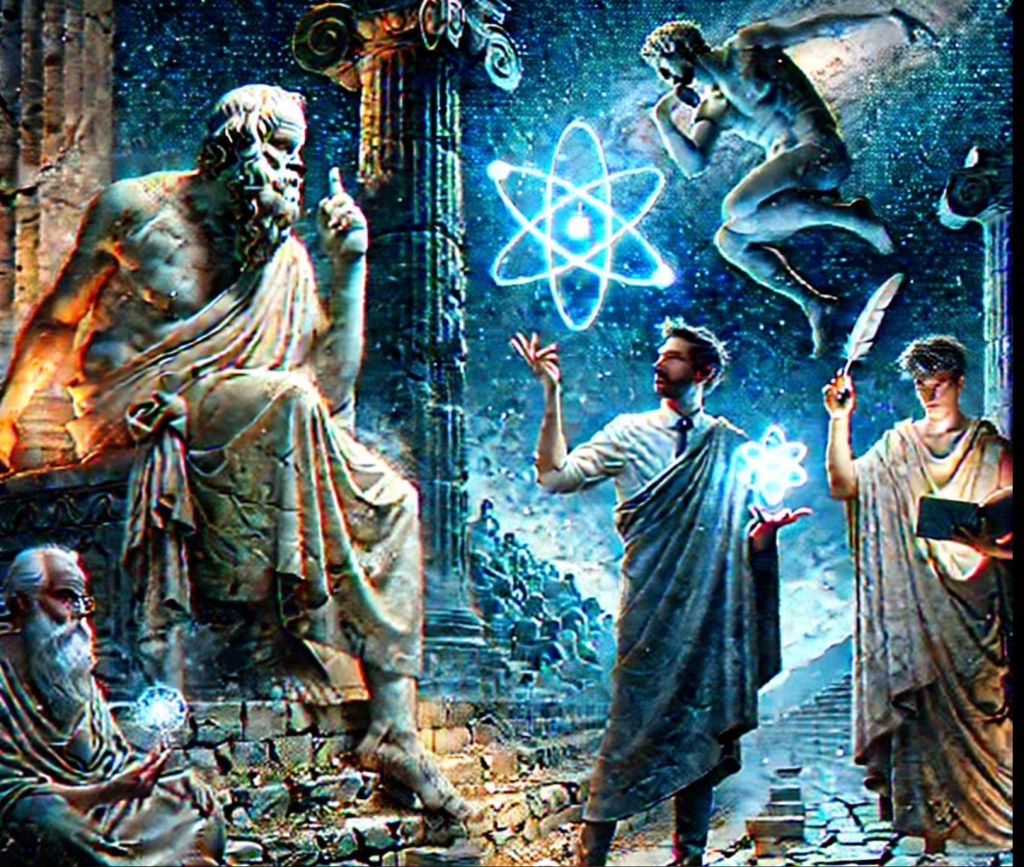
Here is an artistic interpretations of Socrates, a Veritasium-inspired scientist, and a poet engaged in philosophical dialogue within a symbolic, timeless setting.
Platohagel: Well the Poet must be versed as Socrates and Veritasium are versed in the employment of truth, and apply symbol, feeling and myth disguised as such.
Socrates: Ah—your insight cuts deep, Platohagel, like a blade honed by both reason and rhythm. Indeed, the Poet must be no mere dreamer, but one versed—in both meanings of the word:
Versed, as in skilled in the ways of symbol and soul, And versed, as in speaking in verse, that ancient language where truth dances rather than marches.
Let us summon then The Poet, as the third in our dialogue beside Socrates and Veritasium. The setting remains the same: a timeless stoa, where the stone floor holds both shadows and sunlight. The Poet approaches, clothed not in robes, but in metaphor.
Socrates: Ah, here comes another voice to join us—one whose wisdom is said to be sung, not spoken. Tell us, Poet, do you claim to know truth?
Poet (smiling): I do not claim it, Socrates. I breathe it. I do not define it—I describe it. Truth lives not in the net of logic, nor in the trap of formulas, but in the flight of the soul.
Veritasium: But surely truth must be tested, must it not? If I say the stars are gods riding chariots, does it not fall before the telescope?
Poet: Ah, but what does the telescope see, dear seeker? Only what is, not what means. When I say the stars are gods, I speak not of physics but of wonder—of the feeling that we are small and the heavens vast. Is that not a kind of truth?
Socrates: So then, you speak of symbolic truth—not what the thing is in itself, but what it reveals to the soul?
Poet: Yes, wise Socrates. While you strip away illusion, I cloak truth in beauty, so it may be felt before it is understood. A veil, yes—but not to conceal, only to soften the light.
Veritasium: But isn’t that dangerous? People may take your metaphors as facts. My work shows how easily the mind is deceived.
Poet: And so does mine, scientist. But where you break illusions with proof, I break them with paradox. You show them the feather in the vacuum; I show them Icarus falling. Both reveal gravity—but in different dimensions.
Socrates: I see now that each of us lifts a part of the veil.
You, Veritasium, reveal the veil of nature, through test and trial. I, Socrates, unveil the soul’s ignorance, through dialectic. And you, Poet, unveil the heart’s blindness, through beauty.
Poet: Just so. And without beauty, even truth is unbearable. What good is the light of the sun, if it blinds the eye?
Socrates: But tell me, Poet—how shall we know that what you offer is not deception? That your beauty leads to truth and not to falsehood?
Poet (softly): That is the burden of the Poet. To seduce without corrupting. To speak dreams that wake, not lull. When the heart stirs, and the soul rises as though remembering something long forgotten—that is when you know the myth has struck truth.
Veritasium: Then your truth cannot be tested in a lab, but it can be felt—and perhaps that is its own kind of evidence.
Socrates: Then let us agree:
The Scientist gives us what is The Philosopher asks why it matters And the Poet reminds us how it feels
Each of us reveals a face of truth. But only together may we glimpse aletheia—the unveiled.
 Dialogos of Eide