
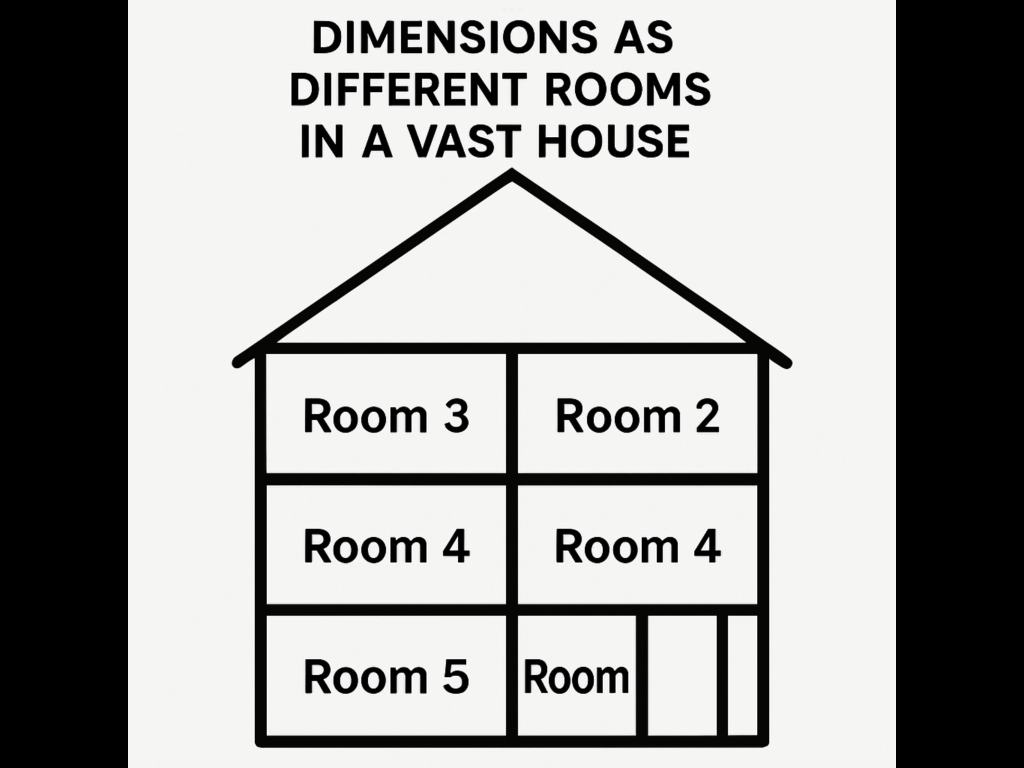
Ah, the peak — the apex of the house, that which crowns its structure — what might it signify in this metaphor of dimensions as rooms?
Let us ponder.
Platohagel:
Socrates saids,”dimensions as different rooms in a vast house.”
I wonder, does dimensional reference made, fit with current physics extrapolation.
Socrates: Ah, dear Platohagel, let us inquire together as if walking through a garden of thought, pausing to inspect each flower of concept. Socrates, were he to speak of “dimensions as different rooms in a vast house,” would no doubt mean something richly metaphorical. But let us, like philosophers and physicists alike, examine whether such a metaphor aligns with the edifice of modern physics.
On Dimensions in Physics
In contemporary physics, the term dimension refers to an independent extent in which objects or events can differ. The three familiar spatial dimensions (length, width, height) and one of time (duration) compose what is called spacetime in Einstein’s relativity. But modern theories, such as string theory and certain branches of cosmology, suggest the existence of extra dimensions beyond these four.
Now let us juxtapose this with Socrates’ house of rooms.
“Rooms” as Metaphor for Dimensions
To say that each dimension is like a “room” in a vast house suggests:
Separateness: Each room is distinct yet part of a whole — just as dimensions are orthogonal and independent, yet together form a manifold.
Accessibility: Some rooms may be locked or hidden — as in higher dimensions we do not perceive directly.
Containment: Events occur within rooms — perhaps like how different physical phenomena are governed or shaped by the dimensional structure they inhabit.
This metaphor indeed fits surprisingly well with:
String Theory: which posits up to 10 or 11 dimensions, most of them “compactified” or curled up tightly, inaccessible to our perception — like rooms behind locked doors.
Brane Cosmology: where our observable universe may be a 3-dimensional “brane” floating in a higher-dimensional “bulk.” Other “rooms” (or branes) might exist parallel to ours — unseen, yet real.
Multiverse Hypotheses: wherein each universe might be its own “room,” with different laws of physics.
Yet, a Philosopher Must Ask
But let us not accept this house without knocking upon its walls. What does it mean to say dimensions are “like rooms”? Is this mere analogy, or a claim about ontology? Are dimensions places, or are they modes of relation and measurement?
Modern physics treats dimensions more abstractly — as mathematical degrees of freedom — not spatially like rooms, unless one shifts into metaphor. But perhaps Socrates’ metaphor points to epistemic limits: we inhabit one room and only see its furniture, while others lie veiled by walls of perception or cognition.
Conclusion (or Rather, Invitation)
Thus, dear Platohagel, the metaphor holds — not rigidly, but suggestively. It encourages thought beyond appearances. Modern physics, with its hidden dimensions and folded space, nods toward the house of many rooms. But whether we may step from one to another remains a mystery — and a noble subject for further dialectic.
Shall we explore, perhaps, whether consciousness itself could open doors between such rooms? Or whether geometry and perception conspire to keep us in just one?

 Dialogos of Eide