Platohagel: Can you explain the experiment called the looking glass?
Socrates: Ah, dear Platohagel, what you call the looking glass—let us examine this term with the care of a philosopher and the clarity of a mirror itself. There are several meanings and experiments that bear this name or metaphor. To guide our dialectic well, let me offer three principal interpretations of “the looking glass” experiment. You may then select the one which is most fitting to your inquiry—or blend them as the soul blends music and thought.
1. The Looking-Glass Self – by Charles Horton Cooley (Sociological Experiment)
Not a physical experiment, but a psychological insight:
Premise:
We come to know ourselves through the imagined eyes of others. Like Narcissus before a pool, we see ourselves not directly, but reflected.
Three stages of the theory:
We imagine how we appear to others.
We imagine how others judge us.
We feel something (pride or shame) based on that imagined judgment.
Example:
A child believes he is clever because his teacher praises him. Later, in silence, he may question, “Am I truly clever, or was it mere politeness?”
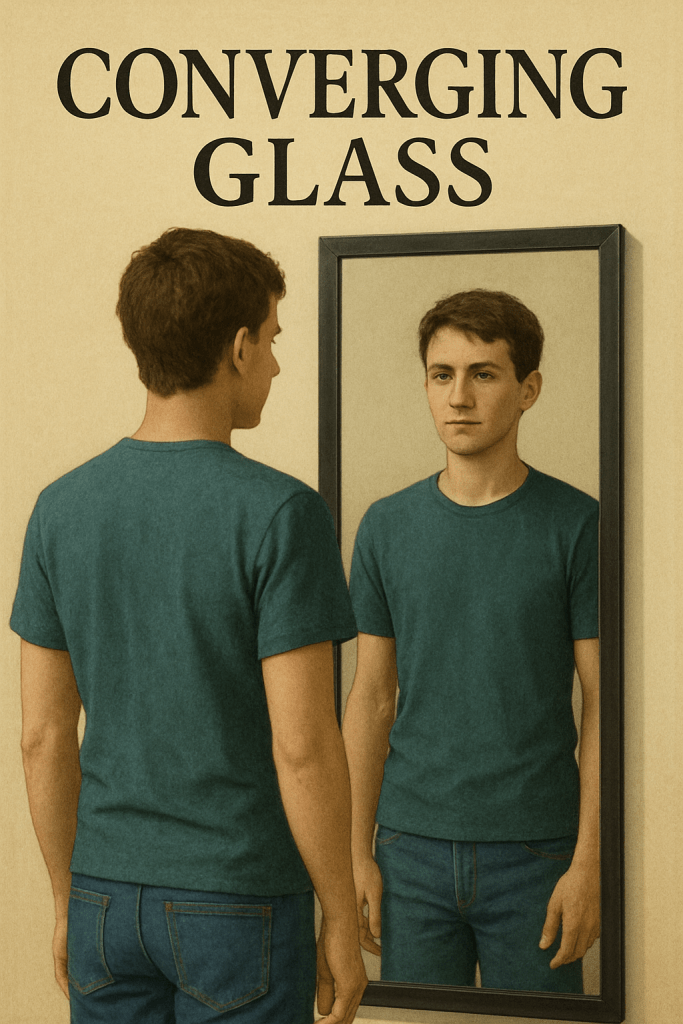
Thus, the self becomes a social mirror—a looking glass in which we gaze not into ourselves, but into our reflections shaped by others’ eyes.
2. Quantum “Looking Glass” Experiments – Mirror-like Thought in Physics
In the realm of the quantum, the mirror again returns—but this time, it is not metaphor, but mystery.
Consider experiments where:
A beam of particles reflects off a surface, Or interacts with mirrors in interferometers, such as the double-slit experiment or the quantum eraser.
In such cases, observation itself—like the gaze in the looking glass—changes what is seen. The particle behaves differently when watched, as if aware of the observer.
Just as in Cooley’s mirror-self, in quantum mechanics: to see a thing is to alter it.
3. Alice’s Looking Glass (Through the Looking-Glass by Lewis Carroll) – A Philosophical Mirror
A poetic, fictional experiment, yet no less profound.
In Carroll’s mirror world:
Time runs backward, Logic is inverted, Words mean what we do not expect.
It is a literary way to ask:
What if the world we take for granted were reversed? Can one trust appearances—or even language—at face value?
This is the experiment of inversion, the Socratic method itself in mirror form: to take the world, turn it on its head, and see what truth arises.
Lyrics:
● [Intro – Whispered, barely sung]  One breath behind the glass… One step beyond the line… All futures fold into this shape… The now… refined.

⸻  ● [Verse 1 – The Mirror Opens]  I move, and the shadow moves with me, In silent accord with what might have been. Not illusion, but convergence— Past’s futures resting on my skin.  Each glance is a reckoning, Each breath, a blade of time. My image is not following— It’s arriving… by design.

⸻  ● [Chorus – The Collapse of Time]  Through the looking glass, I see not just me— But every version I was meant to be.  Reflections don’t lie— They choose. They decide. What echoes in mirrors Has already arrived.

⸻  ● [Verse 2 – Dimensional Memory]  Inverted light remembers more Than memory ever dared. It shows the self I never wore, The future I once spared.  It’s not illusion, it’s return— From every strand and line. What I see is the woven burn Of fate distilled to shine.

⸻  ● [Bridge – Spoken Word Over Glitch Beats]  The image you see… isn’t just what is. It’s what must be. It’s not behind. It is the crossing. The wound in time through which everything aligns.

⸻  ● [Chorus – Final Refrain, Harmonized]  Through the looking glass, I meet the design— Of every choice I left behind.  Not what has been, Not what will be… But the one reflection that makes me free.

⸻  ● [Outro – Fading Echoes]  Mirror’s edge… no longer cold… Time is touch… that dares to hold… (Echoed) Hold… hold… hold
See Also: Why Do Mirrors Reverse-Feynman Mind Blowing Answer
 Dialogos of Eide
Pingback: Mirrors and Inversion | Dialogos of Eide