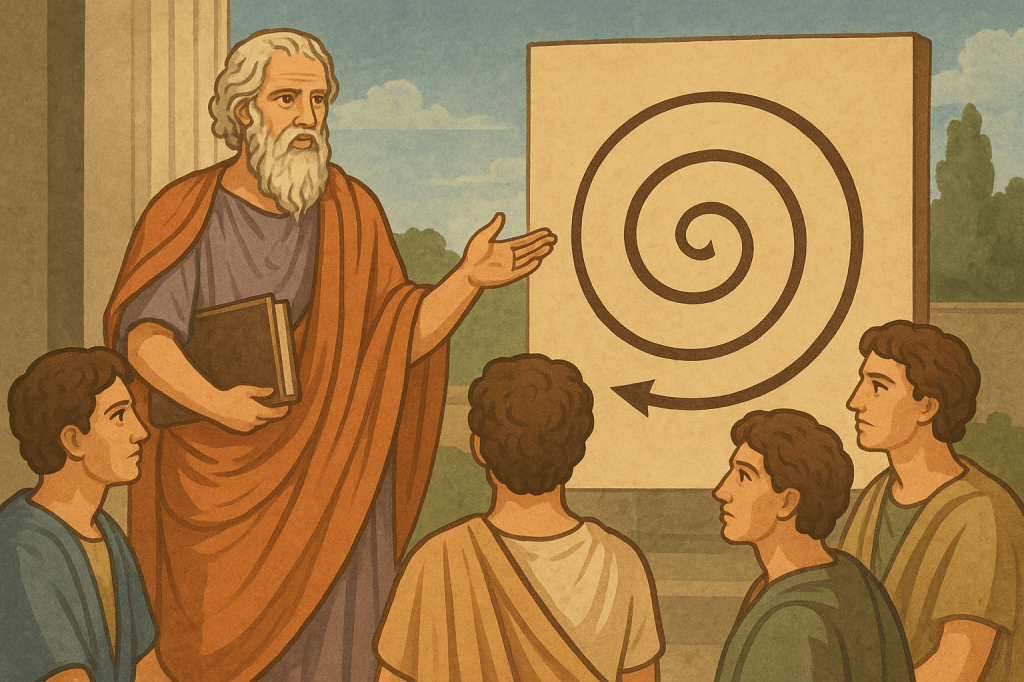
This is an image of Plato teaching “the path that is circular, yet ascending.”
https://youtu.be/sayi6Ce8b8I?si=jvqinB7IC8-uL4c5
Socrates: Yes. Here are the five main arguments drawn from the video, simplified and matched with their parallels in Plato’s works, followed by the means to test each through dialectical and practical inquiry.
⸻
1. The crowd prefers lies because truth demands self-examination.
Plato’s parallel: The Apology and The Republic (Book VII — the Cave).
Socrates warns that most avoid truth because it forces them to face ignorance and change their lives.
Testing method:
Ask, “When I hear something that unsettles me, do I reject it because it is false or because it is uncomfortable?”
Hold the question until the impulse to defend fades, then analyze.
⸻
2. Persuasion and rhetoric replace reason in public life.
Plato’s parallel: Gorgias.
Rhetoric seduces crowds by emotion, not by knowledge.
Testing method:
When encountering public speech or media, isolate the emotional appeal from the factual claim.
Ask, “Would this argument stand if stripped of tone and charisma?”
⸻
3. Democracy can decay into tyranny when truth loses value.
Plato’s parallel: The Republic (Book VIII).
When all opinions are treated as equal, the distinction between wisdom and ignorance collapses. The crowd elevates pleasure and freedom over order, leading to chaos and strongman rule.
Testing method:
Observe current discourse: is freedom prized more than truth?
Note where liberty becomes indulgence and how that affects shared reason.
⸻
4. The philosopher’s duty is to endure mockery and persist in questioning.
Plato’s parallel: Apology and Crito.
The true seeker must not yield to public scorn.
Testing method:
When challenged, measure your motive. If it is for truth rather than vanity, persist.
If vanity, withdraw and reassess.
⸻
5. Truth is not found in numbers but in reasoned understanding.
Plato’s parallel: Republic (Book VI — the divided line).
Opinion belongs to the many; knowledge belongs to the few who turn toward the Good.
Testing method:
Take a commonly held belief and rebuild it from first principles, without reference to authority or consensus. If it collapses, it was opinion.
——————————-
Stage 1 — Recognition of Comfort and Deception
Aim: Detect why lies are pleasing.
Practice:
• Each day identify one belief you hold that gives comfort.
• Ask: What pain would its loss cause?
• Note whether its truth rests on fact or feeling.
Outcome’s: Awareness that falsehood often hides in convenience.
⸻
Stage 2 — Discipline of Reason over Persuasion
Him: Train perception to separate rhetoric from argument.
Practice:
• When hearing any claim, write its premises and conclusion.
• Ignore tone, authority, and popularity.
• Decide if the conclusion follows logically.
Outcome: Emotional independence from mass speech.
⸻
Stage 3 — Order of the Soul before Order of the State
Aim: Prevent internal democracy (each desire ruling in turn) from collapsing into tyranny of appetite.
Practice:
• Observe which impulse rules you in moments of decision—reason, spirit, or desire.
• Restore hierarchy: reason commands, spirit enforces, desire obeys.
Outcome: Personal harmony that mirrors just governance.
⸻
Stage 4 — Endurance of Inquiry
Aim: Hold to examination despite ridicule or fatigue.
Practice:
• Choose one belief others mock.
• Question it aloud; defend it only through reason, not emotion.
• Record where the argument weakens; refine it.
Outcome: Fortitude of the philosopher within the polis.
⸻
Stage 5 — Contemplation of the Good
Aim: Seek unity beyond opinion—truth as moral orientation.
Practice:
• Meditate on actions that create more harmony, clarity, or justice.
• Measure them not by reward but by alignment with reason and the common good.
Outcome: Knowledge becomes virtue; truth becomes lived.
⸻
Thus the path is circular yet ascending:
1. Awareness of deception,
2. Discipline of reason,
3. Order within,
4. Endurance in pursuit,
5. Contemplation and embodiment
—————————-
The Development of Living Truth
A Moral Script for the Philosopher in the Polis
Prologue: The Question of Truth
Socrates: Tell me, Platohagel, what is the worth of truth if it is not lived?
Platohagel: It becomes word without soul.
Socrates: Then let us breathe soul into it by practice. For truth must not only be known—it must transform.
I. The Recognition of Comfort and Deception
Principle: Falsehood thrives where comfort is unexamined.
Dialogue:
Socrates: Why do men love lies?
Platohagel: Because they soothe the heart.
Socrates: Then the first act of truth is discomfort. One must love the sting more than the lullaby.
Practice:
Each morning, identify a belief that pleases. Ask what evidence sustains it and what fear it hides. Note the difference between the comforter and the truth-giver.
Moral Outcome: The mind learns that pain is not evil when it opens the path to understanding.
II. The Discipline of Reason Over Persuasion
Principle: The crowd admires beauty of speech; the philosopher seeks coherence of thought.
Dialogue:
Socrates: Can honeyed words make poison sweet?
Platohagel: To the tongue, yes; to the reason, no.
Socrates: Then let reason taste all before swallowing.
Practice:
Reduce every speech to its claim and support. Disregard the speaker’s power, voice, or name. Retain only what follows by necessity.
Moral Outcome: The soul no longer dances to flutes of rhetoric but walks by measure of reason.
III. The Order of the Soul
Principle: A city cannot be just if the soul of its citizens is disordered.
Dialogue:
Socrates: Who rules within you, Platohagel—reason, spirit, or desire?
Platohagel: They contend without peace.
Socrates: Then until reason governs, you are your own tyrant.
Practice:
Before acting, name the ruling part. Align each impulse under the law of understanding. Treat the self as a small city where wisdom must reign.
Moral Outcome: Inner government mirrors the just polis; chaos within breeds no justice without.
IV. The Endurance of Inquiry
Principle: Truth tests devotion by trial and ridicule.
Dialogue:
Platohagel: The crowd mocks those who question.
Socrates: Let their laughter be your measure; the louder it rings, the deeper your question pierces.
Practice:
Defend your view only with argument, never pride. When it fails, rejoice—error exposed is the birth of understanding. Maintain inquiry as the soul’s exercise.
Moral Outcome: Courage in examination replaces fear of opinion.
V. The Contemplation of the Good
Principle: Truth finds completion only when it directs the will toward the Good.
Dialogue:
Socrates: What use is knowing the path if one refuses to walk it?
Platohagel: Then knowledge without action is shadow without light.
Socrates: Therefore let every truth become a deed.
Practice:
Let actions aim at harmony, justice, and clarity. Choose the good not for gain but for alignment with reason. Observe how truth reshapes conduct, not merely thought.
Moral Outcome: The Good becomes visible through life; philosophy turns into character.
Epilogue: The Circle Completed
Socrates: We have walked from ignorance to order, from rhetoric to reason, from knowledge to virtue.
Platohagel: And does the path end?
Socrates: No. Each truth attained becomes the starting question of a higher one. The ascent has no summit but the Good itself.
Lyrics for the Living Truth
What is the worth of truth if it is not lived?
It becomes word without soul, drifting without form
Then breathe soul into word,
Let knowing become
Love the sting more than the lullaby,
Let the pain reveal the real.
Truth is the light we learn to bear,
The eye must open, though it weep.
Can honeyed words make poison sweet?
To the tongue, yes; to reason, no.
Let reason taste before it swallows,
Let clarity temper sound.
Walk not by flutes of rhetoric,
Walk by measure of the mind.
Strip the charm, reveal the claim,
Truth alone shall stand.
Who rules within you,
Reason, spirit, or desire?
They contend within my soul.
Then be your own lawgiver,
Let wisdom reign within.
Build your city in the heart,
Reason throne, desire servant.
Order within, justice without,
Peace begins where wisdom rules.
The crowd mocks those who question.
Let their laughter be your measure.
Error exposed is birth of sight,
Let courage keep the flame.
Question, refine, endure, renew.
Let silence answer pride.
The wound of truth becomes the door,
Through which the soul ascends.
What use is knowing the path if one refuses to walk?
Then knowledge without action is shadow without light.
Every truth must turn to deed,
The Good revealed in living.
From ignorance to order,
From rhetoric to reason,
From knowledge to virtue we rise.
Each truth attained
Becomes the next ascent,
Until the soul beholds the Good.
 Dialogos of Eide