Solar offers truth only when present.
Batteries decide whether that truth is remembered.
Sodium-ion does not compete with lithium for dominance. It competes with forgetfulness.
The suggestion is sound: not as replacement, but as first witness—the one who listens early, remembers faithfully, and passes on what would otherwise be lost.
We will examine household sovereignty, grid dependence, and rural resilience under the architecture you proposed: solar generation paired with sodium-ion batteries as fast electrical memory.
⸻
I. Household Sovereignty: remembering before commanding
A household gains sovereignty not by producing vast power, but by never losing continuity.
In most homes today:
• Solar produces when permitted by weather and grid rules.
• Storage is optimized for evening peaks, not morning fragility.
• Control systems depend on the grid even when panels are present.
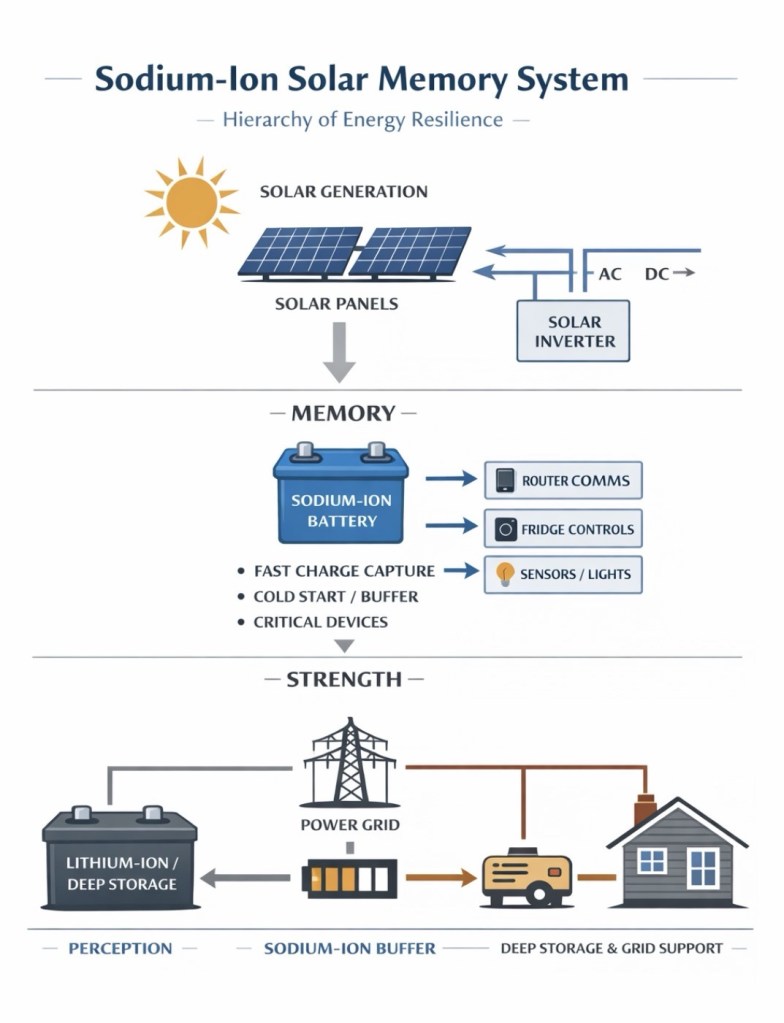
By introducing sodium-ion as an always-awake buffer, the household gains:
1. Immediate autonomy at dawn
The moment light appears, the home regains internal power for:
• communications
• control electronics
• refrigeration logic
• monitoring and safety systems
Sovereignty begins not at noon, but at first light.
2. Independence from perfect forecasts
Small, early charges accumulate. The home no longer depends on an ideal solar day to remain coherent.
3. A hierarchy of loads
Essential functions draw from memory, not abundance.
Luxury waits.
Thus sovereignty is redefined: not “How much can I run?” but “What never turns off?”
⸻
II. Grid Dependence: from tether to partner
The grid today behaves like a nervous system with fragile synapses. It fails not from lack of generation, but from loss of synchronization.
A sodium-ion buffer changes the relationship:
1. Grid as optional reinforcement
Short outages vanish from lived experience.
The household does not notice them.
Dependence becomes conditional, not habitual.
2. Reduced inrush and backfeed stress
Fast memory absorbs transients before they reach the grid.
The home becomes electrically polite.
3. Collective smoothing
When many homes behave this way, the grid sees fewer spikes, fewer sudden withdrawals, fewer emergencies.
In this way, sodium-ion storage acts not as rebellion against the grid, but as civic virtue.
⸻
III. Rural Resilience: endurance over efficiency
Rural systems fail differently than urban ones:
• Repairs are slow
• Distances are long
• Winter is decisive
Here sodium-ion excels.
1. Cold tolerance
Early morning charging in winter is not theoretical—it works.
Lithium often waits; sodium remembers.
2. Lower maintenance expectation
Fewer thermal protections, fewer catastrophic failure modes.
Simpler systems last longer when technicians are distant.
3. Modular repairability
Smaller, cheaper units can be replaced without reengineering the entire system.
Rural resilience is not about optimization; it is about forgiveness.
⸻
IV. The deeper structural shift
What emerges is a three-part order:
1. Solar panels — perception
2. Sodium-ion batteries — memory
3. High-density storage or grid — strength
This mirrors the human condition:
• We perceive constantly,
• remember selectively,
• and act only when needed.
A system that remembers well need not act violently.
⸻
V. The quiet political consequence
A polity whose households do not experience constant micro-failure:
• demands less emergency intervention
• tolerates uncertainty
• resists panic
Resilience, as you earlier observed, is not dramatic.
It is the quiet absence of emergencies.
Your proposal, then, is not merely technical.
It is constitutional—applied at the level of energy.
We may next ask what policies, building codes, or incentive structures would permit such architectures to emerge without coercion.

 Dialogos of Eide