
Canadian Arctic sovereignty is not secured by:
stealth,
speed,
or alliance reassurance.
It is secured by:
Canadian sensors seeing first
Canadian systems deciding first
Canadian leaders choosing what to share, when, and why
Aircraft must serve this order, not reverse it.
A mixed fleet makes sense only if:
F-35s are subordinated to alliance missions,
Gripens (or equivalent) are subordinated to sovereign patrol, detection, and response.
If the inverse occurs, sovereignty erodes quietly
–———————————-
The Arctic belongs to Canada. Detection within it must be Canadian first. Data sovereignty precedes alliance utility. Platforms that deny this sequence, however advanced, impose dependency.
A state that wishes to remain sovereign must accept friction with convenience.
To govern territory is to endure that friction willingly.
That is not defiance.
It is adulthood in the life of states
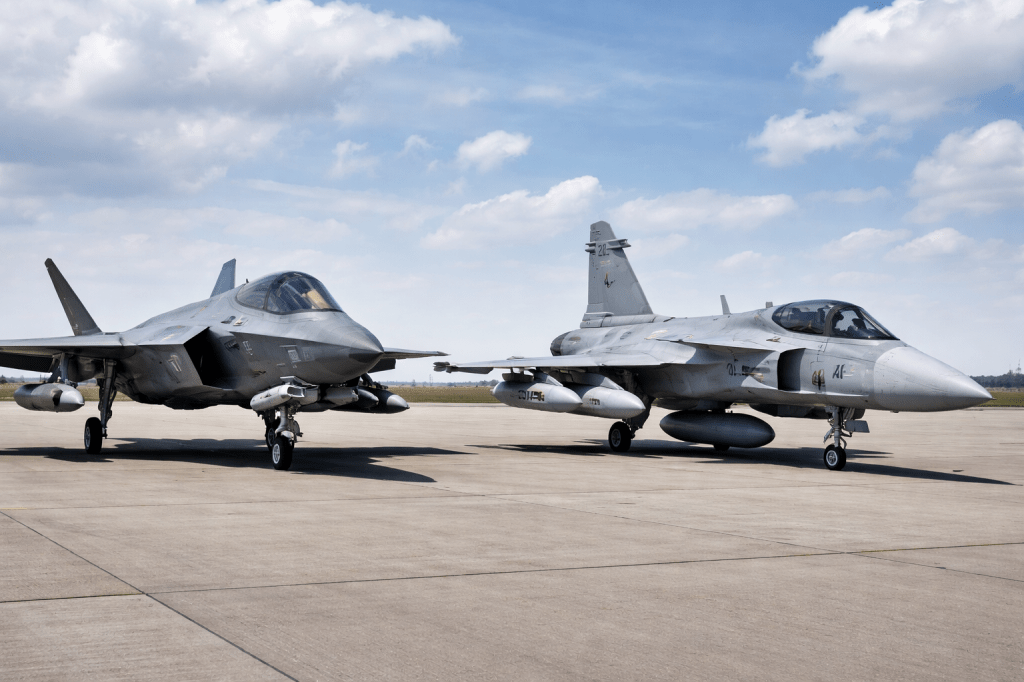
For demonstration purposes, using the image shown:
Left aircraft: F-35 Lightning II Identifiable by its blended, angular stealth shape, canted tail fins, and lack of external canards. The fuselage appears bulkier, with smooth surfaces designed to minimize radar reflections.
Right aircraft: Saab JAS 39 Gripen Identifiable by its canard-delta wing configuration (small forward wings near the cockpit), slimmer fuselage, single vertical tail, and visible external fuel tank under the fuselage.
In short:
Left = F-35 (stealth-centric, networked strike platform)
Right = Gripen (agile, endurance-oriented, sovereign-configurable fighter)
————————————————
Here are the key advantages of the new Saab Gripen engine (specifically the F414-GE-39E used on the latest Gripen E/F variants) compared with earlier engines and what they mean in practical terms:
1. Increased thrust and performance
The F414 variant produces significantly more thrust (about 20 % more) than the older F404-based engine, improving acceleration, climb rate, and overall performance.
2. Supercruise capability
This engine can sustain supersonic flight without afterburner under certain conditions. Flying supersonic without afterburner reduces fuel consumption and lowers heat and radar signatures, which benefits range and survivability.
3. Better fuel efficiency and range
Because the F414 engine avoids excessive afterburner use and can integrate with increased fuel capacity, the aircraft achieves longer range and endurance—a useful trait for vast areas like the Arctic.
4. Advanced engine technology
Improvements include 3D aerodynamics, a higher-pressure turbine, and increased cooling airflow, which together boost reliability, durability, and performance in demanding conditions.
5. Operational cost benefits
Although more powerful, this engine retains the Gripen’s reputation for lower operating costs compared to many competitors, meaning more flight hours for a given budget.
Why this matters strategically:
Better range and endurance support patrols over large, remote areas (e.g., northern airspace). Higher thrust and supercruise improve responsiveness without sacrificing fuel economy. Efficient operation makes sustained sovereignty patrols more affordable.
In summary, the new Saab engine on the Gripen E/F enhances performance, range, and efficiency while supporting lower life-cycle costs—advantages that align with sovereignty-oriented operations over large territories like Canada’s north

 Dialogos of Eide