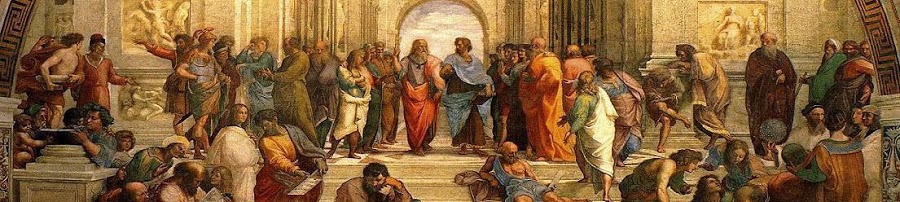
Socrates: Tell me, Platohagel, when you first learned of motion, how was it described to you?
Platohagel: As a body moving in a straight line unless acted upon by a force.
Socrates: And this straight line—where did it live?
Platohagel: In an empty, fixed space. Euclidean, uniform, the same everywhere.
Socrates: So gravity, in that account, was what?
Platohagel: A force pulling bodies away from their straight paths.
Socrates: Good. Now tell me—when we observe planets, satellites, or falling stones today, do we still see them deflected by a force, or do we see something subtler?
Platohagel: We see bodies in free fall, moving as though unforced, yet tracing curved paths.
Socrates: Then perhaps the path is not bent by the body, but by the space through which it moves?
Platohagel: That seems to be the case.
Socrates: And what kind of space allows its straightest paths to appear curved?
Platohagel: A non-Euclidean one.
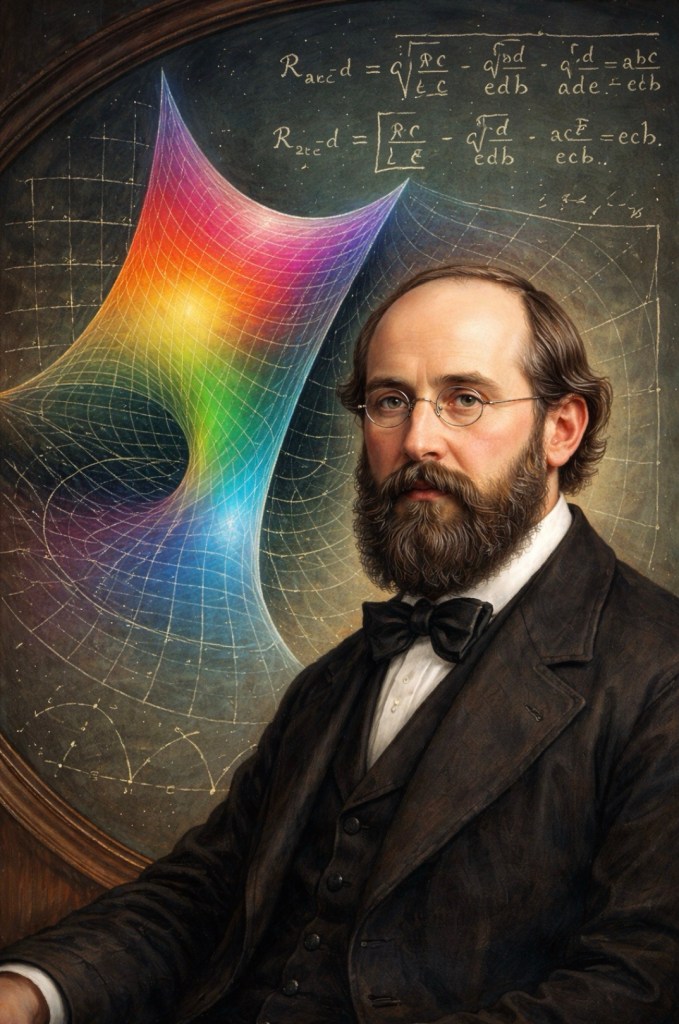
Socrates: Just so. Here enters Riemann, who taught us that geometry need not be flat, nor fixed in advance. Space may possess curvature, and straightness becomes a local matter, not a global decree.
Platohagel: Then Newton’s straight line survives only as a special case?
Socrates: Exactly—an approximation valid where curvature is negligible. Useful, but no longer sovereign.
Platohagel: And gravity?
Socrates: No longer a messenger pushing from afar, but the very grammar of motion. Mass–energy shapes geometry; geometry guides motion. Neither speaks alone.
Platohagel: So when we measure gravity, we are not weighing Earth, but testing the rules by which motion is permitted?
Socrates: You have said it well. Satellites trace geodesics. Interferometers test straightness itself. What deviates is not the object, but our expectation of flatness.
Platohagel: Then we truly have left Euclid’s world.
Socrates: Not abandoned it—enfolded it. For Euclid still lives where curvature sleeps. But the world itself, it seems, is Riemannian at heart.
Platohagel: And our task?
Socrates: To remember always that what appears as force may be form, what appears as motion may be geometry, and what appears as fact may be an answer to a very carefully chosen question.
Platohagel: I see.
Socrates: Then let us stop here—for to see is enough, until the next straight line bends
 Dialogos of Eide