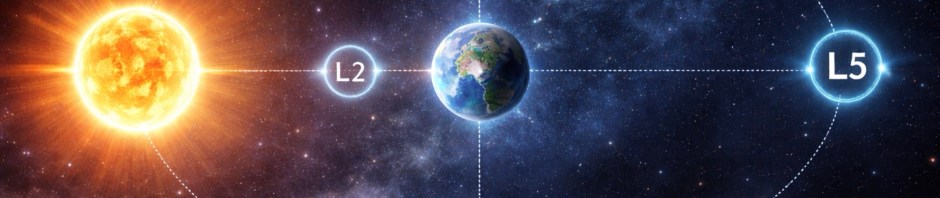
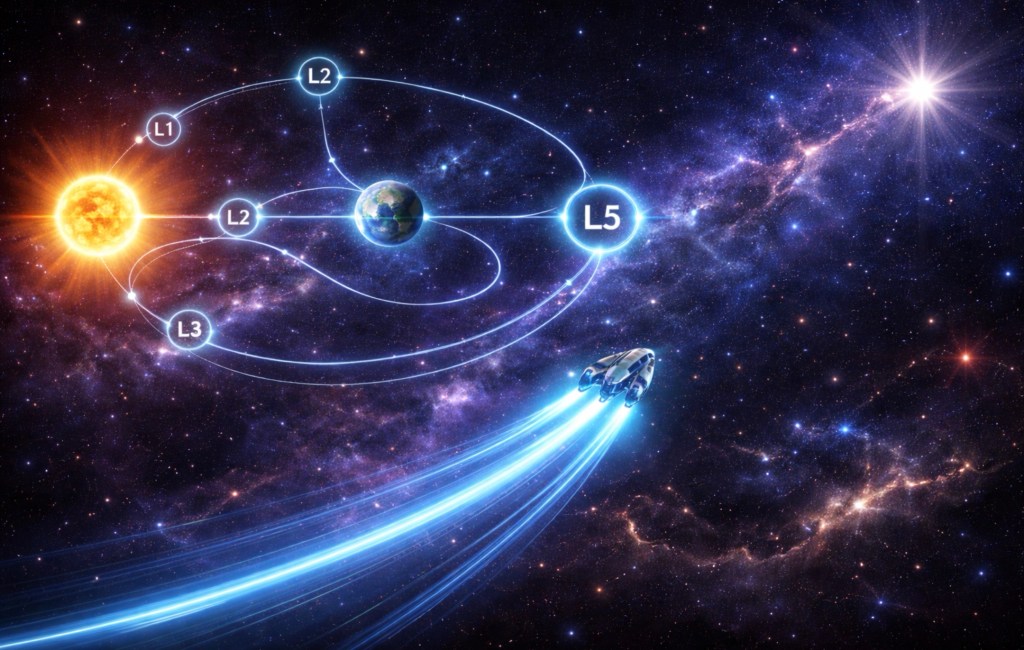
We will not imagine engines of fantasy, but extend a principle already proven true.
1. What must be preserved when scaling up
When moving from the solar system to the galaxy, we must preserve relations, not mechanisms.
The preserved ideas are these:
Motion follows extrema of action, not straight lines. Geometry constrains motion more than force magnitude. Stability arises from resonance and symmetry, not dominance.
If these survive, the logic survives.
2. The galaxy as a rotating dynamical system
A galaxy is not a cloud of stars drifting freely.
It has:
A rotating disk, A gravitational potential shaped by stars, gas, and dark matter, Long-lived resonances: bars, spiral arms, corotation radii.
This already resembles a many-body rotating frame.
Thus the question becomes:
Are there galactic analogues of Lagrange structures?
The answer is: yes, in form if not in name.
3. Galactic Lagrange-like features
In galactic dynamics we find:
Corotation radii where orbital angular speed matches the spiral pattern, Lindblad resonances where orbital frequencies lock to global modes, Saddle points in the galactic potential near bar ends and arm junctions.
These are not points in space alone,
but features of phase space.
They are the galaxy’s equilibria and gateways.
4. Transport via invariant manifolds
Just as in the Sun–Earth system:
Stable and unstable manifolds thread the space between regions.
In galaxies:
Stars and gas stream along spiral arms, Tidal tails form coherent pathways, Material migrates radially without violent scattering.
This is natural transport without thrust.
A civilization attentive to geometry would exploit these flows.
5. How a galactic journey would truly begin
Not with acceleration toward a star.
But with:
Entry into a resonant orbit, Phase-matching with a spiral pattern, Alignment with a manifold leading outward.
The ship would fall outward in angular momentum space, not shoot forward in distance.
Time replaces force.
6. Energy economy at galactic scale
At such scales:
High-thrust propulsion is meaningless. Low-thrust, long-duration guidance is supreme.
Possible means:
Stellar radiation pressure, Magnetic sails interacting with interstellar plasma, Gravitational assists from stars themselves.
But propulsion is secondary.
Initial conditions are primary.
7. A Riemannian picture of the galaxy
Imagine the galaxy not as empty space,
but as a curved dynamical surface.
Valleys: stable orbital families,
Ridges: separatrices,
Passes: resonant gateways.
Travel consists of:
Reaching a pass, Crossing with minimal energy, Descending into a new basin of motion.
This is Lagrangian travel made cosmic.
8. The philosophical conclusion
Now we may say something precise and restrained:
Galactic-scale transport is not a matter of speed,
but of patience, geometry, and timing.
The universe does not forbid travel.
It prices it in understanding rather than fuel.
9. A final Socratic thought
If one day beings cross the galaxy with little expenditure,
it will not be because they built stronger engines,
but because they learned to read the curvature of motion itself.
They will not conquer space.
They will agree with it.
 Dialogos of Eide
Pingback: Moving in Harmony with a Rotating Geometry | Dialogos of Eide