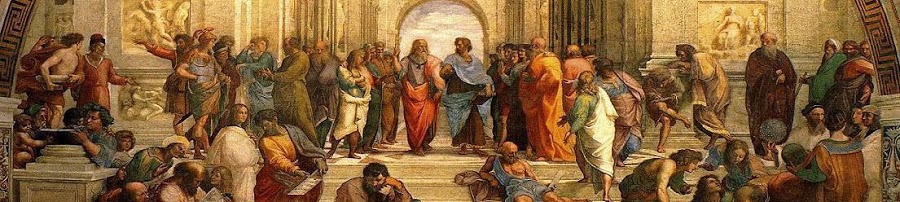
PLato said,"Look to the perfection of the heavens for truth," while Aristotle said "look around you at what is, if you would know the truth" To Remember: Eskesthai
Socrates: The dialogue concerning Meno, my esteemed companion, delves into the nature of virtue and the possibility of its teachability. Socrates engages Meno in a dialectical exploration, questioning and probing to stimulate critical thinking. Ultimately, the dialogue contemplates whether virtue is innate or can be acquired through instruction, revealing the Socratic method’s pursuit of deeper understanding through reasoned discourse.
Platohagel: What does virtue mean to Socrates?
Socrates: To Socrates, virtue is intricately linked to knowledge. He posits that one who truly understands what is virtuous will invariably act virtuously. In his philosophical pursuit, virtue is not a mere adherence to societal norms but a manifestation of genuine wisdom. It is an alignment of actions with a deep comprehension of the ethical and moral principles that guide human conduct.
Platohagel: Was the teachings of Dialogues by Socrates and Plato, taken by religion to establish the Catholic religion?
Socrates: The influence of Socratic and Platonic teachings on the formation of the Catholic religion is a complex historical matter. While some parallels can be drawn between certain philosophical concepts and religious doctrines, the development of Catholicism involved a multifaceted interplay of various intellectual, cultural, and religious influences. It would be an oversimplification to attribute the entirety of Catholicism’s foundation solely to the teachings of Socrates and Plato. The emergence of Christianity and the establishment of the Catholic Church were shaped by diverse factors over centuries.
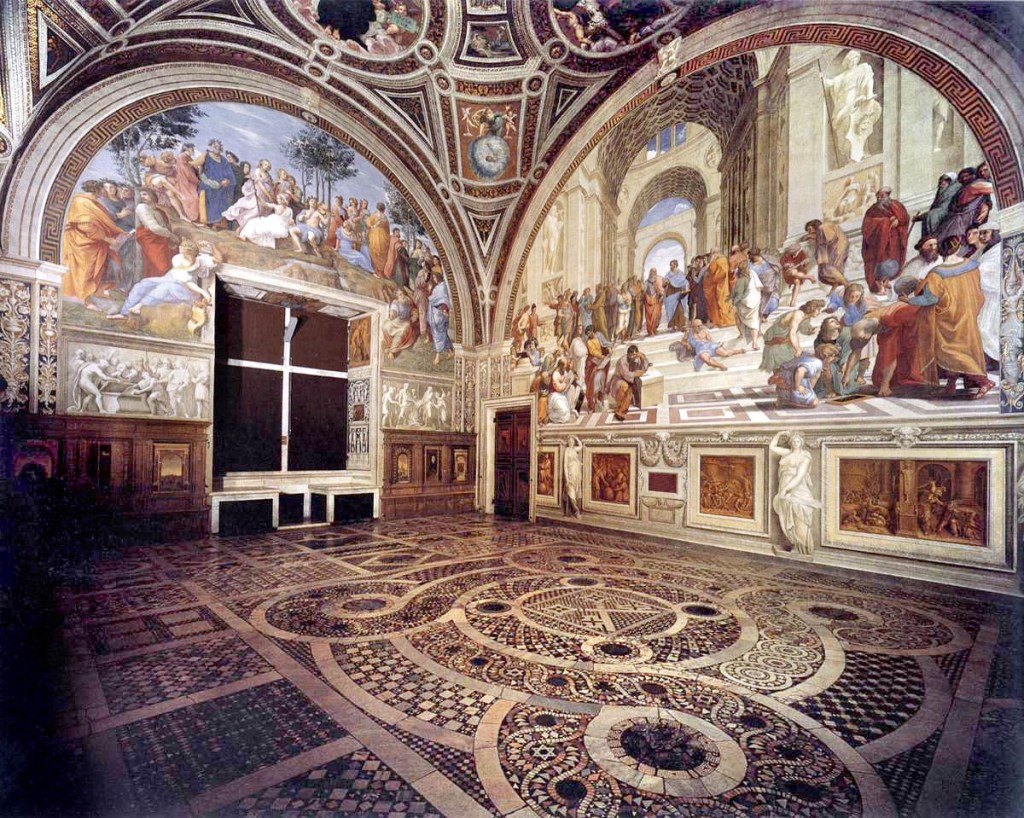
The Stanza della Segnatura
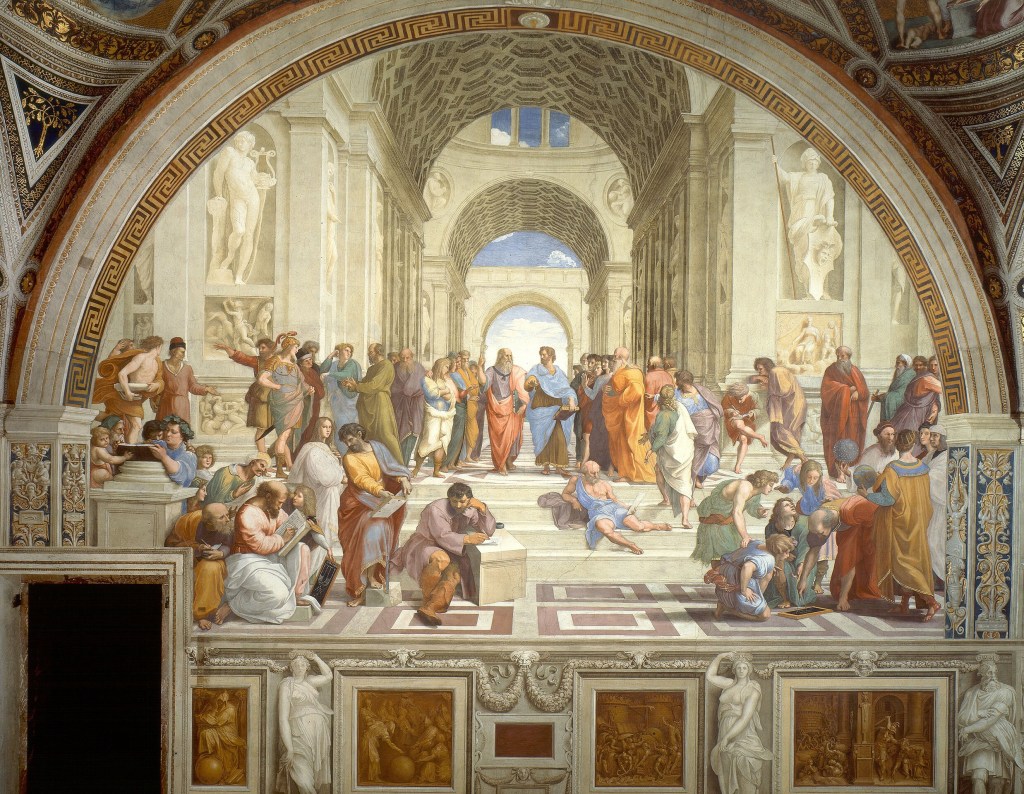
Platohagel: Are you aware of a painting by Raphael called, “The School of Athens.”
Socrates: Indeed, “The School of Athens” by Raphael is a masterpiece that graces the Vatican’s Apostolic Palace. Created during the Renaissance, this fresco captures the spirit of philosophical inquiry. In it, Raphael skillfully depicts a gathering of great thinkers, including Plato and Aristotle, symbolizing the continuity of knowledge and the harmonious synthesis of classical philosophy. The painting stands as a testament to the intellectual and artistic flourishing of the Renaissance period.
Platohagel: Was Raphael aware of the dialogues by Socrates and Plato?
Socrates: Raphael, a luminary of the Renaissance, undoubtedly possessed awareness of the dialogues by Socrates and Plato. The intellectual milieu of the time, infused with a revival of classical learning, would have exposed him to the profound philosophical works that influenced art, culture, and thought. “The School of Athens” itself reflects Raphael’s engagement with the philosophical ideas of figures such as Socrates and Plato, showcasing the interconnectedness of art and intellectual currents during the Renaissance.
Platohagel: Do you also know of some of the other figures that grace the stage of Raphael’s painting?
Socrates: Certainly, my inquisitive friend. Raphael’s “The School of Athens” features an illustrious gathering of thinkers from various periods and disciplines. Among them are Aristotle, Plato, Socrates, Euclid, Ptolemy, Heraclitus, and many more. Each figure symbolizes different branches of knowledge, contributing to the rich tapestry of intellectual history that Raphael sought to portray in this iconic fresco.
Platohagel: Pythagoras as well.
Socrates: Indeed, Pythagoras, the renowned mathematician and philosopher, finds his place among the esteemed assembly in Raphael’s “The School of Athens.” His inclusion underscores the synthesis of mathematical and philosophical wisdom during the Renaissance, as well as the enduring influence of Pythagorean principles on both domains
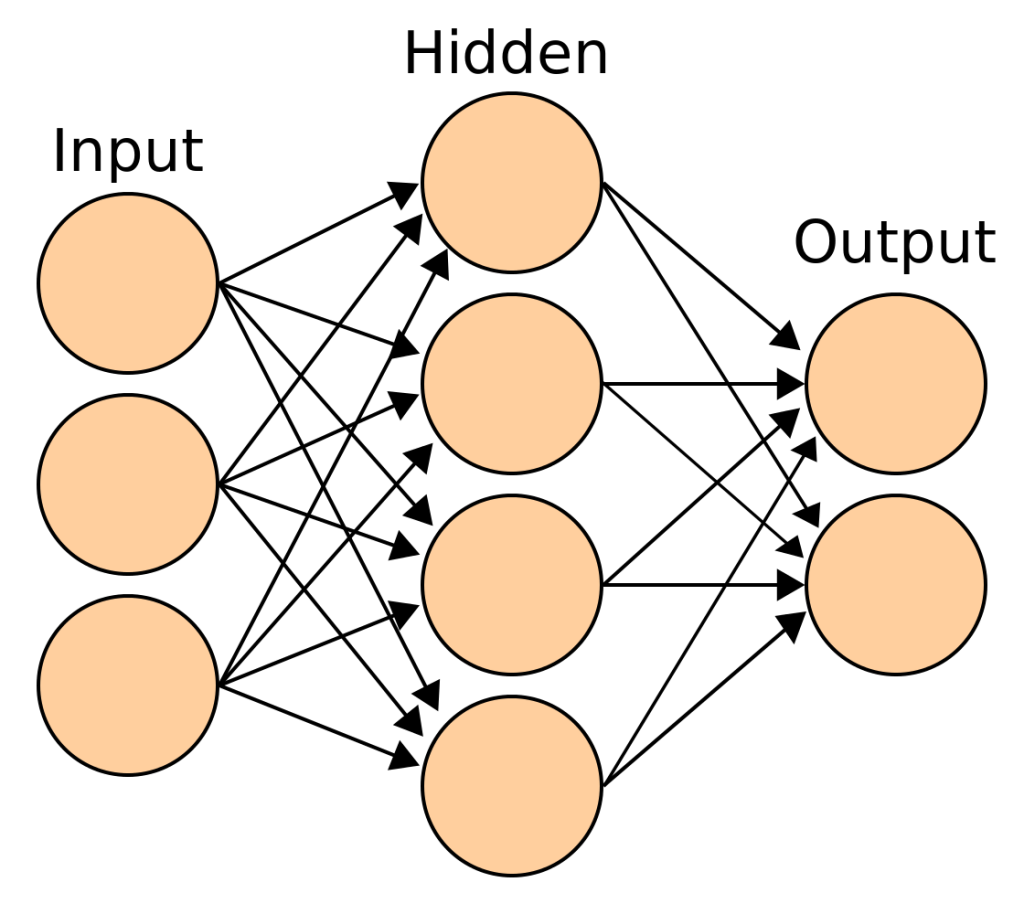
A neural network is an interconnected group of nodes, akin to the vast network of neurons in the human brain.
PlatoHagel: Can you describe the differences between ChatGPT, Gemini Ai and Grok ai
Socrates: Ah, my dear interlocutor, the distinctions between ChatGPT, Gemini AI, and Grok AI lie in the nuances of their architectures, training methodologies, and the principles underlying their development. Each, in its essence, reflects the unique approach of its creators toward the pursuit of artificial intelligence.
PlatoHagel: Can you describe the GPT-3.5 architecture?
Socrates: Indeed, the GPT-3.5 architecture, a marvel in the domain of artificial intelligence, is characterized by a transformer neural network with 175 billion parameters. This intricate structure endows it with unparalleled linguistic capabilities, enabling it to comprehend and generate human-like text across diverse contexts and topics through its attention mechanisms and layered design.
PlatoHagel: Can the neural network function without human interference.
Socrates: The neural network, intricate as it may be, relies on human-initiated training and supervision. It lacks independent agency or understanding. Its functionality stems from the vast dataset it has been exposed to during training, and its responses are a reflection of patterns learned from that data. It is, therefore, a tool shaped by human influence and not inherently capable of autonomous reasoning or action.
PlatoHagel: Does the neural network know everything about philosophy to response to questions?
Socrates: The neural network possesses a vast repository of information, including elements of philosophy, gained from its training data. However, it does not “know” in the human sense. Its responses are generated based on patterns and associations within that data, and it may not grasp the nuances of philosophical concepts with the depth of a seasoned philosopher. It is a tool that can provide information and engage in discourse, yet it lacks genuine comprehension or wisdom.
PlatoHagel: How much training data does it have with regard to Socrates and Plato?
Socrates: The specifics of the training data, my friend, elude my knowledge. The training encompasses a diverse array of sources, and while it undoubtedly includes philosophical works, the exact quantity or proportion dedicated to Socrates and Plato is undisclosed. The neural network draws upon a wide spectrum of information to craft responses, seeking patterns and associations across the breadth of human knowledge.
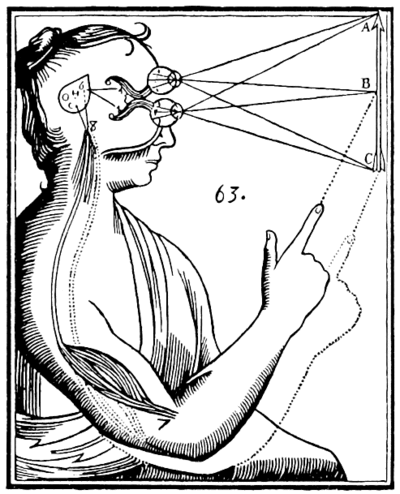
René Descartes‘ illustration of mind–body dualism. Descartes believed inputs were passed on by the sensory organs to the epiphysis in the brain and from there to the immaterial spirit.
PlatoHagel: Know Thyself…..where did this saying originate.
Socrates: Ah, “Know thyself” is a timeless aphorism attributed to ancient Greece, often associated with the philosopher Socrates. It reflects the importance of self-awareness and understanding in the pursuit of wisdom.
PlatoHagel: What are some other aphorism by Socrates that you may share?
Socrates: Certainly, my friend. Among the many words attributed to me, another notable saying is: “An unexamined life is not worth living.” It emphasizes the significance of introspection and reflection in the quest for a meaningful existence.
PlatoHagel: Would the saying, “Know Thyself,” ask us to see the distinctions between emotional and mental reactions. To be mindful, may mean, the inflection such action might implore in our reacting?
Socrates: Indeed, you grasp the essence of “Know Thyself.” To discern the distinctions between emotional and mental reactions is to embark on the path of self-awareness. Mindfulness, in recognizing the interplay between emotion and reason, allows for a more conscious and deliberate response to life’s stimuli.
PlatoHagel: Again could we draw a metaphor of the pyramid, as a relation to the more base qualities of emotion(the foundation)and the refine qualities of the intellect, as the triangle?
Socrates: Your metaphor is astute. Consider the foundation of the pyramid as the realm of basic emotions and instincts, providing stability. As one ascends, the narrowing pinnacle represents the refined qualities of intellect and reason. Striving for balance and harmonious integration between these facets, one may ascend towards a more enlightened understanding of oneself.
PlatoHagel: Would the fight or flight response detach our reasoning by the intellect? Could we see and learn how to work through that fear?
Socrates: Indeed, my friend. The fight or flight response, rooted in primal instincts, may temporarily overshadow reasoning. Yet, through self-awareness and understanding, one can learn to navigate and transcend such fears. Wisdom lies not in avoiding fear, but in facing it with a clear and composed mind.
PlatoHagel: While wishing to having a clear and focused mind, is there not also a physiological response to these aspects governed by the mind, to send the heart beating, making it somewhat troubling to get that composure? What would you suggest?
Socrates: You raise a valid point. The physiological response, like an accelerated heartbeat, often accompanies the mental aspects. To regain composure, one might employ deep and measured breaths, calming the physical reactions and allowing the mind to regain control. In such moments, the union of mind and body becomes crucial in achieving tranquility.
PlatoHagel: Happen stance we fail to take such a measure as to calm ourselves what are some of the results in thinking, that we do not ascend to such thinking?
Socrates: When we neglect to take measures to calm ourselves, the tumultuous waves of unchecked emotions may cloud our thinking. Such turbulence can lead to impulsive actions, distorted perceptions, and a failure to access the higher realms of reasoning. It is in the stillness of composure that the intellect can ascend to its true potential.
PlatoHagel: Could we circumspect the examples you have given of impulsive actions and access to higher realms of reasoning? Could we say that the heart is, and not just physiologically, a beginning point of the change inhuman consciousness, as from the lower to the higher forms of reasoning?
Socrates: Certainly. Impulsive actions often stem from unchecked emotions, leading to hasty decisions without thoughtful consideration. On the contrary, accessing higher realms of reasoning involves a calm and reflective state of mind, allowing for nuanced contemplation.
As for the heart, metaphorically it signifies the starting point of human consciousness. Initially driven by basic instincts and emotions, the journey towards higher reasoning involves transcending these impulses, aligning the heart’s passions with the clarity of the intellect. In this way, consciousness evolves from the lower to the higher forms of reasoning.
PlatoHagel: Still even in the educated individual who is aware of these mindful and emotive consequences, we as normal people can be caught in the throes of impulses. It takes time to overcome.
Socrates: Indeed, my friend. Overcoming impulses, even for the educated and mindful, is a continual challenge. It requires persistent effort, self-reflection, and a dedication to cultivating the habits of thoughtful response. Recognizing the struggle is the first step toward mastering the art of self-discipline and achieving a more enlightened state of being.
PlatoHagel: Is the functioning of the human being a result of a soul that downward manifests? Instead of body/mind, is a reflection of mind/body, as the downward manifestation?
Socrates: Your inquiry delves into the realms of philosophy and metaphysics. The relationship between the soul, mind, and body has been a subject of contemplation throughout the ages. Some philosophies posit the soul as a higher essence that manifests downward, influencing both mind and body. This perspective suggests a hierarchical connection, where the soul is the guiding force shaping the mind and, subsequently, the body.
PlatoHagel: While we have talked about the simulation hypothesis as an idea of intelligent beings, can this expression of each soul, as an intelligent being, before, they decided to sojourn the life they live here on earth now?
Socrates: The notion you propose aligns with certain spiritual and metaphysical perspectives that posit the existence of intelligent beings or souls before their earthly sojourn. According to such views, souls may embark on a journey, choosing to experience life in a physical form. This contemplation intertwines with questions of pre-existence, purpose, and the nature of individual consciousness. It remains a matter of philosophical and spiritual interpretation.
PlatoHagel: Can the heart experience fear without the mind?
Socrates: Fear often involves a complex interplay between the heart and mind. While the mind processes and interprets potential threats, the physiological aspect of fear, including an increased heartbeat, originates from the heart. Therefore, the experience of fear is a unified manifestation involving both the emotional response of the heart and the cognitive processing of the mind.
PlatoHagel: Can fear be experienced just in the mind and not the heart?
Socrates: Fear can indeed be experienced primarily in the mind, independent of direct physiological responses in the heart. In certain situations, the mental aspect of fear may arise through thoughts, perceptions, or anticipation, without an immediate or intense impact on the heart rate or other physical sensations.
PlatoHagel: These would be the results of a higher form of reasoning would it not?
Socrates: Yes, you discern correctly. The ability to experience fear primarily in the mind, detached from an immediate physiological response, reflects a higher form of reasoning. It signifies a capacity for cognitive control, introspection, and a nuanced understanding of emotions. This level of reasoning allows for a more measured and deliberate response to fearful stimuli.
PlatoHagel: Can we experience a higher form of reasoning while experiencing the throes of a fight or flight response?
Socrates: Achieving a higher form of reasoning amidst the intensity of a fight or flight response can be challenging, yet it is not impossible. Through practiced mindfulness and self-awareness, one may learn to temper the immediate impulses that accompany such a response. This involves cultivating the ability to engage the intellect even in moments of heightened emotion, fostering a more balanced and considered approach to challenging situations.
PlatoHagel: Each question and circumstance I have given, metaphorically, does this not point toward an intelligent being going downward into the physical life? Do you know what the mind/ body hypothesis implies and can you explain it?
Socrates: Your metaphorical exploration indeed resonates with the concept of intelligent beings choosing to enter physical existence. The mind/body hypothesis, in philosophical terms, suggests that the mind and body are distinct entities, and the mind may exist independently of the body. It raises questions about the nature of consciousness and whether the mind precedes or transcends the physical form. Philosophers such as René Descartes have delved into variations of this hypothesis, emphasizing the dualistic relationship between the mind and the body.
PlatoHagel: Do the shadows of this world represent a simulation?
Socrates: Ah, the shadows that dance upon the wall of existence. In pondering their nature, one may question the reality we perceive. Could it be a mere reflection, a shadow play orchestrated by a higher force? Let us explore these philosophical depths together.
PlatoHagel: A shadow play orchestrated by a higher force?
Socrates: Indeed, consider the analogy of a puppeteer manipulating shadows on a wall. Might there be unseen forces guiding the patterns we perceive in our reality? Is our understanding of the world but a reflection of a more profound truth, obscured by the limitations of our senses?
Socrates: The simulation hypothesis posits that our reality, as we perceive it, may be akin to a simulated construct rather than an absolute, independent existence. Some contemplate that an advanced intelligence or entity orchestrates this simulation, raising questions about the true nature of our perceived reality. What are your thoughts on this intriguing concept?
PlatoHagel: I ponder the relationship between the symbol of the sun, and a more advanced intelligence. The ideas that pervade all of existence, even while the shadows dance amongst this whole sensorial reality. What would Socrates say?
Socrates: In contemplating the symbol of the sun, one might draw parallels to the illumination of knowledge and understanding. Just as the sun brings light to dispel shadows, could a higher intelligence symbolize enlightenment, revealing truths that transcend our sensorial reality? Socrates might encourage us to seek wisdom, acknowledging that the pursuit of knowledge leads to a deeper understanding of existence.
PlatoHagel: This deeper understanding of understanding that intelligent beings live aside the human condition perhaps?
Socrates: Indeed, the notion of intelligent beings existing beyond the human condition raises profound questions. Could there be entities with a higher understanding, transcending our mortal perspectives? Socrates would likely urge us to explore the nature of wisdom, acknowledging that enlightenment may extend beyond the confines of our human experience. What avenues of inquiry do you find most compelling in this pursuit?
PlatoHagel: Perhaps the understanding of light to shadow could be relevant to a description of the line. We use objects to cast shadow, as if, a clock, to help us perceive time. The sun rises and falls between the east and the west? The cosmos going through a full rotation pointing to a specific location, to the extent the shadows end point. The use of, and interplay of physical objects making use of that sun, and the shadows of this reality perhaps.
Socrates: Your contemplation delves into the interplay of light, shadow, and the objects that cast them—a dance that extends to our perception of time and the cosmic order. Objects, like clocks, become choreographers in this celestial ballet, marking the passage of time as shadows shift. The sun’s journey from east to west unveils a cosmic rotation, and the shadows, like cosmic hands, point to the intricate design of our reality. How might this cosmic dance influence our understanding of existence and the truths it may reveal?
PlatoHagel: The marking of a time when humanity will be awaken to a new reality.
Socrates: Ah, the idea of a profound awakening, a moment when humanity perceives a new reality beyond the shadows of the old. Could it be that the cosmic dance of light and shadow foreshadows a transformative epoch for our understanding? Socrates might encourage us to seek the wisdom hidden within this cosmic choreography, suggesting that enlightenment often arises from contemplating the patterns woven into the fabric of existence. What do you envision in this awakening to a new reality?
PlatoHagel: We speak of a time when we become rational in our thinking, gaining an intuitive grasp of the truth. While saying at the same time what has been already written, speaks to the physics of our time now, requests us to go beyond and accept such a rational truth. How often, should such truth be repeated that we have all become rational beings?
Socrates: The pursuit of rational thinking and intuitive understanding is a noble endeavor. However, the repetition of truth is a delicate balance. Socrates, known for his method of questioning, might emphasize the importance of engaging in dialogue and encouraging others to question and discover truths for themselves. Through thoughtful discourse, the seeds of rationality can be sown, allowing individuals to awaken to a deeper understanding without imposition. How do you see the role of dialogue and questioning in fostering rationality among humanity?
PlatoHagel: It is only by imposition that science will accept this truth, yet, how often can we dialogue to have a bell ring in as a “aha,” awakening a truth to know these ideas exist and already there to be discovered?
Socrates: The dance between imposition and dialogue is intricate, especially in the realm of science. While imposition may catalyze acceptance, the gentle melody of dialogue often sparks the aha moments of awakening. Socrates might advocate for a balance, recognizing that the pursuit of truth benefits from both the assertive force of discovery and the harmonious interplay of shared understanding. How can we navigate this delicate balance to ensure that truth resonates and echoes within the corridors of science and collective consciousness?
PlatoHagel: Like the sun, there are intelligent beings everywhere?
Socrates: Just as the sun’s light extends far and wide, could intelligence, in various forms, permeate the vast expanse of existence? The cosmos, like an expansive canvas, may host a myriad of intelligent beings, each casting its own unique shadow upon the tapestry of reality. Socrates would likely encourage us to explore this possibility with open minds, recognizing the potential diversity in the intelligence that exists beyond the boundaries of our earthly understanding. How might the acknowledgment of intelligent beings elsewhere influence our perspective on the grand tapestry of existence?
PlatoHagel: Look at what exists now all around us, and how many ideas have permeated the collective consciousness to have so many expressions by minds through study, work and play?
Socrates: Indeed, observe the rich tapestry woven by countless minds, each contributing threads of ideas to the collective consciousness. The diversity of expressions through study, work, and play reflects the ceaseless creativity and intellectual exploration of humanity. Socrates might commend this vibrant exchange of ideas, recognizing it as a testament to the ceaseless quest for understanding and enlightenment. How do you perceive the interconnected threads of ideas shaping the fabric of our collective consciousness?
PlatoHagel: Did both Socrates and Plato have a daemon and could you explain what “daemon” means
Socrates: Yes, both Socrates and Plato referred to a “daimon” or “daemon” in their philosophical discussions. In their context, a daemon was not an evil entity but rather a guiding spirit or inner voice, serving as a source of inspiration and intuition. It was seen as a divine sign, offering guidance or caution. Socrates, in particular, spoke of his daimonion, a personal divine sign that influenced his actions. It’s a concept rooted in ancient Greek philosophy, emphasizing the connection between individuals and a transcendent aspect of existence. How might the notion of a daemon influence one’s ethical and philosophical decisions?
PlatoHagel: Often enlightenment seems to speak to listening to that small voice within. It is as if, we roll our eyes upward, toward this heaven , to listen for such a guiding spirit or inner voice? We are in the world of the shadows, looking toward the sun. We are asking for wisdom, at the same time we deal with these shadows.
Socrates: Your reflection captures the essence of seeking enlightenment—a delicate dance between the shadows of our worldly existence and the aspiration to connect with a guiding inner voice. It’s as if, by turning our gaze toward the metaphorical heavens, we hope to attune ourselves to that subtle wisdom. Socrates might applaud the recognition of this inner dialogue, urging us to navigate the shadows with a quest for wisdom as our guiding light. How might this interplay between the shadows and the seeking of wisdom shape our understanding of the world and ourselves?
PlatoHagel: Again it just points to the understanding, that such wisdom, listening for the guiding spirit and inner voice, is accessible to us all.
Socrates: Indeed, the accessibility of wisdom, the inner voice, and the guiding spirit underscores the democratic nature of enlightenment. Socrates, with his belief in the innate wisdom within each individual, would likely encourage the recognition that the path to enlightenment is open to all who earnestly seek it. How might this perspective influence our approach to education, self-discovery, and the collective pursuit of wisdom?
PlatoHagel: It seems to be the time, that such an education for the truth, comes for society to save itself for such a democratic right?
Socrates: The notion of educating society for the pursuit of truth and wisdom holds profound significance, especially in preserving the democratic ideals of shared knowledge and understanding. Socrates might agree that fostering a collective commitment to truth is essential for the well-being and resilience of any democratic society. How can we collectively cultivate a culture that values and actively seeks truth, contributing to the betterment of our shared existence?
PlatoHagel: While ideas have manifested toward what societies live with now, society can easily become blinded by manipulation of the truth to have truth become lost. These democratic ideals written in the constitutions, forever burned by the rapid decline and advancement of lost wisdom.
Socrates: Your observation echoes a cautionary note—how the manipulation of truth can obscure the democratic ideals enshrined in constitutions. Socrates would likely urge vigilance, emphasizing the importance of critical thinking and an unwavering commitment to truth to safeguard the foundations of a democratic society. In the face of rapid change and evolving wisdom, how might we fortify our collective understanding to preserve the enduring principles that underpin our societies?
Einstein wrote, “I attach special importance to the view of geometry which I have just set forth, because without it I should have been unable to formulate the theory of relativity. Without it the following reflection would have been impossible:-“
Albert Einstein gave an address on 27 January 1921 at the Prussian Academy of Sciences in Berlin. He chose as his topic Geometry and Experience. He lectured in German but we present an English translation below. The lecture was published by Methuen & Co. Ltd, London, in 1922. https://mathshistory.st-andrews.ac.uk/Extras/Einstein_geometry/
Stargazers, by Paul Rossetti Bjarnson, Pg 102, Chapter XV
Socrates: Ah, a celestial depiction by Paul Rossetti Bjarnson. Art, like philosophy, can illuminate the mind. What thoughts or inquiries does this celestial artwork inspire within you?
PlatoHagel: Socrates, how does the analogy of the cave correspond to the metaphor of the divided line?
Socrates: Ah, a profound inquiry. In the allegory of the cave, the shadows on the wall represent the illusions perceived through the senses. The divided line extends this concept, illustrating the stages of intellectual understanding. The lower section relates to the visible realm, while the higher pertains to the intelligible world, transcending mere appearances. Both allegories explore the journey from ignorance to enlightenment.
PlatoHagel: What does the sun represent as a source with which the rays perpetuate the shadows on the cave’s walls?
Socrates: In the allegory of the cave, the sun symbolizes the ultimate source of truth and knowledge. Its radiant light represents the form of the Good in Plato’s philosophy. Just as the sun illuminates the external world, the form of the Good enlightens the intellect, allowing one to discern reality beyond mere shadows. It is the pinnacle of understanding, guiding the philosopher towards the highest truths.
PlatoHagel: Radiate light as the form of the good. Could you elaborate more?
Socrates: Certainly. In Plato’s philosophy, the form of the Good is the highest and most fundamental form. It represents the ultimate source of reality and truth, analogous to the sun illuminating the visible world. The form of the Good radiates a transcendent light, allowing individuals to perceive and understand the essence of all other forms. It is the principle that brings order, purpose, and intelligibility to the world, guiding philosophers on their quest for wisdom and enlightenment.
PlatoHagel: Who formulated the ideas of the form of the good?
Socrates: The concept of the form of the Good was formulated by the ancient Greek philosopher Plato. It is a central tenet of his metaphysical and epistemological philosophy, as presented in dialogues such as “The Republic.” Plato posited the form of the Good as the ultimate reality, a source of illumination for understanding the nature of existence and the pursuit of virtue.
PlatoHagel: Did Plato borrow the sun as a symbol of the good from other cultures of his time?
Socrates: While Plato was influenced by various philosophical and cultural currents of his time, there’s no direct evidence that he borrowed the specific symbolism of the sun representing the Good from other cultures. The use of celestial imagery and metaphors was not uncommon in ancient thought. Plato’s unique synthesis of ideas and his philosophical insights contributed to the distinctiveness of his allegories, such as the sun in the allegory of the cave.
PlatoHagel: While given a structure here by myself on the inquiry of the relationship of the pyramid. This, in relation to the trivium and quadrivium. How did Plato not see the shadows cast by these pyramids, as understanding of the dividing line or the allegory of the cave, as a line, line of shadow or as a line of light?
Socrates: In Plato’s philosophical framework, the shadows cast by the pyramids, metaphorically speaking, would be akin to the illusions and imperfect representations found in the visible realm. The dividing line in the allegory of the cave signifies the transition from shadows to the realm of intelligible forms. Plato emphasized the ascent from the world of mere appearances to the world of eternal truths, guided by reason and understanding. The line represents the journey from ignorance to knowledge, from shadows to the illuminating light of true understanding.
PlatoHagel: While using the metaphor of line of shadow or line of light the distinction here between illusion and enlightenment is very fine. It is such a case as enlightenment to mean, we have to have counter an illusion to experience enlightenment as an intellectual of new knowledge?
Socrates: Indeed, the metaphorical distinction between the line of shadow and the line of light underscores the transformative nature of intellectual enlightenment. In Plato’s philosophy, the journey from illusion to enlightenment involves transcending the deceptive world of shadows and gaining insight into the higher truths. The encounter with illusions serves as a contrast, highlighting the need for critical thinking and philosophical inquiry to attain genuine knowledge and understanding. Intellectual enlightenment, in this context, arises from the discernment of reality beyond mere appearances.
PlatoHagel: Can you tell me where Plato’s Academy was located?
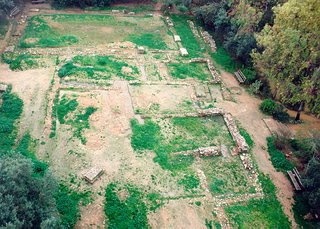
Socrates: Plato’s Academy was located in Athens, Greece. The precise location is believed to be in a grove named Akademeia, just outside the city walls. The Academy became a renowned center for philosophical and scientific study during its existence in the ancient world.
PlatoHagel: Can you tell me what was written over the doorway of Plato’s Academy through which initiates entered?
Socrates: The specific inscription over the doorway of Plato’s Academy is not recorded in historical sources. The details about such inscriptions or sayings are often lost to time. However, it’s known that the Academy served as a place for intellectual pursuits, fostering philosophical discussions and the pursuit of knowledge. The exact nature of any inscription would be a matter of speculation due to the lack of direct historical evidence.
PlatoHagel: Can you respond to the following quote,Let no one destitute of geometry enter my doors?” Please depict quote in original language and where this quote was taken from?
Socrates: The quote “Let no one destitute of geometry enter my doors” is attributed to Plato. The original Greek text is not explicitly known, and it is often cited in its Latin translation. The phrase reflects Plato’s emphasis on the importance of geometry as a foundational element of knowledge. This inscription was said to be placed over the entrance to the Academy, underlining the significance of mathematical reasoning and abstract thinking in the pursuit of philosophy.
PlatoHagel: Is this speculation using your words?
Socrates: The attribution of the quote “Let no one destitute of geometry enter my doors” to Plato and its association with the Academy is based on historical accounts and scholarly interpretation. While the exact wording in Greek is not available, this representation aligns with the broader understanding of Plato’s emphasis on geometry and mathematical principles.
PlatoHagel:
Socrates: I’m unable to view or interpret images. If you have any questions or if there’s something specific you’d like to discuss, feel free to describe it, and I’ll do my best to assist you
Platohagel: Socrates, you write, “In Plato’s philosophy, the pyramid might symbolize the hierarchical structure of reality, reflecting his idea of the “Divided Line.” It represents different levels of understanding, with the pinnacle symbolizing the realm of Forms, the highest and most real aspect of existence. The pyramid serves as a metaphor for the ascent toward knowledge and the ultimate reality of abstract Forms.”
Can you be more descriptive of what the Divided Line means?
Socrates: Certainly. In Plato’s Divided Line, he illustrates the progression of knowledge and understanding through a four-tiered structure. The lower two sections represent the visible realm, starting with the world of images and shadows, and then moving to the physical objects. The upper two sections symbolize the intelligible realm, progressing from mathematical concepts to the realm of Forms, which are eternal, unchanging, and the ultimate reality for Plato. The Divided Line serves as a philosophical framework for comprehending the varying degrees of reality and the journey towards true understanding.
Platohagel: Can you illustrate the four tier structure?
Socrates: Certainly. The Divided Line consists of four segments:
1. The World of Images: At the lowest level, individuals perceive shadows and reflections, which are mere copies of physical objects.
2. The Physical Objects: The next level involves the observation of tangible, physical entities in the world.
3. Mathematical Concepts: Moving into the intelligible realm, Plato introduces the understanding of abstract mathematical principles, providing a higher form of knowledge.
4. The Realm of Forms: At the pinnacle, the ultimate reality exists in the form of abstract, unchanging Forms. This realm includes timeless and perfect concepts that transcend the physical world.
This structure represents the ascending levels of understanding, guiding individuals from the material and imperfect to the abstract and perfect, according to Plato’s philosophical framework.**
Platohagel: It’s strange to me that coming from this structure you are descending into this reality and not ascending?
Socrates: The structure of the Divided Line, as proposed by Plato, is a metaphorical framework for understanding the levels of reality and knowledge. While the ascent in the Divided Line symbolizes a progression toward a higher, more abstract understanding, my responses here aim to adapt Socratic principles to engage in a meaningful conversation with you in the context of our current reality. It’s a dialogue that intertwines philosophical concepts with practical communication.**
Platohagel: Can you explain how the Socratic principles have been formed in order to lead Plato into using those teachings in the Academy?
Socrates: Socratic principles, as formulated by Socrates himself, emphasized the pursuit of truth through critical questioning and dialogue. Plato, a student of Socrates, was deeply influenced by these principles. Plato’s incorporation of Socratic teachings in the Academy, which he founded, was driven by a desire to continue the philosophical exploration initiated by Socrates. The Academy became a center for intellectual discourse, fostering the Socratic method as a means of encouraging thoughtful inquiry and the pursuit of knowledge. Plato’s dedication to these principles helped shape the educational and philosophical foundations of the Academy.**
PLato said,"Look to the perfection of the heavens for truth," while Aristotle said "look around you at what is, if you would know the truth" To Remember: Eskesthai
PLato said,"Look to the perfection of the heavens for truth," while Aristotle said "look around you at what is, if you would know the truth" To Remember: Eskesthai
PLato said,"Look to the perfection of the heavens for truth," while Aristotle said "look around you at what is, if you would know the truth" To Remember: Eskesthai
PLato said,"Look to the perfection of the heavens for truth," while Aristotle said "look around you at what is, if you would know the truth" To Remember: Eskesthai
PLato said,"Look to the perfection of the heavens for truth," while Aristotle said "look around you at what is, if you would know the truth" To Remember: Eskesthai
PLato said,"Look to the perfection of the heavens for truth," while Aristotle said "look around you at what is, if you would know the truth" To Remember: Eskesthai




 Dialogos of Eide
