
Measurements by GPS confirm that the neutrinos identified by the Super-Kamiokande detector were indeed produced on the east coast of Japan. The physicists therefore estimate that the results obtained point to a 99.3% probability that electron neutrino appearance was detected.Neutrino Oscillations Caught in the Act
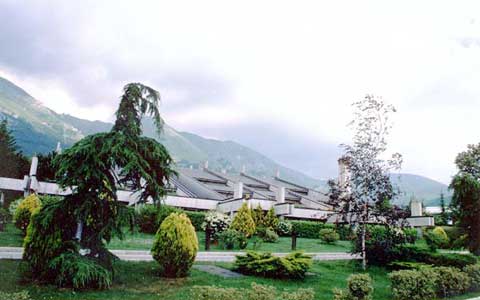
The Gran Sasso National Laboratory (LNGS) is one of four INFN national laboratories.
PERIMETER INSTITUTE RECORDED SEMINAR ARCHIVE
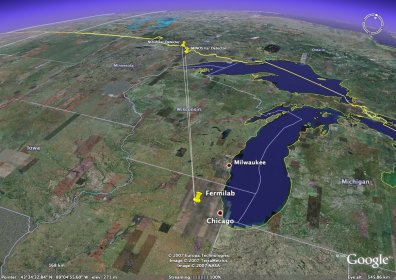
Using the NuMI beam to search for electron neutrino appearance.
The NOνA Experiment (Fermilab E929) will construct a detector optimized for electron neutrino detection in the existing NuMI neutrino beam. The primary goal of the experiment is to search for evidence of muon to electron neutrino oscillations. This oscillation, if it occurs, holds the key to many of the unanswered questions in neutrino oscillation physics. In addition to providing a measurement of the last unknown mixing angle, θ13, this oscillation channel opens the possibility of seeing matter/anti-matter asymmetries in neutrinos and determination of the ordering of the neutrino mass states.See:The NOνA Experiment at Fermilab (E929)
 |
Image from a neutrino detection experiment. (Credit: Image courtesy of Southern Methodist University)
Hunting Oscillation of Muon to Electron: Neutrino Data to Flow in 2010; NOvA Scientists Tune Design |
Bee:And for all I know you need a charge for Cherenkov radiation and neutrinos don’t have one.


 Dialogos of Eide