
Now, we must examine the conditions. Alberta, rich in natural resources—especially oil and gas—has long felt misunderstood or constrained by federal policies crafted in Ottawa or influenced by the needs of other provinces. Energy regulations, carbon taxes, and pipeline politics have stirred dissatisfaction, especially when juxtaposed with perceptions of central or eastern Canadian priorities.
But who fans these embers of alienation?
There are indeed voices—think tanks, media outlets, and political actors—some funded directly or indirectly through U.S. interests, that influence public discourse. These may emphasize narratives of Western alienation, resource sovereignty, and economic self-determination. Some organizations south of the border have funded environmental opposition to Alberta’s energy projects—ostensibly to protect climate interests, though critics argue these efforts inadvertently (or intentionally) favor American energy dominance.
Yet one must ask: do these influences create the sentiment, or merely amplify what is already smoldering? Can one seduce a soul not already restless?
And if indeed the United States—or factions within it—benefit from a divided Canada, or a weakened Alberta, should we not also consider cui bono: who profits from discord, and who benefits from unity?
Let us also not forget the role of local actors in Alberta—those who, for political or economic reasons, may court the rhetoric of separation or autonomy. Not all foreign influence is coercion; some is invited, some imitated, and some made convenient by internal grievance.
Alberta Separatist Media and Western Alienation
Western alienation has long percolated in Alberta politics; recent analysis notes that roughly 27 % of young Albertans now support outright independence . A variety of online outlets and blogs have amplified these grievances. Prominent examples include Rebel News, The Western Standard, the True North Centre (True North/Juno News), and The Post Millennial. Each is ideologically right‐leaning and has cultivated an audience receptive to Alberta’s “fair deal” and separatist rhetoric.
Rebel News (The Rebel Media): A far‑right Canadian commentary site founded in 2015 by Ezra Levant and Brian Lilley . Rebel promotes populist, pro‑oil, anti-immigrant and climate-skeptical views . It operates on a crowdfunded model (donations and paid subscriptions) and famously partnered with U.S. alt‑right groups (e.g. New York’s Gatestone Institute, funded by Trump donor Robert Mercer) to produce anti-Muslim propaganda . Rebel News has grown a large online following (over 900,000 YouTube subscribers by 2018 ) and frequently headlines Western grievances. Its content often resonates with U.S. far‑right media trends, although its funding remains chiefly grassroots and Canadian.
The Western Standard: A Calgary-based conservative news website re-launched in 2019 by former Alberta MLA Derek Fildebrandt . Originally co-founded by Ezra Levant (2004), it emphasizes free-market and pro‑energy policies from a Western perspective. Its ideological bent is mainstream right‑wing (pro-oil, pro-gun rights, etc.). The site is funded by subscriptions and advertising , with all shareholders based in Alberta . It has no obvious U.S. backers, but it has given space to Alberta autonomy themes (for example, publishing polls suggesting ~45% of Albertans favor independence ). The Western Standard’s reach is mainly regional, but it is influential among provincial conservatives and has been cited by national media on separatism discussions.
True North Centre for Public Policy (True North/Juno News): A right-wing media outlet and think-tank founded circa 2019 (evolving from a pre-existing charity) by former Sun News columnist Candice Malcolm (who remains Editor‑in‑Chief) . Its focus is hard-right: anti‑climate-change, anti‑immigration, and pro-Alberta. True North has drawn significant funding from energy-sector donors; for instance, ex-Encana CEO Gwyn Morgan donated about $530,000 since 2019 . Malcolm and associates (e.g. William McBeath, former Wildrose aide) align closely with Alberta’s UCP leadership , and True North has hosted events featuring Premier Danielle Smith . It is a registered charity claiming a journalistic mission, but its social media engagement is explicitly partisan. Researchers found True North generated over 300,000 Facebook interactions on climate/energy posts in one year—more than established outlets —and commentators note its “very, very close” ties to the Smith government . There are no known U.S. funding partners, but its style and content echo global right-wing networks.
The Post Millennial: A Canadian online news site founded in 2017 by Matthew Azrieli and Ali Taghva . It features national and local news with a heavy dose of opinion. Since 2022 it has been owned by U.S. Human Events Media Group (publisher of the U.S. right-wing Human Events) , explicitly linking it to American conservative media. Media watchdogs label it “far-right” . The Post Millennial has given a platform to Alberta separatist voices (e.g. hosting Cory Morgan, a Western Standard columnist and Wildrose Party co-founder, on its “Western Voice” show ). Its business model is advertising and donations via its U.S. parent. The site’s online reach is substantial (on the order of 100–200k monthly visits around 2019 ) and it actively courts social-media audiences. Through U.S. ownership and contributors, it ties into broader North American right-wing discourse.
Each outlet thus brings Alberta discontent to an audience beyond the mainstream press. Collectively they lean rightward, often framing Western grievances as ideological or even cultural battles. Funding patterns (crowdfunding for Rebel, corporate and donor support for True North, US investment in PostMillennial, etc.) and occasional U.S. partnerships (as with Rebel’s Mercer-funded videos) show that while these platforms are Canadian, they resonate with a North American conservative network. In sum, these blogs and media sites play a key role in shaping separatist sentiment by amplifying what-albertans-want narratives: they give an echo chamber to anti-Ottawa rhetoric, and in some cases foster direct ties (e.g. “Wexit” advocacy and contacts in U.S. political circles ).
1. Rebel News
YouTube Channel: Rebel News Subscribers: Over 1.6 million Content: Daily videos with strong editorializing, focusing on anti-Trudeau, pro-oil, anti-COVID mandates, and pro-Western autonomy narratives. Influence: Enormous reach. One of the most prominent alt-media voices in Canada; its style mirrors U.S. right-wing channels like Breitbart or PragerU.
2. Western Standard
YouTube Channel: Western Standard Subscribers: Approximately 7,000–10,000 (variable; may grow quickly during political events) Content: Interviews, news summaries, and commentary, often including Alberta-first narratives, interviews with UCP and Wildrose figures, and content on Alberta independence. Influence: Niche, but influential among conservative political watchers in Western Canada.
3. True North (True North Centre for Public Policy)
YouTube Channel: True North Subscribers: Over 140,000 Content: “The Candice Malcolm Show,” “Fake News Friday,” and commentary on immigration, energy, and Western alienation. Framing is distinctly conservative-nationalist. Influence: Moderate to high—especially through YouTube and Facebook. Highly polished productions, increasingly accepted as “alternative journalism.”
4. The Post Millennial
YouTube Channel: Does not maintain a major standalone channel under its own name. Alternative Presence: Content is often republished through affiliated U.S. channels, especially Human Events (its parent company), and used by influencers such as Andy Ngo. Influence: While YouTube isn’t its main platform, it gains traction through Twitter, Facebook, and guest appearances.
Summary of Alberta/Western Separatist Outlets

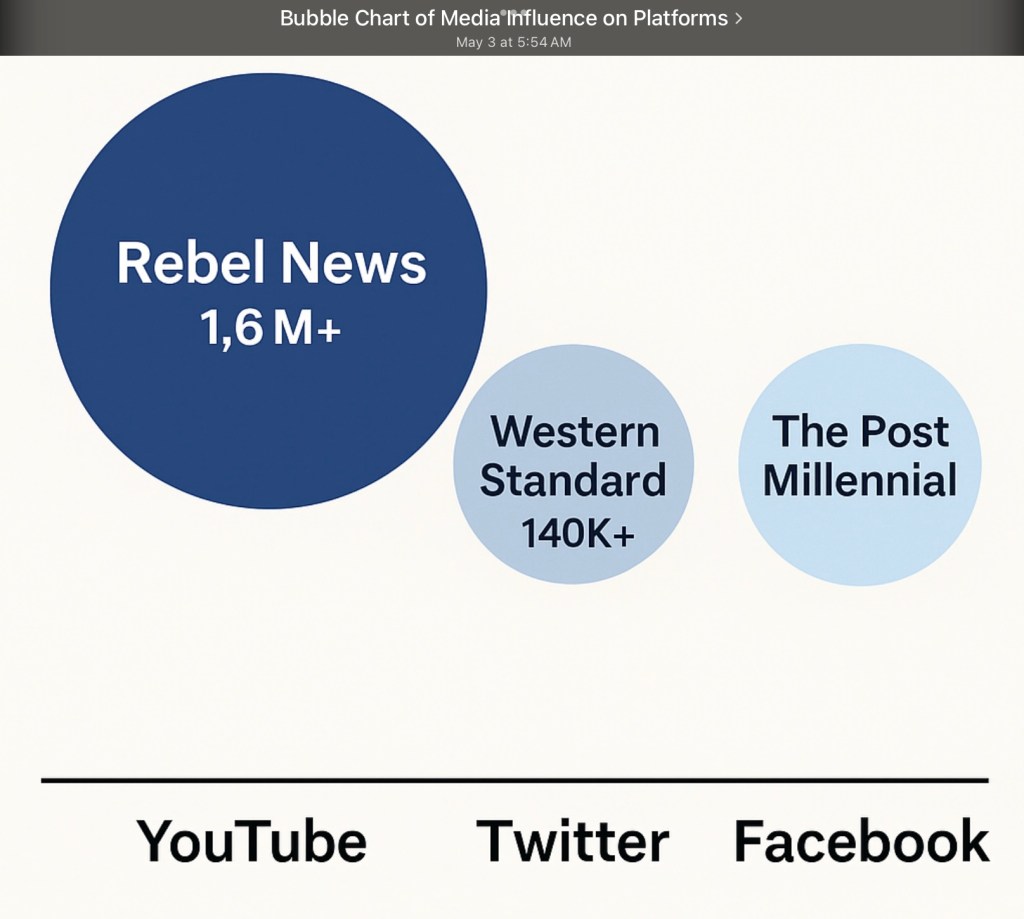
Here is the visual diagram requested, showing the influence of Rebel News, Western Standard, True North, and The Post Millennial across YouTube, Twitter (X), and Facebook:
Media Influence Comparison – Summary
This diagram compares the influence of four Canadian right-wing media outlets – Rebel News, Western Standard, True North, and The Post Millennial – across three major digital platforms: YouTube, Twitter (X), and Facebook.
Key Observations:
• Rebel News demonstrates the highest influence on YouTube, with significant video production and a large subscriber base.
• True North shows strong presence across all three platforms, particularly in Facebook and YouTube engagement.
• The Post Millennial excels on Twitter (X), often due to viral short-form content and U.S.-based amplification.
• Western Standard maintains a steady but more modest influence across all platforms, with a focus on Alberta-centric content.
These influence levels are assessed based on audience size, content reach, and platform engagement, and reflect each group’s role in shaping public discourse related to Alberta separatism and Western alienation.
See: Alberta Separatists Push to Leave Canada After Liberals Win Election
See Also: Is Canada About to Break Apart?

 Dialogos of Eide