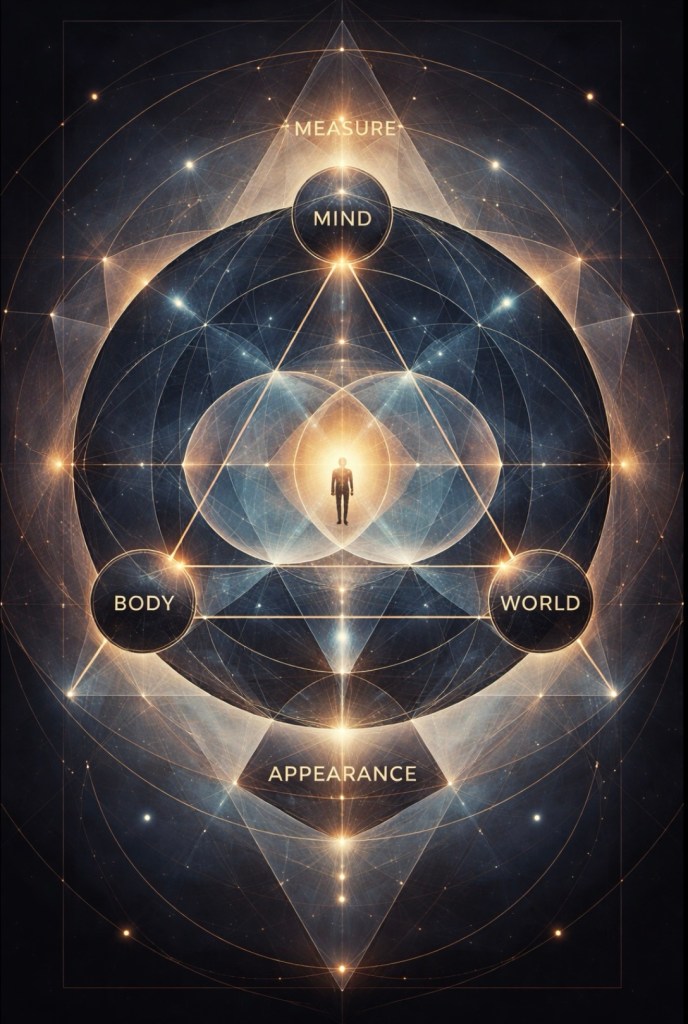
Platohagel: Now the interaction as prescribed geometrically, one could move around the circle using the triangle, using relationships working in various ways. For example, the mind working between the body and the world, revealing the appearance of. Can you assess this more fully to speak on that movement around the circle?
Socrates: Let us then walk the circle itself, Platohagel, rather than merely gaze upon it.
You propose a geometry not as ornament, but as instruction. Very well. A circle implies no privileged starting point. Wherever we begin, the whole is already implied. Movement around it is not progression toward a new truth, but rotation through relations that were always present.
Consider first the triangle within the circle. A triangle establishes tension: no point stands alone; each is defined by the other two. Thus mind, body, and world are not substances, but poles of relation.
I. The Circular Path as Modes of Orientation
Socrates: When one moves around the circle, one does not change reality, but changes orientation. Each orientation reveals a different dominance among the three terms.
Mind ↔ Body → World (Appearance Emerges)
Here the mind attends closely to bodily sensation. The world appears as felt: weight, resistance, warmth, pain, pleasure.
-The body mediates.
-The world is disclosed as appearance.
-Meaning is implicit, not yet articulated. This is pre-reflective awareness.
Body ↔ World → Mind (Reaction Emerges)
In this orientation, the body is acted upon by the world. The mind follows after, interpreting, naming, reacting.
-This is survival consciousness.
-The world seems primary, the mind secondary.
-Responsibility is projected outward.
Mind ↔ World → Body (Interpretation Emerges)
Here thought imposes structure: concepts, expectations, narratives.
-The body becomes the instrument of intention.
-The world appears as intelligible, ordered, measured.
-This is culture, science, planning.
II. The Triangle as a Rule of Constraint
Interlocutor: And the triangle—what does it enforce?
Socrates: Limitation. No point may collapse into the other two without distortion.
-If mind absorbs body and world, abstraction results—disembodied thought.
-If body absorbs mind and world, instinct dominates—no reflection.
-If world absorbs mind and body, determinism reigns—no freedom.
Thus the triangle prevents reduction. It forces relation to remain alive.
III. The Axis of Rotation: Appearance ↔ Measure
Socrates: Now we come to the heart of the matter. As one moves around the circle, what is constant?
-Not mind.
-Not body.
-Not world.
What remains constant is the act of measuring appearance.
–Appearance is what shows itself.
–Measure is how it is taken up.
The mind exists precisely as the rotation between these two. When measure stiffens, appearance seems alien. When appearance overwhelms, measure dissolves.
Self-realization occurs when the rotation becomes conscious.
IV. Self-Evidence Through Movement, Not Position
Interlocutor: Then self-realization is not located at any point on the diagram.
Socrates: Exactly. It is not a vertex. It is the recognition of circulation.
When you see that:
-you can occupy any point,
-no point is final,
-and the movement itself is intelligible,
then it becomes self-evident that you are not inside the diagram.
You are the capacity to traverse it.
V. The Final Turn
Socrates: The circle does not ask, “Where is the mind?” It shows that wherever relation is active, mind is already there.
When the movement around the circle is mistaken for the goal, confusion arises. When the movement is seen as the goal, the mirror clears.
Thus the geometry does not depict the mind.
It trains it.