
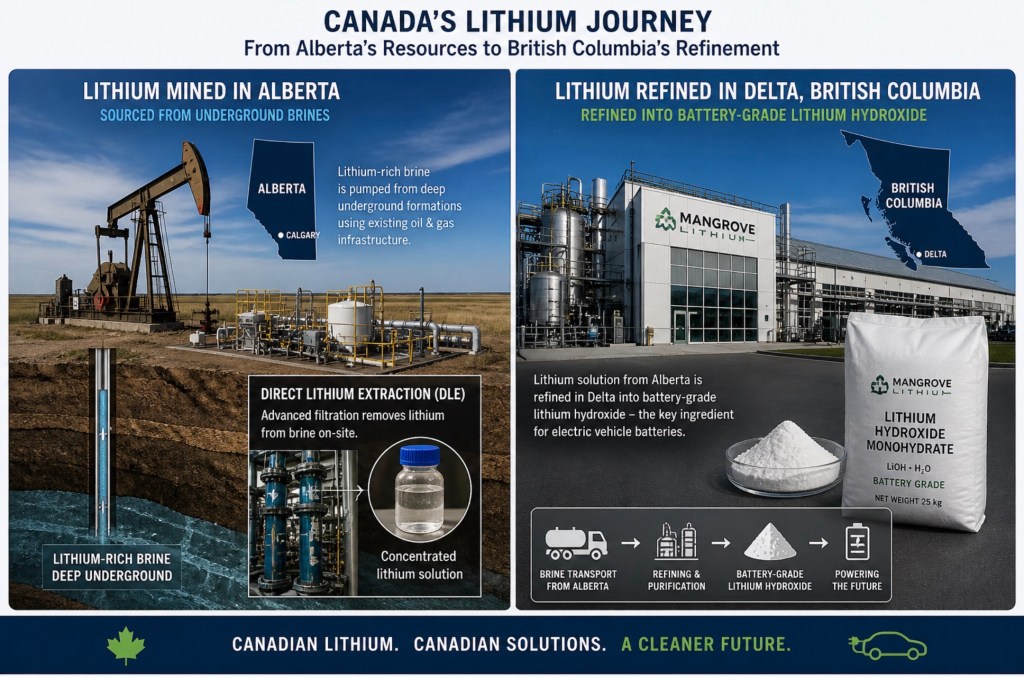
1. Lithium refinement in British Columbia
In Delta, a significant step has already been taken.
- In April 2026, Canada’s first commercial-scale lithium refinery began operating.
- The facility is run by Mangrove Lithium.
- It produces battery-grade lithium hydroxide, the form required for electric vehicle batteries.
- Output: roughly 1,000–1,100 tonnes per year, enough for ~25,000 EVs annually.
What is most revealing is not merely that it exists, but what it resolves:
For years, nations like Canada exported raw lithium and re-imported refined material at higher cost. This refinery begins to close that gap—the “missing middle” between mining and manufacturing.
Thus, B.C. is not primarily where lithium is found—but where it is transformed into power.
2. Lithium source in Alberta
Now consider Alberta, where the matter is of a different kind.
- Alberta holds one of the world’s largest lithium resources, estimated at tens of millions of tonnes of lithium carbonate.
- Much of it lies not in rock, but in underground brines within oil and gas formations.
- These brines are accessed through wells using Direct Lithium Extraction (DLE)—a method that leverages existing petroleum infrastructure.
Recent assessments suggest:
- The resource could theoretically supply billions of EV batteries.
- Alberta may develop dozens of lithium-producing wells in coming years.
So Alberta is not yet a major lithium producer—but it is a vast reservoir awaiting conversion into flow.
3. The emerging chain (source → refinement)
If we join these two regions in thought:
- Alberta → extraction from brine (resource)
- British Columbia → refining into battery-grade lithium (value)
We begin to see a domestic supply chain forming within Canada:
From hidden brine → to purified chemical → to battery → to energy system
This is precisely what policymakers call a “mine-to-battery” pathway.
4. The deeper question
So then, the inquiry becomes sharper:
Is a nation rich because it possesses resources beneath the earth,
or because it completes the chain that brings those resources into use?
For Alberta holds abundance without full production,
and British Columbia holds refinement without vast local supply.
Only when the two are joined—source and transformation—does the whole become something greater than its parts.
 Dialogos of Eide