
1. The present condition of the pipeline
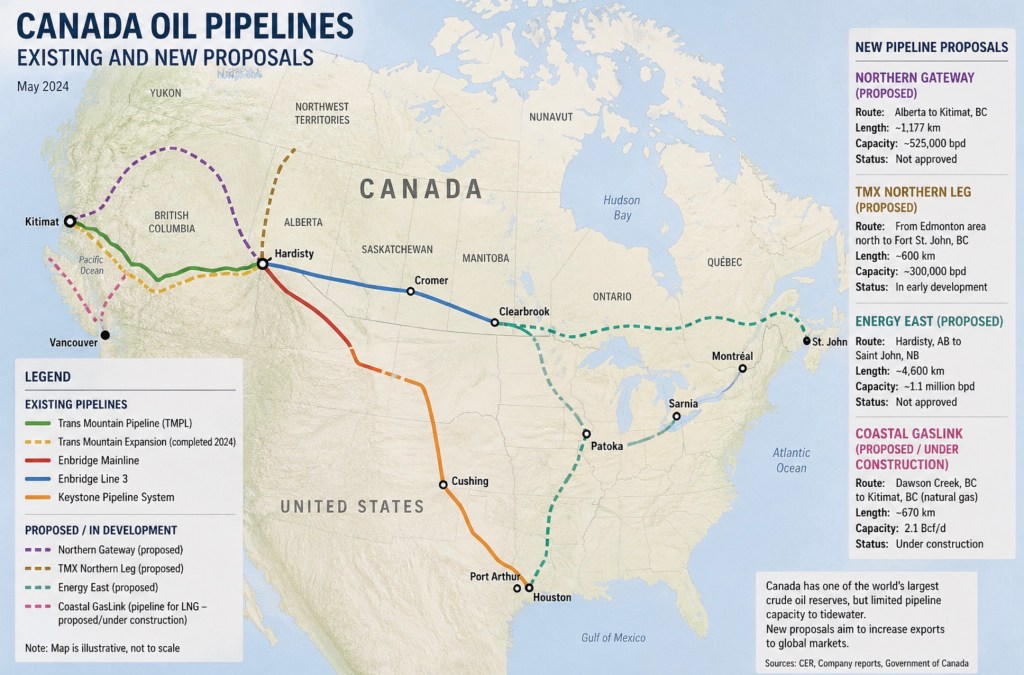
Canada’s only oil pipeline to the Pacific coast is the Trans Mountain system, running from Edmonton to Burnaby. Its recent expansion (completed in 2024) increased capacity from about 300,000 to ~890,000 barrels per day.
Yet even now, reports indicate it is close to full utilization (around 80–90% or more), meaning most of that capacity is already spoken for by shippers.
So the first truth:
there is little “empty space” left to simply pour more oil into.
2. Can capacity still be increased without a new pipeline?
Yes—but only in limited and incremental ways. Consider these like refining the flow of water through a pipe rather than widening the pipe itself:
(a) Optimization of existing infrastructure
- Adding more powerful pump stations
- Using drag-reducing agents (chemicals that reduce friction)
- Improving scheduling and batching of products
These methods can raise throughput modestly.
There are already plans to push capacity toward ~1.19 million barrels/day by ~2027–2028 through such optimizations.
(b) Commercial allocation changes
- Reassigning pipeline space (contracts, “open seasons”)
- Increasing utilization of currently underused segments
This does not increase physical capacity, but may increase effective flow for certain producers.
(c) Minor physical additions
- Looping short segments (adding parallel pipe in constrained sections)
- Expanding terminals and storage
These are still “within the system,” but begin to approach small-scale construction.
3. What cannot be escaped
Here is the constraint that governs all:
- Pipelines have hydraulic limits (pressure, safety, pipe diameter)
- Bitumen (especially diluted bitumen) is heavy and viscous, making flow harder to increase than lighter crude
- Environmental, regulatory, and terrain constraints (Rockies, populated corridors) limit modifications
Thus, beyond a certain point, optimization yields diminishing returns.
4. The deeper conclusion
So we arrive at a distinction:
- Short-term increase → yes, modestly, through optimization
- Meaningful large increase → no, not without new infrastructure
Indeed, even industry voices note that significant export growth requires additional pipeline capacity, not merely better use of existing lines.
5. The underlying question
One might then ask:
Is the question truly about engineering—or about limits imposed by prior decisions?
For the pipeline, like a vessel, may be made smoother within;
but if it is already near full,
then the choice becomes not how to push more through,
but whether to build another path altogether.
Yes — there is discussion and early-stage interest in a Churchill, Manitoba export corridor, but it is important to separate proposal, concept, and feasibility.
Churchill (Hudson Bay) pipeline idea
There is a recurring concept sometimes called a “Churchill trade corridor” or “Hudson Bay export route”, which includes:
- A possible oil pipeline from Alberta to northern Manitoba
- Connection to the Port of Churchill
- Shipping crude out through Hudson Bay to international markets
This is not a single approved project, but a bundle of proposals and political concepts that has reappeared over decades.
Recent renewed interest (2025–2026)
Recent reporting shows renewed attention:
- Manitoba’s government has discussed a broader “Churchill Plus” corridor
- It includes exports of oil, gas, minerals, and agriculture
- Some private-sector companies are quietly evaluating feasibility
- Federal and provincial leaders have signaled interest in upgrading Churchill as a trade hub
So yes: Churchill is back in the discussion cycle.
But is there an actual pipeline proposal right now?
Key distinction:
✔ There is:
- Political discussion
- Corridor planning concepts
- Private-sector “exploration” and NDAs
- Port expansion studies
❌ There is NOT:
- A fully engineered, approved oil pipeline project to Churchill
- A confirmed route, cost, or construction timeline
- Final Indigenous consent agreements
- Regulatory approval
Why Churchill is difficult (core constraint)
Even among engineers and economists, major obstacles remain:
- Hudson Bay is ice-covered ~7 months/year
- Pipeline would likely be 1,000+ km through muskeg/permafrost
- Extremely high capital cost
- Port is seasonal and limited compared to West Coast terminals
Some analysts explicitly argue there is no strong economic case yet for oil pipelines to Churchill
How it fits into Canada’s pipeline system
If it were built, it would be a third export axis, alongside:
- West Coast (Trans Mountain system)
- U.S. Midwest/Gulf routes (Enbridge + others)
- Churchill (hypothetical Arctic/Hudson Bay route)
But today, Churchill is the least developed and most speculative of the three.
Direct answer
Yes — there is a conceptual proposal and ongoing discussion involving Churchill, Manitoba, including the possibility of an oil pipeline.
No — there is no approved or active pipeline construction project to Churchill at this time.

 Dialogos of Eide