You ask of “peak oil demand,” as if it were a single fixed summit in time. Yet those who study such matters do not agree on one year, but rather offer competing visions shaped by assumptions about technology, policy, and human desire.
Let us examine the principal views:
1. The International Energy Agency view
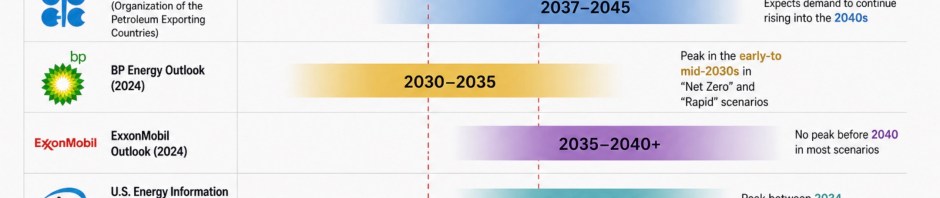
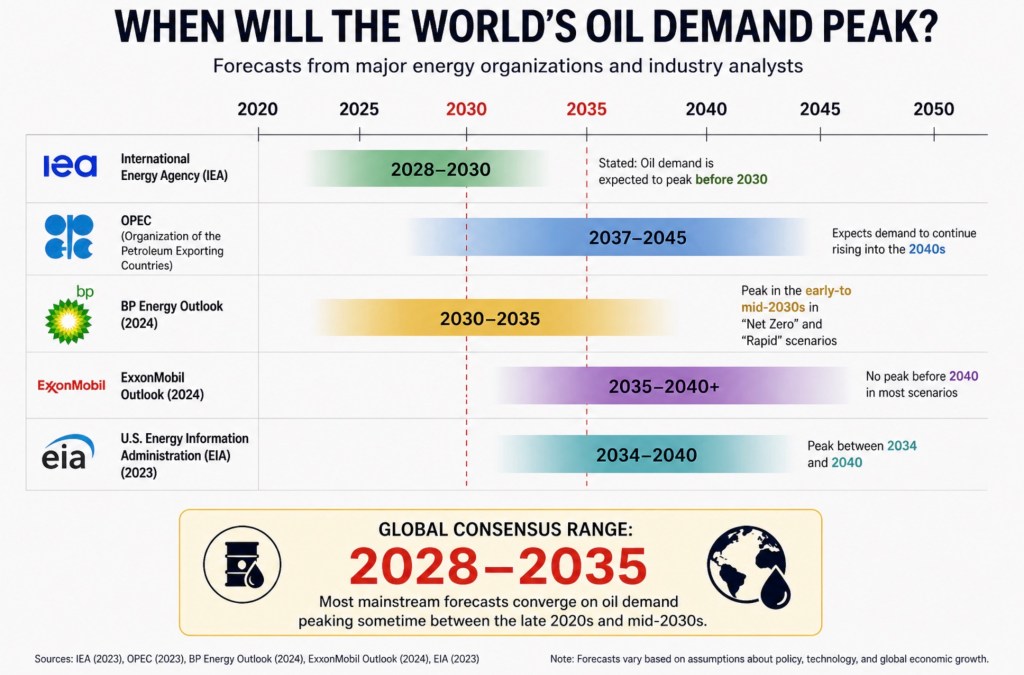
The International Energy Agency has stated that global oil demand is expected to peak before 2030, with many of its scenarios placing the peak around 2028–2030.
This outlook assumes:
- Rapid growth of electric vehicles
- Strong climate policies
- Slowing demand in advanced economies
2. Oil-producing nations’ view
Organizations such as OPEC argue that demand will continue rising beyond 2030, with no clear peak until the late 2030s or even 2040s.
This assumes:
- Continued growth in Asia, Africa, and the Middle East
- Slower energy transition
- Persistent reliance on petrochemicals and aviation fuel
3. Private sector and market analysts
Companies like BP and others tend to offer multiple scenarios:
- Accelerated transition: peak ~2025–2030
- Middle path: early-to-mid 2030s
- Delayed transition: no peak before 2040
4. What is actually observed now
Global oil demand is still near record highs (over 100 million barrels/day) as of the mid-2020s, with growth slowing but not yet reversing.
The essential insight
Peak oil demand is not like a mountain already discovered; it is more like a horizon that shifts as we walk toward it.
- If electrification and policy accelerate → peak comes sooner (late 2020s)
- If global growth and fossil reliance persist → peak comes later (2030s–2040s)
A distilled answer
Most mainstream forecasts converge on:
Peak oil demand: approximately 2028–2035 (with uncertainty extending into the 2040s).
And so one might ask in return:
Is the peak a fact waiting to be discovered—or a consequence of collective choices not yet fully made?

 Dialogos of Eide