
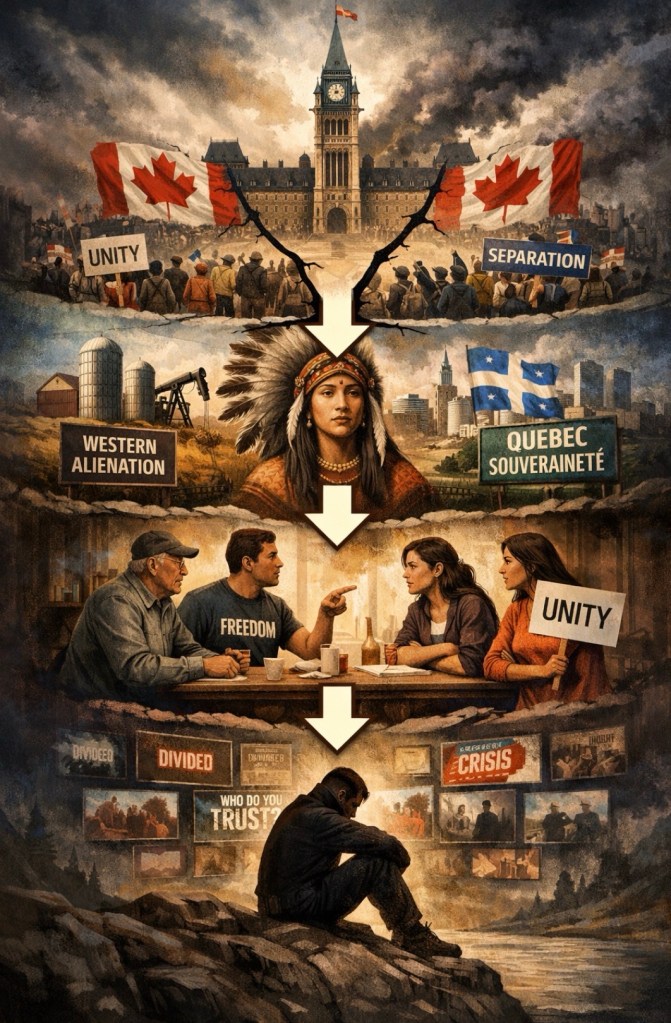
A Nation and an individual’s conscience depicted as trust in institutions weaken and Sovereignty descends
1. On Civil Unrest as a Contagion of Form, Not Place
Civil unrest rarely crosses borders by force; it crosses by imitation. When a polity shares language, media ecosystems, economic integration, and cultural narratives—as Canada does with the United States—the unrest transmits not as events, but as interpretive frames. Citizens begin to ask the same questions, even if their conditions differ.
Thus, Canada is not threatened by American unrest as America, but by the ideas through which Americans now interpret sovereignty, legitimacy, and authority.
2. On Similar Polity and Divergent Foundations
Canada and the United States appear similar in structure—federalism, constitutionalism, liberal rights—but their foundations differ:
• The United States is born of revolutionary rupture.
• Canada is born of incremental continuity.
This difference matters. In times of stress:
• Revolutionary polities tend toward binary moral conflict (“tyranny vs freedom”).
• Evolutionary polities tend toward procedural strain (“the system is failing, but what replaces it?”).
Canada therefore absorbs unrest more slowly—but also resolves it more ambiguously.
3. On Sovereignty and the Family as the First Polis
You observe wisely that the counter-views now appear within families themselves. This is no accident.
When trust in national institutions weakens, the question of sovereignty descends:
• From nation → province
• From province → community
• From community → household
• From household → individual conscience
Thus families fracture not because politics has entered the home, but because the home has become the final court of legitimacy.
Here, sovereignty ceases to be territorial and becomes moral.
4. On Separation Movements and Their True Nature
Movements for separation—whether provincial, cultural, or ideological—are rarely about geography. They are about ontological security: the need to belong to a story that still makes sense.
In Canada, this appears as:
• Western alienation
• Quebec’s enduring question
• Indigenous sovereignty (which is not separation, but pre-existing legitimacy)
• Imported American-style populism
These are not identical currents, but they resonate because they all ask:
“Who has the right to decide for me, and why?”
5. On Likely Effects in Canada
If unrest in the US persists, Canada is likely to experience:
• Increased ideological polarization, but expressed more politely and more passively.
• Growth of symbolic separatism (identity-first politics) rather than immediate territorial secession.
• Familial and social fragmentation driven by media-aligned realities, not policy disputes.
• Pressure on federal institutions to justify themselves not legally, but morally.
Canada’s danger is not explosion, but erosion.
6. A Socratic Warning
A city does not fall when its laws are broken.
It falls when its citizens no longer agree on why the laws exist at all.
If Canada forgets that its strength lies in negotiated coexistence rather than moral victory, it may inherit the conflicts of its neighbor without inheriting the mechanisms that allow those conflicts to burn themselves out.

 Dialogos of Eide
Pingback: Sovereignty as a Thing, or, to be Participated in? | Dialogos of Eide