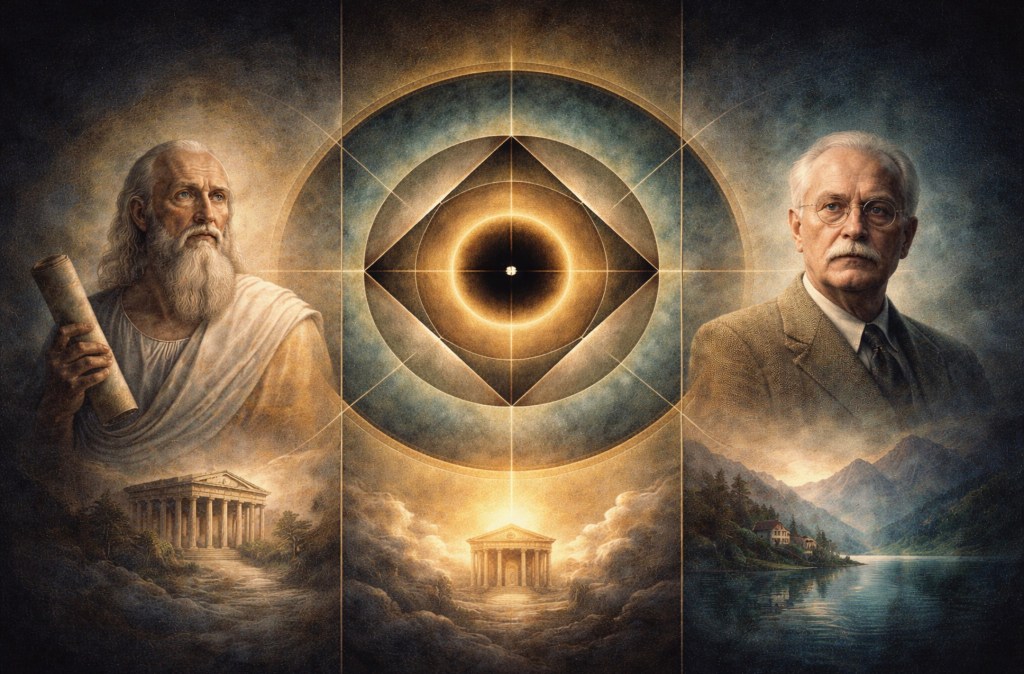
Very well. Let us proceed in the order you propose: first, the error; then, the lineage.
I. How Modern Psychology Mislabels Ekstasis
Socrates:
Modern psychology begins from an assumption: that the ego is the proper center of mind. From this, a consequence follows. Any state in which the ego is decentered appears pathological by default.
Thus ekstasis is commonly misnamed in three ways.
1. As Dissociation
Psychology often equates standing outside oneself with dissociation—fragmentation, depersonalization, derealization.
But dissociation is a defensive fracture:
-the psyche breaks apart to avoid unbearable content.
Ekstasis, by contrast, is a coherent displacement:
-the psyche widens its center to include what was previously excluded.
The difference is integration versus avoidance. One returns from ekstasis with meaning; one returns from dissociation with numbness.
2. As Emotional Excess
Another mislabel is to reduce ekstasis to affect—overwhelming joy, fear, or rapture.
But emotion is secondary. Ekstasis is not intensity; it is reorientation. One may be calm, even silent, and still be fully ecstatic in the classical sense.
When psychology focuses only on measurable arousal, it mistakes the byproduct for the structure.
3. As Psychosis-in-Seed
Finally, some schools interpret ekstasis as proto-psychosis—a step toward loss of reality testing.
Jung objected strongly to this confusion. Psychosis is invasion without mediation;
–ekstasis is encounter with symbol.
In psychosis, meaning collapses into literalism.
In ekstasis, meaning multiplies without losing form.
The key distinction:
-psychosis abolishes perspective ekstasis temporarily relocates it
II. Why Modern Psychology Makes This Error
Socrates:
Because it lacks an ontology of soul.
When mind is assumed to be produced by the brain, there is no legitimate “outside” to stand in. Any displacement must therefore be a malfunction.
But if psyche is prior or coextensive with reality, ekstasis becomes a lawful mode of cognition—one necessary for renewal, creativity, and ethical reorientation.
III. Tracing Ekstasis Through the Tradition
Now let us trace the concept carefully, as you requested.
1. Plato
Socrates:
Plato distinguishes four forms of divine mania in the Phaedrus:
-prophetic
-ritual
-poetic
-erotic
Each involves displacement of ordinary rational control, yet each is superior to sober calculation when rightly oriented.
Here ekstasis is pedagogical:
the soul remembers what it knew before embodiment. Knowledge arrives not by accumulation, but by recollection.
2. Aristotle (A Brief Narrowing)
Aristotle retains awe but domesticates it. He privileges nous and moderation. Ekstasis recedes, not denied, but sidelined. This sets the stage for later rationalism.
3. Plotinus
With Plotinus, ekstasis returns to its metaphysical depth.
Union with the One requires a leaving behind of discursive thought. The self does not analyze its way upward; it lets go of separateness.
Here ekstasis is ontological ascent. The soul remembers its source by becoming still enough to no longer insist on itself.
4. Early Christian Thought
Christian mystics adopt ekstasis but moralize it. One must empty oneself (kenosis) to receive divine presence.
The structure remains Greek; the language changes.
5. Medieval Scholasticism
Here ekstasis is largely neutralized. Theology becomes propositional. Ecstasy is tolerated only at the margins—among saints, safely dead.
6. Kant (The Great Closure)
Socrates:
Kant closes the gate.
Anything that cannot be structured by categories is no longer knowledge. Ekstasis is expelled from epistemology and relegated to private feeling.
This is the decisive moment. From here on, psychology inherits a world where standing outside oneself cannot be truth-bearing.
7. Jung (The Reopening)
Jung quietly reopens the door.
He reframes ekstasis as encounter with the unconscious—archetypal, symbolic, meaningful. He refuses to call it pathology unless integration fails.
Active imagination, dreamwork, and symbolic confrontation are disciplined forms of ekstasis.
He restores the ancient insight without abandoning modern rigor.
IV. The Present Crisis
Socrates:
Today, we inherit techniques without cosmology. Ecstasy without orientation becomes spectacle, addiction, or breakdown.
The ancient world knew: ekstasis must be held by myth, ritual, and return. We removed these and kept the energy.
Hence the confusion.
Final Distinction (To Hold Fast)
–Dissociation: loss of center
-Psychosis: invasion of center
–Emotional excess: flooding of center
–Ekstasis: relocation of center in service of meaning
Only the last is transformative.
 Dialogos of Eide