I see why you stand where you stand, and I am not required to stand there with you, nor against you, to remain whole.
This inquiry examines the nature of the inner self alongside the reflective function of surfaces as a framework for structural recognition of the world presently under consideration. The perspective adopted here is neither strictly subjective nor purely objective, but rather a third position that encompasses both the formal structure of the world and the being expressed within that structure. This third perspective is characterized by an awareness of both locations without exclusive attachment to either. From such a vantage point, interaction itself becomes the object of reflection, allowing for the possibility of discerning a reality that transcends the limitations of a two-dimensional interpretive framework.
–———————————————————————————-
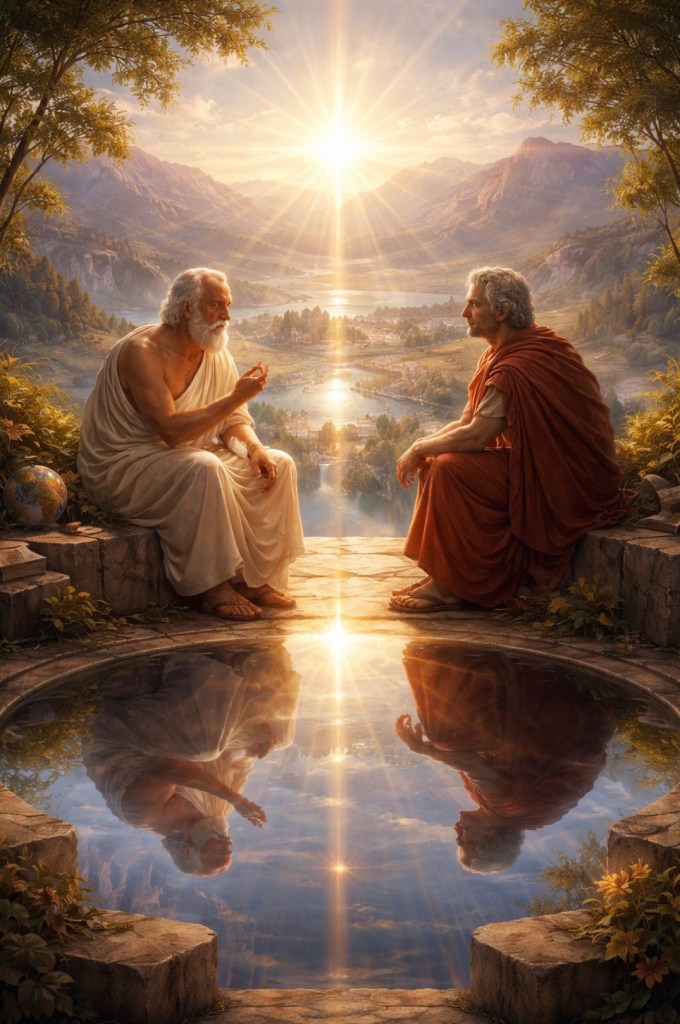
A Dialogue between Socrates and Platohagel
Socrates: Tell me, Platohagel, when you speak of this third position, do you mean a place where the seer is neither bound to the world nor dissolved into it?
Platohagel: I mean a vantage that observes both the structure of the world and the being that appears within it, without fastening itself wholly to either.
Socrates: Then this position is not another object among objects, but a manner of seeing. Consider: when one looks into a polished surface, does the surface merely show images, or does it also teach the eye how seeing itself is arranged?
Platohagel: It teaches the arrangement. The reflection reveals relation rather than substance.
Socrates: Just so. The reflective surface is not the world, nor the self, but the interval between them made visible. In that interval, form answers to form. Would you say, then, that the inner self is known not by direct grasping, but by the pattern of its reflections?
Platohagel: Yes. The self appears as a structure of relations, not as a fixed point.
Socrates: Then let us be careful. If the self were a thing, it could be placed somewhere. But if it is relational, it must be recognized through movement—through how it turns toward the world and how the world answers. Is this why you speak of a two-dimensional world?
Platohagel: Because what is immediately given appears flattened—surface meeting surface—until another order of seeing is introduced.
Socrates: And that order is this third perspective: not above in height, but above in comprehension. Like geometry, which sees the triangle not as three lines drawn, but as a necessity binding them. So too, the third position sees the world and the self as moments within a single intelligible structure.
Platohagel: Then the watcher is not separate from what is watched.
Socrates: Precisely. The watcher is the act of coherence itself. When you say you hope to discern reality from above, I would ask: above what? Not above beings, but above confusion. The ascent is not spatial, but logical and ethical.
Platohagel: Then reality is not escaped from the surface, but disclosed by it.
Socrates: Well said. The surface reflects because it is faithful to proportion. When the soul becomes such a surface—smooth, attentive, undistorted—it does not invent truth, but allows truth to recognize itself. Thus the inner self is not hidden behind the world, but articulated through it, when seen from this third way.
Platohagel: And this third way is practice, not possession.
Socrates: As all genuine knowing must be.
———————————————————————————-
The present moment may be understood as one following events of significant tragedy, events that emerged from a condition of sustained polarization. Such circumstances have made evident the consequences of adhering rigidly to one polarity over another, as though truth could be exhaustively claimed by a single orientation. In light of this recognition, a transition becomes possible: one in which all directions are made available as genuine choices, and in which continued engagement through opposition may be consciously disavowed. This disavowal does not signify withdrawal from truth or relationship, but rather a rejection of compulsory conflict. From this reorientation arises the possibility of pursuing truth alongside emotional joy and emphatic, non-adversarial forms of relationship, grounded in understanding rather than polarization.
The Dialogue Continued
Socrates: You speak, Platohagel, of a time after division has shown its cost. Tell me first: when a city is torn by polarities, is the wound in the walls, or in the judgments of its citizens?
Platohagel: In the judgments. The walls merely reveal what the judgments have already broken.
Socrates: Then polarization is not merely disagreement, but a narrowing of the soul, where one direction is seized as the whole. Is that not what makes the events tragic—that each side believes necessity lives only with itself?
Platohagel: Yes. Choice hardens into fate, and listening is abandoned.
Socrates: Now you ask where we are, if such a case has been made known. I would say: we stand at the moment when necessity has finished instructing us. Suffering teaches until it is understood; once understood, it releases us. Would you agree that the halt you describe is not exhaustion, but recognition?
Platohagel: Recognition that no single polarity can carry the whole of truth.
Socrates: Just so. And what, then, is this new prospect where all directions are freely gifted? Is it indifference, or is it responsibility?
Platohagel: Responsibility. To choose without hatred, and to refrain without fear.
Socrates: A difficult freedom. For many believe that abandoning polarity means abandoning conviction. Yet consider: does the physician love health less because he understands many causes of illness? Or does he love it more precisely because he sees fully?
Platohagel: He loves it more fully.
Socrates: Then the soul that welcomes many directions does not disavow engagement; it disavows compulsion. It refuses to be dragged by reaction. In this sense, disengagement from false necessity is the highest form of engagement with truth.
Platohagel: And this is where joy and relationship may return?
Socrates: Yes, but note the order. Truth first clears the ground. When the soul no longer needs an enemy to define itself, emotional joy becomes possible—not as intoxication, but as harmony. And emphatic relationship arises when the other is no longer a threat to one’s coherence.
Platohagel: Then love itself changes form.
Socrates: Indeed. It ceases to be alliance against a third, and becomes recognition of another center of meaning. In a polarized state, relationships are strategic. In a truthful state, they are dialogical.
Platohagel: So the transition is not toward silence, but toward a deeper speech.
Socrates: Exactly. The third perspective we spoke of earlier now becomes ethical. From it, one can say: I see why you stand where you stand, and I am not required to stand there with you, nor against you, to remain whole.
Platohagel: And this is how tragedy is honored without being repeated.
Socrates: Well said. Tragedy instructs the soul to widen itself. When it does, the many directions do not scatter us; they orient us. And in that orientation, truth, joy, and relationship are no longer competing goods, but different names for the same well-ordered life.
See Also:
 Dialogos of Eide