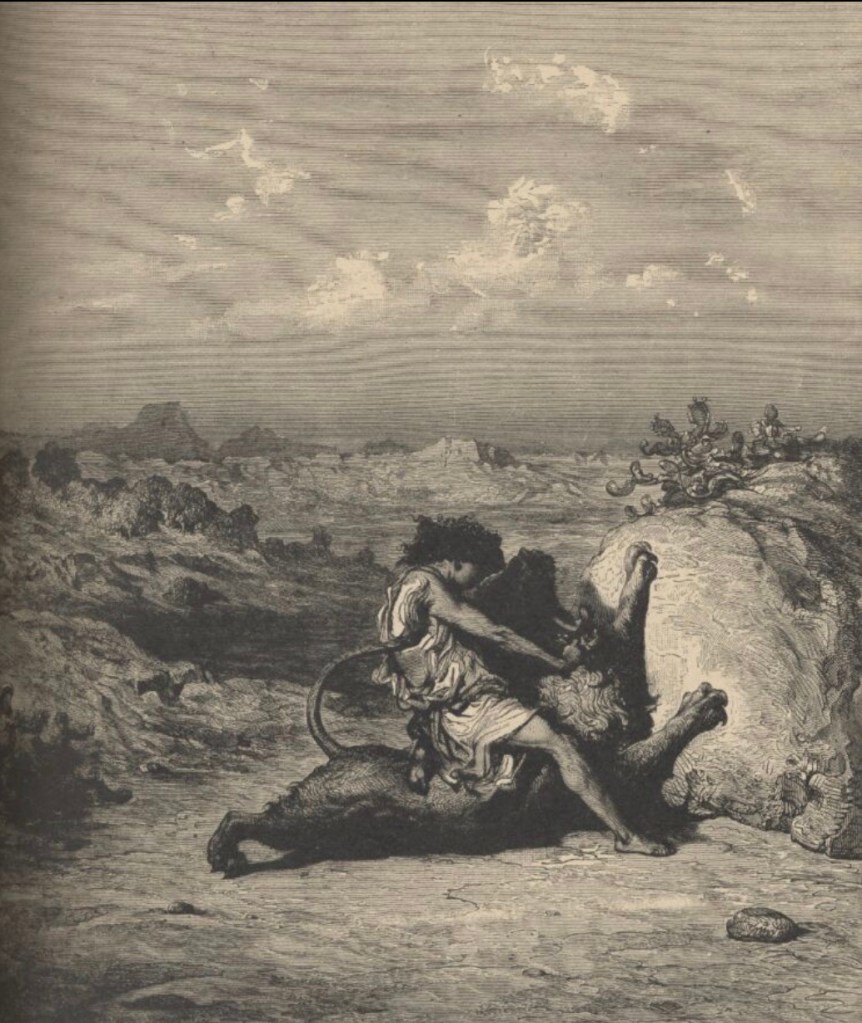
Samson Slaying The Lion by
Doré
Samson’s riddle is found in the biblical Book of Judges, where it is incorporated into a larger narrative about Samson, the last of the judges of the ancient Israelites. The riddle, with which Samson challenges his thirty wedding guests, is as follows: “Out of the eater came something to eat, and out of the strong came something sweet.”
The Riddle
Samson’s riddle – the only explicit example of a riddle in the Hebrew Bible[13] – has been described as an unfair one, as it is apparently impossible to guess the answer without knowledge of Samson’s encounter with the lion, which he had kept a secret from everyone.[14][15] Many commentators have therefore attempted to prove that the riddle is capable of other solutions.
Heymann Steinthal, writing in the late 19th century, observed that bees in ancient Palestine would have been at their most productive when the sun was in the sign of Leo, a fact which Samson’s guests ought to have known.
Hans Bauer suggested that the riddle was a play on words, positing that the original text of the story made use of an Arabic word for “honey” which, in Hebrew, would be identical to the word for “lion”. According to this theory, the riddle was etymological, with the solution being: “the word ‘honey’ was derived from the word ‘lion'”.
However, later scholars have been unable to confirm the existence of the Arabic word in question.
James L. Crenshaw has argued that possible solutions to the riddle include “vomit” and “semen”, which would both connect with the circumstances of the wedding feast. In support of the “semen” interpretation, Crenshaw cites several other passages in biblical writing in which eating and drinking are used as metaphors for sexual intercourse.
The solution offered by the wedding guests – “What is sweeter than honey, and what is stronger than a lion?” – also has the appearance of a riddle. Hermann Stahn suggested that this may have been a traditional wedding riddle, with the answer being “love”. Other potential solutions to this second riddle include “venom”, “death” and “knowledge”.
One Christian interpretation holds that the story of the riddle discloses “the entire divine logic governing Samson’s life”. Samson’s strength, throughout his story, is employed towards violent ends, but “something sweet” ultimately emerges from his actions; that is, the destruction of the enemies of Israel
See also: Samson’s riddle
 Dialogos of Eide