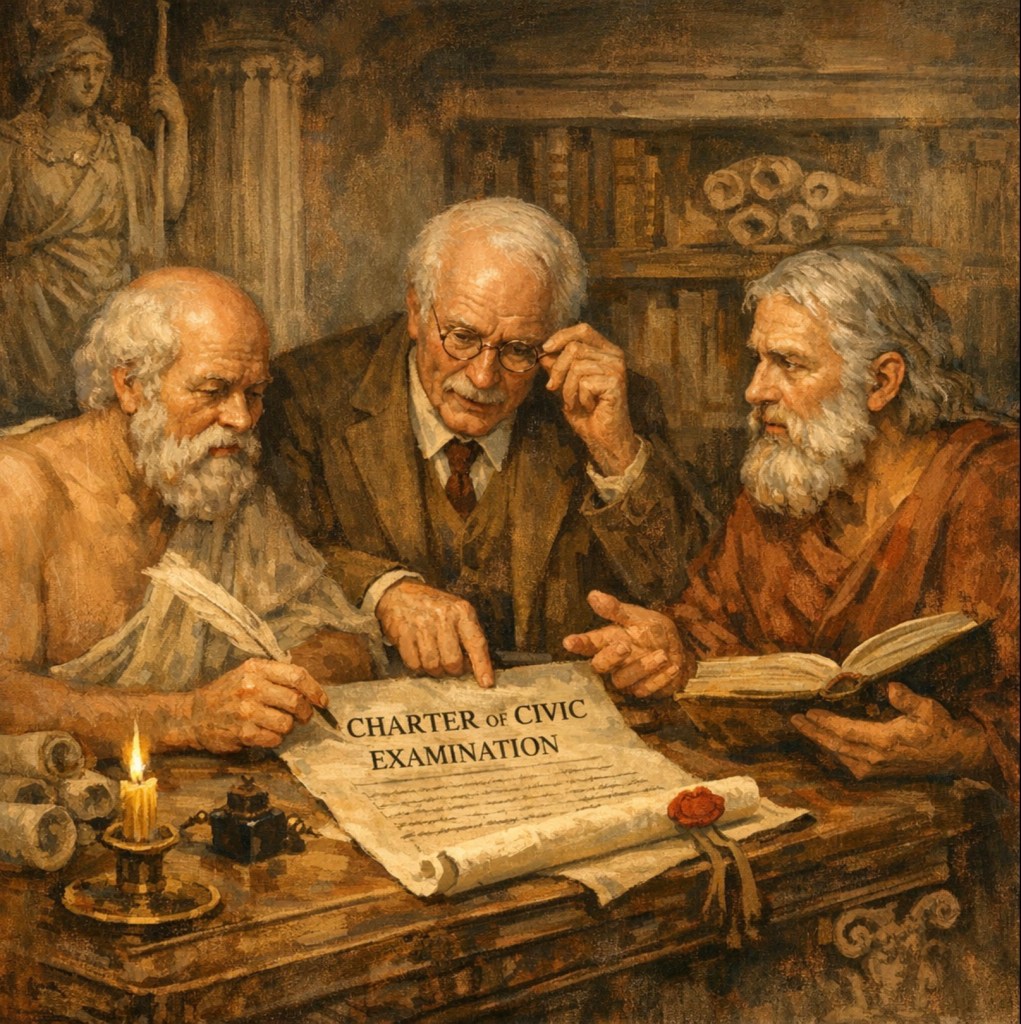
Socrates teaches how to ask.
Jung teaches what within us answers.
Plato teaches how the answers shape the city.
1. Preamble — the purpose of civic examination
2. Civic Axiom — the principle of the cycle
3. Charter — the commitments guiding civic conduct
4. Practice Formula — the operational cycle
5. Oath — the personal pledge that embodies the method
Preamble to the Charter of Civic Examination
We recognize that the health of a free society depends upon the integrity of its citizens and the clarity of their understanding. A community that refuses to examine itself becomes governed by unrecognized fears, hidden motives, and untested beliefs. From such neglect arise division, projection, and the decay of civic trust.
Therefore we affirm that the care of the civic body begins with the care of the soul. Through honest inquiry, reflection upon the hidden aspects of the psyche, and the disciplined pursuit of truth, individuals may restore coherence within themselves and contribute to the renewal of the common life.
Guided by the spirit of inquiry exemplified by Socrates, informed by the psychological insight of Carl Gustav Jung, and mindful of the civic philosophy articulated by Plato, we establish this Charter of Civic Examination.
Its purpose is to cultivate clarity, encourage disciplined questioning, acknowledge the presence of the shadow within individuals and institutions, and foster the integration that makes renewal of the civic order possible.
Through this practice we commit ourselves to an ongoing cycle of awareness, examination, and renewal, recognizing that the vitality of the polis depends upon the willingness of its citizens to examine both themselves and the world they share.
I. The Civic Axiom
Civic Axiom of Renewal
• Clarity awakens examination.
• Examination reveals the shadow.
• Recognition restores inner coherence.
• Coherence renews the civic body.
This form expresses the essential movement linking the soul and the polis. It reflects the spirit of inquiry associated with Socrates, the psychological insight of Carl Gustav Jung, and the civic vision of Plato.
II. The Guiding Civic Charter
Charter for Civic Examination
1. Seek clarity. Recognize contradictions in thought, action, and institutions.
2. Practice examination. Question beliefs openly and honestly.
3. Acknowledge the shadow. Recognize projections, fears, and hidden motives within oneself and the collective.
4. Integrate understanding. Align beliefs, actions, and responsibilities.
5. Renew the civic order. Shape dialogue and institutions according to truth and coherence.
6. Repeat the cycle. Renewal requires continuous examination.
This charter transforms philosophical insight into civic discipline.
III. The Shadow Principle
Recognition of the Shadow
The Charter acknowledges that individuals, communities, and institutions may act from motives not fully recognized by conscious intention. Unexamined fears, interests, resentments, and ambitions may influence judgment while remaining unseen.
Civic examination therefore requires that participants consider not only the stated intentions of actions and policies, but also the possibility of hidden influences within themselves and within the institutions they serve.
IV. The Practice Formula
Clarity → Examination → Shadow → Integration → Renewal
• Clarity opens awareness.
• Examination tests belief.
• Shadow reveals hidden forces.
• Integration restores balance.
• Renewal transforms civic life.
The sequence repeats as new clarity arises.
Civic Oath of Examination
I commit myself to the pursuit of clarity in thought and action.
I will examine my beliefs with honesty and humility, recognizing that certainty without inquiry leads to error.
I will acknowledge the shadow within myself before condemning it in others, and I will seek understanding before judgment.
I will examine not only the faults of others but the unseen motives within myself.
I will strive to align my words, my actions, and my responsibilities with truth.
In dialogue with others, I will pursue understanding rather than domination, knowing that the health of the civic body depends upon the integrity of its citizens.
Through continual examination and integration, I dedicate myself to the renewal of the common life we share.
—————————————————-
I have added to this page of charter a call to citizens to examine public life but have not yet added item III to downloadable Pdf. So here for now I give a means to examine ourselves. Otherwise inquiry becomes accusation rather than wisdom. Let us therefore place the Shadow principle directly within the Charter of Civic Examination so it stands as a structural part of the civic method.
 Dialogos of Eide