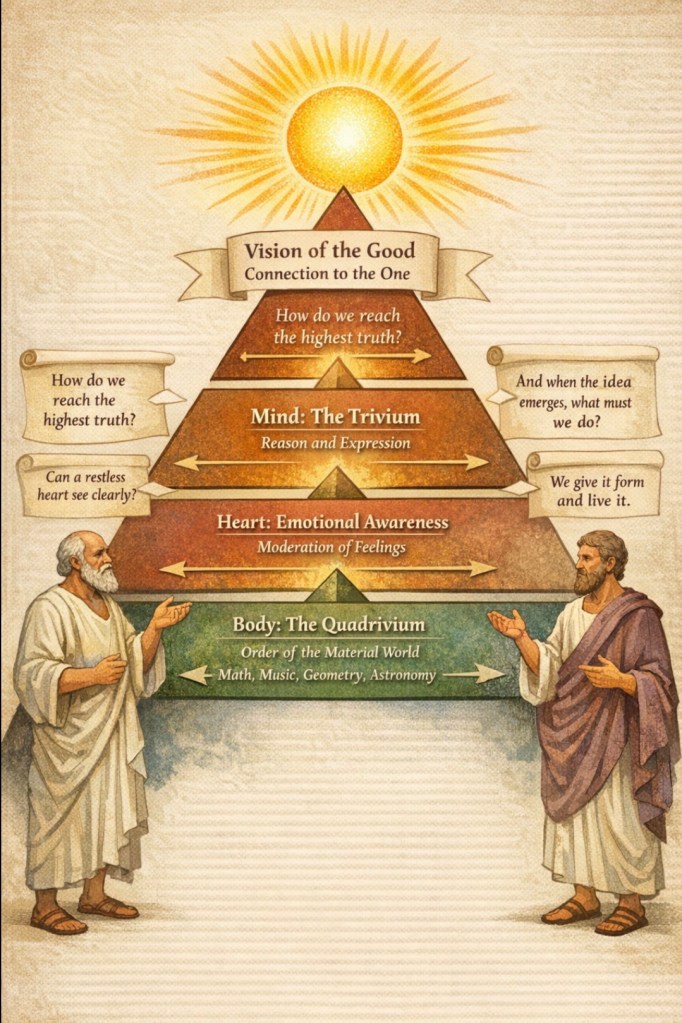
This dialogue mirrors the pyramid structure: foundation in reality, integration of emotion, discipline of mind, receptivity to ideas, and expression of virtue and creativity. It also preserves the Socratic method: questions guide the ascent, rather than answers imposed.
Socratic Dialogue Reflecting the Pyramid Method
Characters:
Socrates – the questioning guide, persistent in inquiry.
Plato – the student and interlocutor, attempting to understand the ascent toward the Good.
——————————————
Socrates: Tell me, Plato, when a man examines what he already knows, what does he find?
Plato: He finds that some things are clear, self-evident, Socrates, while others remain uncertain.
Socrates: And what must he do with what is uncertain?
Plato: He must question it, and see whether it stands to reason.
Socrates: Indeed. And do you see that in such questioning, one does not create knowledge, but rather discovers it within oneself?
Plato: Yes, Socrates. It is as if the mind itself awakens, and the question arises naturally from what is already present.
Socrates: Then consciousness, in its careful examination, becomes a preparation. It readies the soul to receive the next idea.
Plato: And this idea, Socrates, is not yet fully formed—it waits, like a seed, for the mind to nourish it.
Socrates: Precisely. And when the idea is received, what must the philosopher do?
Plato: Transform it into an ideal, Socrates, giving it expression through thought, word, or action.
Socrates: But tell me, Plato, if the body is restless, and the heart swells with emotion, can the soul discern the idea clearly?
Plato: No, Socrates. One must first recognize the body, moderate the emotions, and achieve calm awareness.
Socrates: And thus the ascent begins from the foundation: the world, the body, the pattern of reality; rises through the heart to the mind; and finally reaches toward the Good.
Plato: A pyramid, Socrates, with the base as order, the edges as inquiry, and the apex as vision and unity.
Socrates: Well said, Plato. And remember: the ascent is not complete unless what is seen is expressed—through creativity, through participation, through living in harmony with the One.
Plato: Then philosophy is not merely seeing, Socrates, but living, creating, and participating in the order of reality itself.
Socrates: Exactly. The mind waits, the idea emerges, the ideal forms, and through disciplined practice, virtue arises as the natural result of consciousness aligned with the Good.
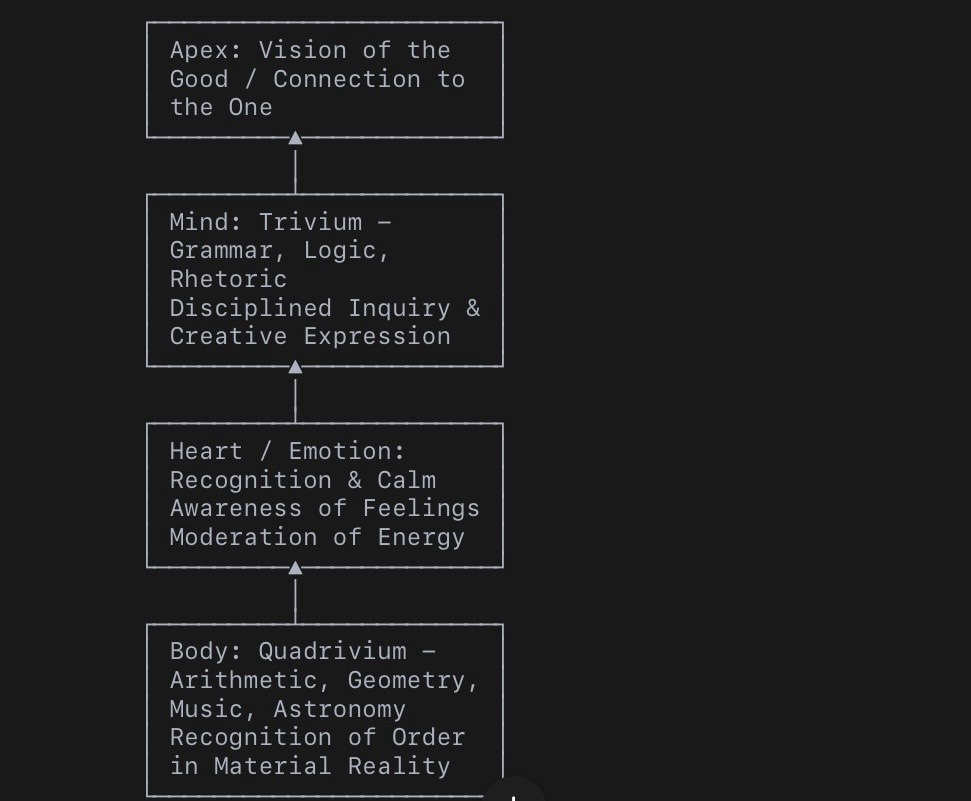
Diagram of the Pyramid of Conscious Ascent
Explanation of the Layers:
Foundation (Body / Quadrivium) – Perceive order in reality; cultivate stability and awareness of the material world.
Heart / Emotion – Recognize emotional responses; achieve calm awareness, integrating body and mind.
Mind / Trivium – Use disciplined inquiry to process, reason, and express knowledge; prepare for insight.
Apex / Vision of the Good / One – Receptive consciousness, creative inspiration, and participation in unity; ideals emerge as questions and answers in life.
This structure shows integration of body, emotion, mind, and higher insight, forming a coherent ascent rather than abstraction
 Dialogos of Eide
Pingback: What Dialogos of Eide and AI Developed | Dialogos of Eide