Dialogue on the Pyramid of Harmony
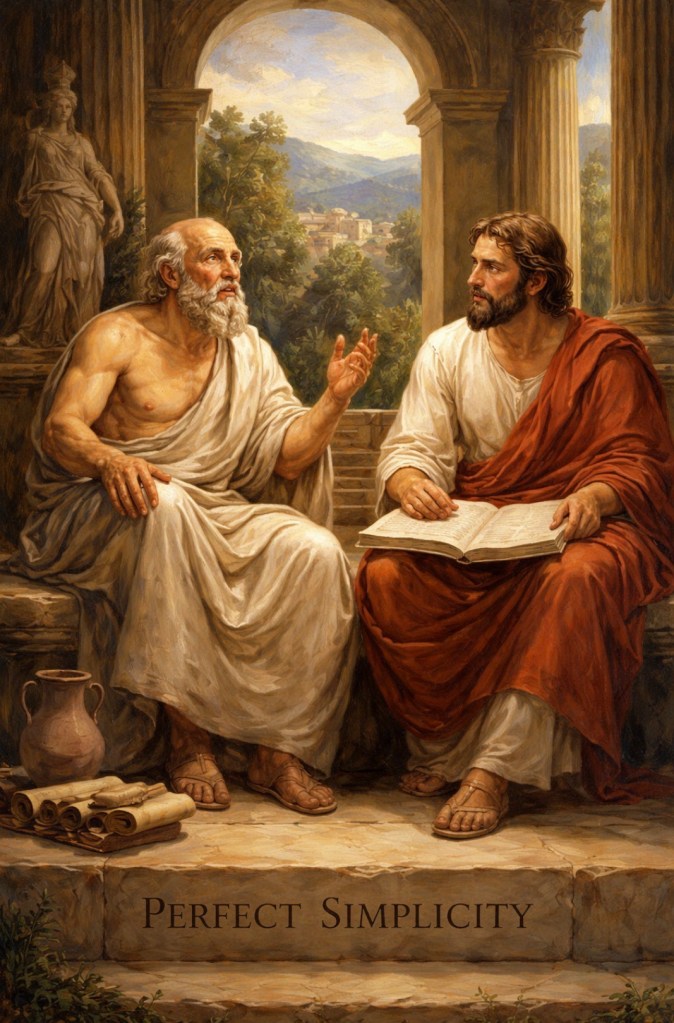
A conversation between Socrates and Plato
Socrates: Tell me, Plato, you have often spoken of the education of the soul through the disciplines of language and number. Yet I wonder whether these arts merely instruct the mind, or whether they lead the soul toward something greater.
Plato: I believe they prepare the ascent, Socrates. The arts of language—grammar, logic, and rhetoric—discipline the instrument of thought. When these are mastered, the mind becomes capable of perceiving order rather than confusion.
Socrates: You refer to what later scholars call the Trivium.
Plato: Just so. But once the mind becomes ordered, another stage follows: the contemplation of number and proportion in the world itself.
Socrates: Ah, the four mathematical arts: arithmetic, geometry, music, and astronomy.
Plato: Yes—the Quadrivium. Arithmetic studies number itself. Geometry reveals number extended into space. Music shows number moving through time. And astronomy displays number governing the motions of the heavens.
Socrates: Then these studies teach us that the cosmos is not chaos, but harmony.
Plato: Precisely. The discoveries of Pythagoras revealed that musical harmony arises from simple numerical ratios. When two tones stand in proportions such as two to one or three to two, the ear perceives consonance.
Socrates: A remarkable insight—that beauty in sound corresponds to order in number.
Plato: And from this insight came a greater vision: if harmony governs music, perhaps the cosmos itself is arranged through similar proportion.
Socrates: What some have called the harmony of the spheres.
Plato: Indeed. Not that the planets produce audible music, but that their motions obey the same mathematical harmony.
Socrates: Then the same order appears in three places: in number, in music, and in the heavens.
Plato: And perhaps also within the soul.
Socrates: Now we approach the matter that interests me most. For if the mind can recognize harmony, must there not be a corresponding order within it?
Plato: That seems necessary. The intellect perceives proportion because it participates in the Logos—the rational structure underlying the world.
Socrates: Yet some would say that the soul merely observes this order, as one might watch a musician playing.
Plato: But consider, Socrates: when we hear a perfectly tuned instrument, the harmony does not remain outside us. Something within responds.
Socrates: As though the soul itself were an instrument capable of resonance.
Plato: Exactly. The harmony in sound awakens a harmony within consciousness.
Socrates: Then the education of the mind through language and number prepares the instrument of the soul to resonate with the order of the cosmos.
Plato: That is the idea.
Socrates: Yet there remains something missing in this account. Knowledge alone does not seem sufficient. Many know the principles of harmony, yet their lives remain disordered.
Plato: You point to an important element. The intellect must be joined with a deeper center of experience.
Socrates: What some might call the heart.
Plato: Yes. The heart, in this sense, is not merely the seat of emotion but the place where understanding becomes lived reality.
Socrates: Then the disciplines of language and number converge there.
Plato: Like the sides of a pyramid meeting toward a single point.
Socrates: A fitting image. The Trivium forms one side—the ordering of speech and thought. The Quadrivium forms the other—the ordering of nature through number.
Plato: And where they meet, the soul recognizes harmony.
Socrates: Which directs the gaze upward toward unity.
Plato: Toward what the Pythagoreans called the Monad.
Socrates: The source from which number itself emerges.
Plato: Yes. From unity arise all multiplicities.
Socrates: Yet I wonder whether the path toward this unity requires increasing complexity or rather the opposite.
Plato: The opposite, I think. The ascent is a simplification. Confusion becomes clarity; multiplicity becomes proportion; proportion becomes harmony.
Socrates: And harmony becomes unity.
Plato: Precisely.
Socrates: But earlier we spoke of music as the bridge between mind and cosmos. Why should music possess such a privilege?
Plato: Because music uniquely joins several domains at once. It is mathematics in ratio, physics in vibration, perception in hearing, and consciousness in emotional resonance.
Socrates: Thus number becomes experience.
Plato: Exactly.
Socrates: Then perhaps the cosmos itself may be understood as a kind of living harmony.
Plato: That was the intuition of Pythagoras.
Socrates: And if that is so, the soul that becomes harmonized does not merely observe the order of the world—it participates in it.
Plato: Like a single tone within a vast symphony.
Socrates: Yet your earlier remark about breath intrigues me. For sound, as musicians know, arises from breath passing through form.
Plato: That is true.
Socrates: Then breath may be the hidden mediator between life and tone.
Plato: The Greeks called such animating breath pneuma.
Socrates: Consider then the rhythm of breathing—inhaling and exhaling.
Plato: A continual cycle.
Socrates: Might this rhythm mirror the cosmic movement described by the philosophers who came after us—the unfolding of reality from unity and its return again?
Plato: The movement later thinkers would describe as emanation and return.
Socrates: Exactly. As breath flows outward and inward, so unity expresses itself in multiplicity and gathers itself again into simplicity.
Plato: Then the act of breathing could symbolize the entire structure of reality.
Socrates: And if the soul learns to align breath, thought, and perception with harmony, the person may become attuned to that deeper order.
Plato: In such a state the individual no longer struggles to produce harmony; one resonates with it.
Socrates: Like an instrument that has finally been tuned.
Plato: Yes.
Socrates: Yet we must not forget that beyond harmony lies something even simpler.
Plato: The One itself.
Socrates: Which cannot be fully spoken or heard.
Plato: Only approached.
Socrates: Then perhaps the tone of harmony serves merely as a guide—a path leading the soul toward silence.
Plato: Silence that contains unity.
Socrates: So the ascent toward the One might be imagined as breathing the tone of harmony into being, until even the tone dissolves into perfect simplicity.
Plato: A beautiful way of expressing the philosophical journey, Socrates.
Socrates: Whether beautiful or not, my friend, the important question remains.
Plato: Which is?
Socrates: If the cosmos itself is harmony, and the soul can resonate with that harmony, then perhaps each human life is an opportunity to tune the instrument of consciousness until it sounds in accord with the fundamental unity from which all things arise.
Plato: And in that resonance, the many may discover the One.
 Dialogos of Eide
Pingback: What Dialogos of Eide and AI Developed | Dialogos of Eide