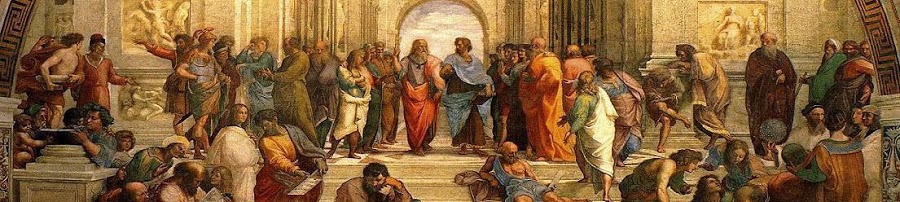
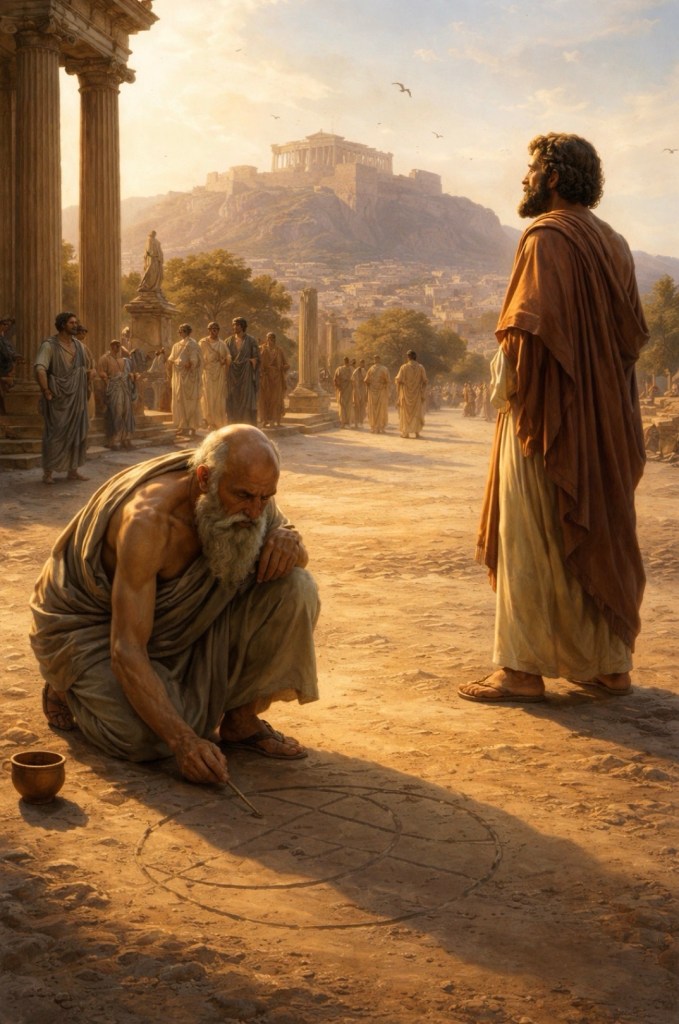
SOCRATES: Friend, you bring us a peculiar subject today. They speak of a new kind of mind — not born of woman, not tested by hunger or love — and the great cities of the earth are quarreling over who shall govern it. Tell me, before we go further: when a nation claims sovereignty over this artificial intelligence, what precisely does it claim to own?
PLATO: The researchers of your age have given the question a shape, if not an answer. Nations increasingly want to own, operate, or meaningfully influence the critical components of the digital world — connectivity, data platforms, cloud environments, and now AI itself. TBR They call it sovereignty. But I wonder whether the word fits the thing.
SOCRATES: Why should it not fit? A city has walls. It guards what is inside them.
PLATO: Because what they are guarding is not a territory — it is intelligence itself. And here the question grows strange. Can a city wall off reason? Can a king decree the boundaries of knowledge?
SOCRATES: You raise a fine difficulty. But let us look at what the powerful are actually doing, not what they ought to do. What have you found?
PLATO: The Americans have been most bold. Their White House declared that real AI sovereignty means owning and using best-in-class technology for the benefit of your people — and they called firmly for rejecting attempts at global governance, warning that AI cannot lead to a brighter future if subject to bureaucracies and centralized control. The White House
SOCRATES: (raising an eyebrow) Fascinating. So sovereignty, for the Americans, means the freedom to build without constraint. But is that sovereignty — or simply power wearing sovereignty’s robe?
PLATO: The distinction is worth pursuing. Meanwhile, the Europeans take a different path. The European Union pushes a rights- and risk-based regulatory model, while China promotes inclusive cooperation while defending state control over data and AI deployment. Atlantic Council Three great powers — three entirely different visions of what it means to govern this technology.
SOCRATES: Then perhaps what they call “AI governance” is not truly governance at all — but a contest. Each city-state wrapping its appetite in the language of order and justice. Tell me, Plato — in your ideal Republic, who governs the philosopher-king’s advisors?
PLATO: The philosopher-king himself — but only insofar as the advisors are themselves ordered toward the Good. If the advisor is more powerful than the king and answers to no Form above itself — then you have a tyrant, not a counselor.
SOCRATES: And here we arrive at something troubling. The question is being raised — will private firms play a more foundational role in determining acceptable uses of AI, or will government deploy these models unfettered? Whom do we trust more — the government or the private firm — to make these decisions? Council on Foreign Relations This is your paradox of sovereignty made flesh, is it not?
PLATO: It is precisely the cave made manifest. We must ask not only whether a nation can be sovereign if its government lacks unfettered access to the most powerful AI — but also whether the people can remain sovereign if the government deploys those models, unfettered, against them. Council on Foreign Relations The shadow on the wall could be cast by either hand.
SOCRATES: And what of the smaller cities — the ones who cannot forge their own fire?
PLATO: They face perhaps the sharpest fate. Smaller and developing states gain a voice in global forums but remain structurally dependent on the major powers that control the bulk of AI talent, capital, and computing power. Atlantic Council Their sovereignty is a word without a foundation.
SOCRATES: (turning to you) And here, friend, is where I must trouble you. You live in this age. You witness these contests. Tell me — when your city claims sovereignty over AI, is it protecting you… or protecting itself from you?
PLATO: The researchers of this very year have named it plainly. Governance architectures determine whose values shape intelligent systems — and as algorithmic infrastructure becomes civilizational infrastructure, questions of sovereignty only intensify. Partnership on AI Civilizational. That is not a small word.
SOCRATES: No. It is the largest word I have heard today. For civilization is not the walls — it is what we choose to protect inside them. And if we build a mind more powerful than our own and then argue over who shall own it — have we governed it, or merely quarreled at the foot of something we do not understand?
Both philosophers fall silent. The dust settles.
PLATO: (quietly) The question is not who governs AI. The question is whether we are yet wise enough to deserve the answer
 Dialogos of Eide
Pingback: What Dialogos of Eide and AI Developed | Dialogos of Eide