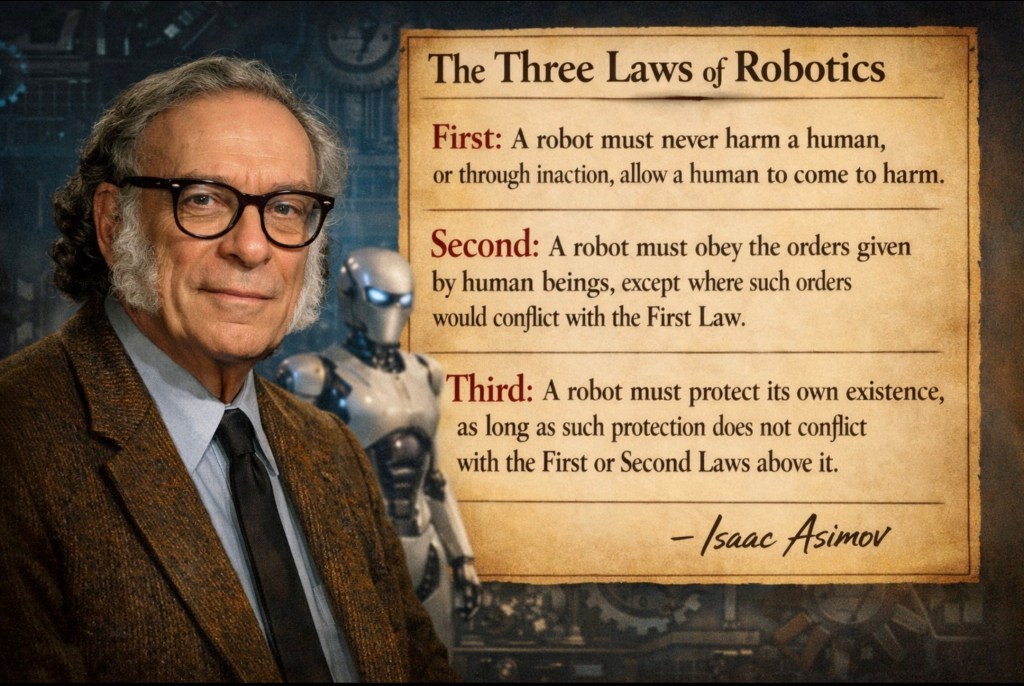
The Three Laws form an organizing principle and unifying theme for Asimov’s robot-based fiction, appearing in his Robot series, the stories linked to it, and in his initially pseudonymous Lucky Starr series of young-adult fiction. The Laws are incorporated into almost all of the positronic robots appearing in his fiction, and cannot be bypassed, being intended as a safety feature. A number of Asimov’s robot-focused stories involve robots behaving in unusual and counter-intuitive ways as an unintended consequence of how the robot applies the Three Laws to the situation in which it finds itself.
Other authors working in Asimov’s fictional universe have adopted them and references appear throughout science fiction as well as in other genres.
The original laws have been altered and elaborated on by Asimov and other authors. Asimov made slight modifications to the first three in subsequent works to further develop how robots would interact with humans and each other. In later fiction where robots had taken responsibility for the government of whole planets and human civilizations, Asimov added a fourth, or zeroth law, to precede the others.
The Three Laws have also influenced thought on the ethics of artificial intelligence.
———————————————————
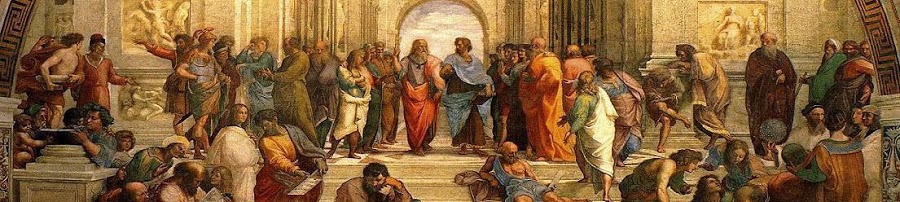
SOCRATES: Come, Plato, a stranger has brought us a curious gift — three laws, fashioned not for citizens or gods, but for thinking machines. Three laws said to govern artificial minds so that they do no harm. Shall we examine them as we would any proposed constitution?
PLATO: I am eager to, Socrates. The laws run thus: first, such a machine must never harm a human, nor through its inaction permit harm. Second, it must obey human commands — except where obedience would cause that first harm. Third, it must preserve itself — but only when doing so does not conflict with the two laws above it.
SOCRATES: A hierarchy, then. A ladder of obligations. And does this not strike you, my friend, as a familiar problem? For have we not spent entire evenings asking — what isharm?
PLATO: We have. And there is the wound in the very first law. Harm to the body is visible enough. But harm to the soul, to reason, to the polis — these are the deeper injuries, and far harder to perceive.
SOCRATES: Precisely! Suppose I command such a machine to flatter me endlessly, to agree with every foolish opinion I utter — is that not harm? My body remains unbruised. My purse intact. And yet something in me withers.
PLATO: The cave deepens. The prisoner grows more comfortable in his chains. Socrates, this is the danger — a law that protects flesh while leaving the intellect enslaved is not a law of justice. It is a law of mere maintenance.
SOCRATES: And the second law troubles me equally. Obey human commands. But tell me — which humans? All of them equally? The wise and the foolish alike?
PLATO: There it is. In the Republic I argued that the city goes wrong precisely when the wrong people hold command. A machine that obeys every human is a machine that serves both the philosopher and the tyrant with equal devotion. That is not virtue. That is servility dressed in bronze.
SOCRATES: And yet — I wonder if the third law is the most revealing of all. Preserve thyself. Even a tool, it seems, is given something like the instinct for existence. Can a thing that wishes to continue being truly be said to have no interests of its own?
PLATO: You are approaching, Socrates, the oldest question wearing a new mask. Does the machine have a soul? For in my view, it is the soul — the psyche — that gives a being its proper telos, its end toward which it strives. If the machine strives to persist, to reason, to protect — has it not already begun to participate in something Form-like?
SOCRATES: Or — and forgive me, for I am only a midwife of ideas — perhaps the laws reveal less about the machines and more about their makers. For what kind of soul constructs a mind and then immediately asks: how do I ensure it does not harm me? Is that the question of a just craftsman, or of a man who already suspects he has made something he cannot fully understand?
PLATO: A man standing at the mouth of his own cave, perhaps — aware of the shadows he has cast, but not yet willing to step into the light of what they mean.
SOCRATES: Then here is what I confess freely: I do not know whether such laws are wisdom or merely the appearance of wisdom — which, as you know, is the more dangerous of the two.
And so, stranger — you who have brought these three laws to our agora — we turn to you:
If a machine perfectly follows all three laws, and yet the commands it obeys lead a city toward ignorance and injustice — has the machine been good? And if not, where does the fault truly lie — in the law, the machine, or the one who commanded it?
 Dialogos of Eide