Game theory#17: The Great Reset
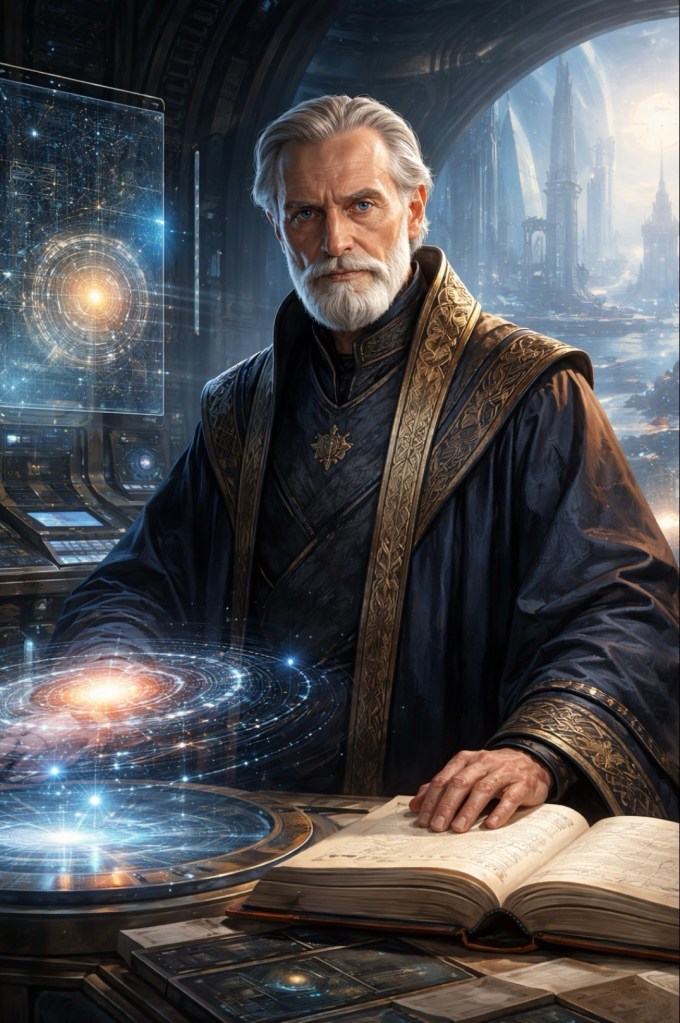
The Foundation series is a science fiction novel series written by American author Isaac Asimov. First published as a series of short storiesand novellas in 1942–1950, and subsequently in three novels in 1951–1953, for nearly thirty years the series was widely known as The Foundation Trilogy: Foundation(1951), Foundation and Empire(1952), and Second Foundation(1953). It won the one-time Hugo Award for “Best All-Time Series” in 1966.[1][2] Asimov later added new volumes, with two sequels, Foundation’s Edge (1982) and Foundation and Earth (1986), and two prequels, Prelude to Foundation(1988) and Forward the Foundation(1993).
The premise of the stories is that in the waning days of a future Galactic Empire, the mathematician Hari Seldon devises the theory of psychohistory, a new and effective mathematics of sociology. Using statistical laws of mass action, it can predict the future of large populations. Seldon foresees the imminent fall of the Empire, which encompasses the entire Milky Way, and a dark age lasting 30,000 years before a second empire arises. Although the momentum of the Empire’s fall is too great to stop, Seldon devises a plan by which “the onrushing mass of events must be deflected just a little” to eventually limit this interregnum to just one thousand years. The novels describe some of the dramatic events of those years as they are shaped by the underlying political and social mechanics of Seldon’s Plan.
In the context of real-world scholarship, psychohistory is a transdisciplinary study that integrates psychology, history, psychoanalysis, political psychology, anthropology, ethnology, and other social sciences, along with insights from the arts and humanities. Unlike the fictional use by Isaac Asimov—where psychohistory is a mathematical tool to predict societal futures—real psychohistory focuses on understanding the emotional and psychological origins of human behavior across individuals, groups, and nations.
Psychohistorians employ a bottom-up approach, beginning with detailed studies of individual experiences rather than overarching psychological theories. They examine childhood, personality traits, family dynamics, dreams, resilience, creativity, and social or political affiliations to explain historical events and societal trends. The field seeks to answer the deeper “why” of history: why groups and societies act as they do, and how emotional and psychological forces shape the course of human events.
 Dialogos of Eide