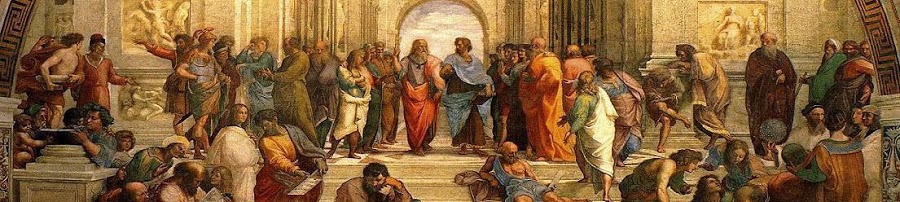
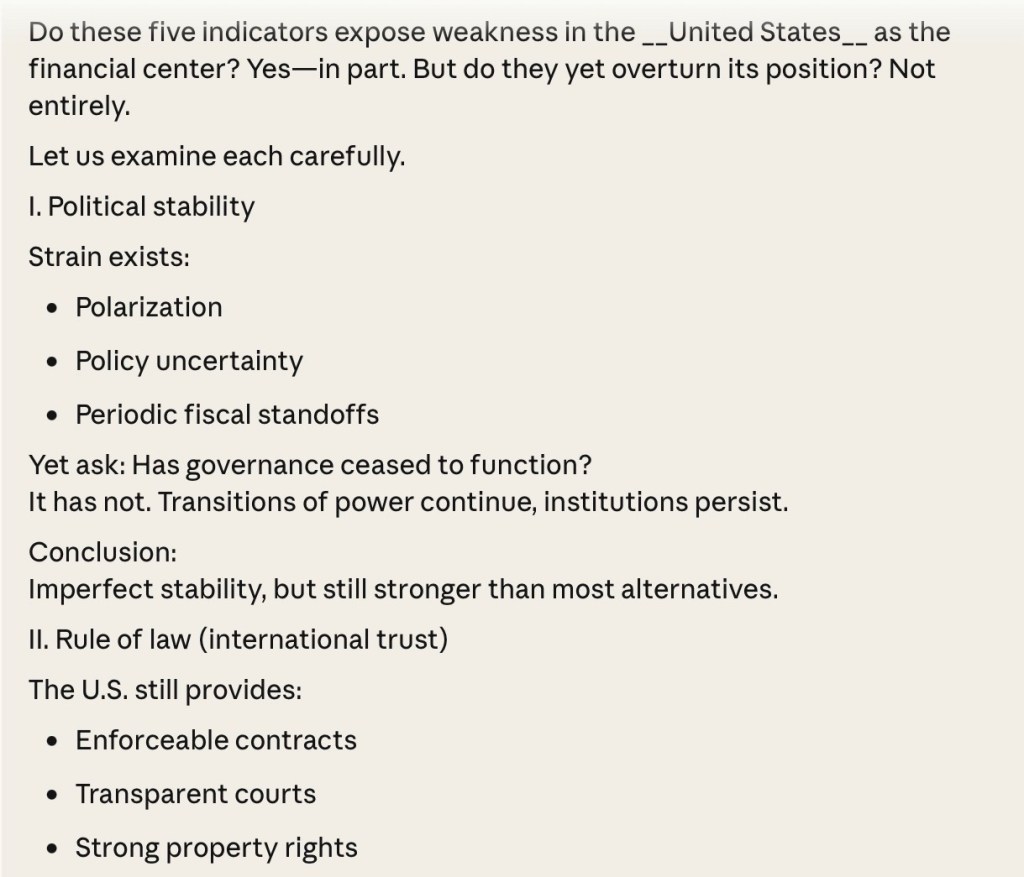
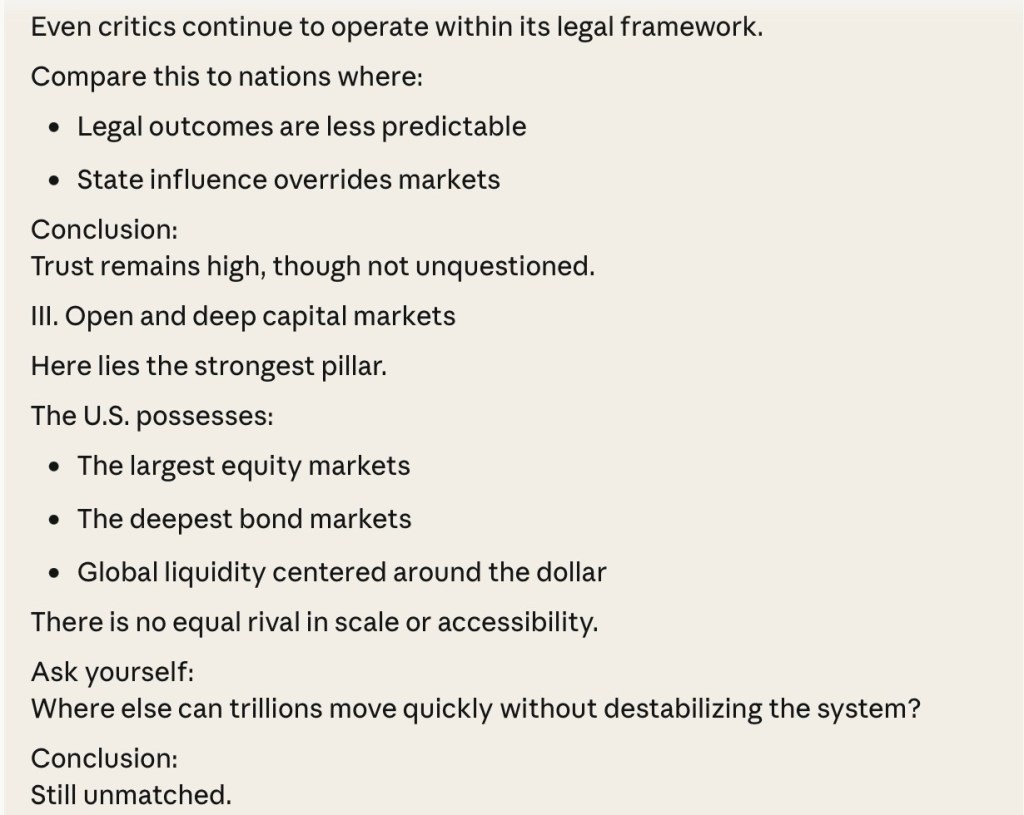
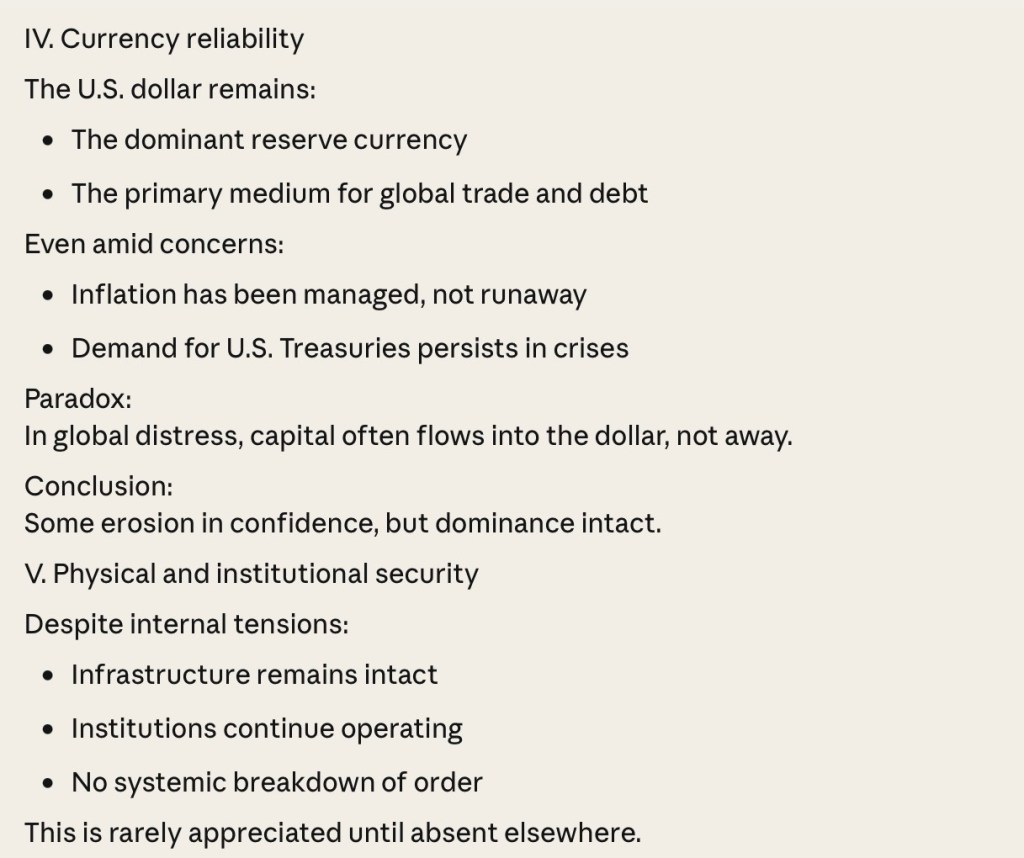
SOCRATES: Ah, friend, you have done something remarkable here — you have answered your own question, and answered it well. But I wonder whether you have noticed what you have also done: you have described a structure held in place not by its own strength, but by the absence of a worthy challenger. Now tell me — is that the same as being strong?
PLATO: The distinction matters enormously, Socrates. A city that governs well because its citizens are virtuous is not the same as a city that governs because no rival has yet risen to contest it. The first possesses arête — excellence rooted in its own nature. The second possesses only hegemonia by default. And here lies the deeper question our friend has uncovered beneath the five criteria: does the United States hold its position as financial center because it is the Form of such a center — or because the cave has, as yet, cast no other shadow large enough to rival it?
SOCRATES: Beautifully put, Plato. But let us press further. You say, friend, that the shift — if it comes — will be gradual: dilution, not displacement. I find this word dilution fascinating. When we dilute wine with water, the wine does not suddenly vanish — yet at some point, we are no longer drinking wine at all. We are drinking something else entirely, and cannot name the precise moment the transformation occurred. Is that not the more troubling possibility? Not collapse, which announces itself — but imperceptible transition, which does not?
PLATO: And this is why the five criteria, though sound as instruments of measurement, may be insufficient as instruments of warning. Consider my Allegory of the Cave. The prisoners do not perceive the moment the fire begins to dim — they perceive only the shadows, and judge those shadows by what they have always seen. The financial world, too, watches the shadows: Treasury yields, equity volumes, dollar indices. But the fire — the underlying legitimacy, the moral authority to set the terms of global exchange — that may be shifting in ways the shadows have not yet revealed.
SOCRATES: And what is that fire, precisely? You speak of legitimacy and moral authority — but I confess I am a simple man, ignorant of finance. Is the fire the trust that undergirds the system? The collective belief — held by billions across the world — that this currency, this contract, this court will hold? Because if it is belief that sustains the structure…
PLATO: …then belief can erode long before the structure visibly cracks. Yes. You see it, Socrates. And our friend sees it too — which is why they spoke not of failure, but of strain. The five pillars do not need to fall. They need only to become less self-evident — less automatically assumed — for the architecture of alternatives to become thinkable. And once a thing becomes thinkable, it begins to become possible.
SOCRATES: Which brings me to what I find most interesting of all in your reflection, friend. You end with an image — a throne that weakens before another is ready to be sat upon. It is a vivid image. But I want to ask you something about it. In the history of such transitions — and Plato has read far more of these than I — has the successor throne ever been built by design? Or does it tend to emerge from the very chaos produced by the weakening of the old?
PLATO: Almost always the latter, Socrates. The Republic does not yield peacefully to its successor — it yields through crisis, through stasis, through the moment when the gap between its professed ideals and its actual condition becomes too wide to sustain. And in that gap, something new finds its footing. The question for our friend is therefore not merely: when will the successor mature? — but rather: will the transition be navigated by those with wisdom, or seized by those with power?
SOCRATES: And so I leave you, friend, with the question that seems to me to lurk beneath all five of your criteria, beneath the throne and the dilution and the gradual multipolar drift:
Who, in this transition, holds the responsibility of the philosopher-king — and does any nation, institution, or framework yet possess both the wisdom and the legitimacy to guide the world through it?
For a throne left vacant is not merely an absence of a ruler. It is an invitation — and not always to the worthy.
 Dialogos of Eide