 |
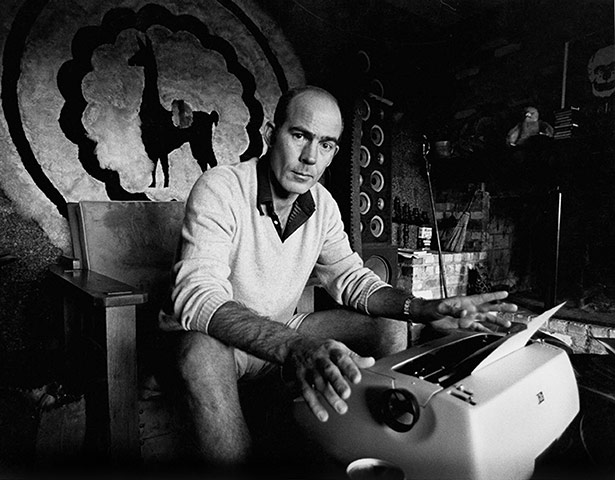
| Marshall McLuhan in the early 1970s |
Born July 21, 1911
Edmonton, Alberta Died December 31, 1980 (aged 69)
Toronto, Ontario School Media theory Main interests Media, Mass media, Sensorium, New Criticism
Notable ideas The medium is the message, Global village, Metamedia, Media ecology, Figure and ground media, Tetrad of media effects, Hot and cool media
Herbert Marshall McLuhan, CC (July 21, 1911 – December 31, 1980) was a Canadian educator, philosopher, and scholar—a professor of English literature, a literary critic, a rhetorician, and a communication theorist. McLuhan’s work is viewed as one of the cornerstones of the study of media theory, as well as having practical applications in the advertising and television industries.[1][2]
McLuhan is known for coining the expressions “the medium is the message” and “the global village” and predicted the World Wide Web almost thirty years before it was invented.[3] Although he was a fixture in media discourse in the late 1960s, his influence waned in the years before and after his death and he continued to be a controversial figure in academic circles.[4] In the Internet age, however, there was renewed interest in his work and perspective.[5][6][7]
Life and career
McLuhan was born in Edmonton, Alberta, to Elsie Naomi (née Hall) and Herbert Ernest McLuhan. His brother, Maurice, was born two years later. “Marshall” was a family name: his maternal grandmother’s surname. Both of his parents were born in Canada. His mother was a Baptist schoolteacher who later became an actress. His father was a Methodist and had a real estate business in Edmonton. When war broke out, the business failed, and McLuhan’s father enlisted in the Canadian army. After a year of service he contracted influenza and remained in Canada, away from the front. After Herbert’s discharge from the army in 1915, the McLuhan family moved to Winnipeg, Manitoba, where Marshall grew up and went to school, attending Kelvin Technical School before enrolling in the University of Manitoba in 1928.[8]
At Manitoba, McLuhan’s discomfort with religion[9] and his turn to literature to gratify his soul’s hunger for truth and beauty[10] initiated a stage in his spiritual development which he would later refer to as agnosticism.[11] McLuhan earned a BA (1933)—winning a University Gold Medal in Arts and Sciences[12][13]—and MA (1934) in English from the University of Manitoba, after a one year stint as an engineering major. He had long desired to pursue graduate studies in England and, having failed to secure a Rhodes scholarship to Oxford, McLuhan was accepted for enrollment at the University of Cambridge. Although he already had earned BA and MA degrees at Manitoba, Cambridge required him to enroll as an undergraduate “affiliated” student, with one year’s credit toward a three-year Cambridge Bachelor’s degree, before any doctoral studies.[14] He entered Trinity Hall, Cambridge in the Fall of 1934, where he studied under I. A. Richards and F. R. Leavis, and was influenced by New Criticism.[15] Upon reflection years after, he credited the faculty there with influencing the direction of his later work because of their emphasis on the training of perception and such concepts as Richards’ notion of feedforward.[16] These studies formed an important precursor to his later ideas on technological forms.[17] He received his bachelor’s degree from Cambridge in 1936[18] and began graduate work. Later, he returned from England to take a job as a teaching assistant at the University of Wisconsin–Madison, which he held for the 1936–37 academic year, unable to find a suitable job in Canada.[19]
While studying the trivium at Cambridge he took the first steps toward his eventual conversion to Roman Catholicism in 1937,[20] founded on his reading of G. K. Chesterton.[21] In 1935 he wrote to his mother: “[H]ad I not encountered Chesterton, I would have remained agnostic for many years at least”.[22] At the end of March 1937,[23] McLuhan completed what was a slow but total conversion process when he was formally received into the Roman Catholic Church. After consulting with a minister, his father accepted the decision to convert; his mother, however, felt that his conversion would hurt his career and was inconsolable.[24] McLuhan was devout throughout his life, but his religion remained a private matter.[25] He had a lifelong interest in the number three[26]—the trivium, the Trinity—and sometimes said that the Virgin Mary provided intellectual guidance for him.[27] For the rest of his career he taught in Roman Catholic institutions of higher education. From 1937 to 1944 he taught English at Saint Louis University (with an interruption from 1939 to 1940 when he returned to Cambridge). At Saint Louis he tutored and befriended Walter J. Ong, S.J. (1912–2003), who would go on to write his Ph.D. dissertation on a topic McLuhan had called to his attention, and who would himself also later become a well-known authority on communication and technology.
While in St. Louis, he also met his future wife. On August 4, 1939, McLuhan married teacher and aspiring actress Corinne Lewis (1912–2008)[28] of Fort Worth, Texas, and they spent 1939–40 in Cambridge, where he completed his master’s degree (awarded in January 1940[18]) and began to work on his doctoral dissertation on Thomas Nashe and the verbal arts. War had broken out in Europe while the McLuhans were in England, and he obtained permission to complete and submit his dissertation from the United States, without having to return to Cambridge for an oral defense. In 1940 the McLuhans returned to Saint Louis University, where he continued teaching and they started a family. He was awarded a Ph.D. in December 1943.[29] Returning to Canada, from 1944 to 1946 McLuhan taught at Assumption College in Windsor, Ontario. Moving to Toronto in 1946, McLuhan joined the faculty of St. Michael’s College, a Catholic college of the University of Toronto. Hugh Kenner was one of his students and Canadian economist and communications scholar Harold Innis was a university colleague who had a strong influence on McLuhan’s work.
In the early 1950s, McLuhan began the Communication and Culture seminars, funded by the Ford Foundation, at the University of Toronto. As his reputation grew, he received a growing number of offers from other universities and, to keep him, the university created the Centre for Culture and Technology in 1963.[17] He published his first major work during this period: The Mechanical Bride (1951) was an examination of the effect of advertising on society and culture. He also produced an important journal, Explorations, with Edmund Carpenter, throughout the 1950s.[30] Together with Harold Innis, Eric A. Havelock, and Northrop Frye, McLuhan and Carpenter have been characterized as the Toronto School of communication theory. McLuhan remained at the University of Toronto through 1979, spending much of this time as head of his Centre for Culture and Technology.
McLuhan was named to the Albert Schweitzer Chair in Humanities at Fordham University in the Bronx, New York, for one year (1967–68).[31] While at Fordham, McLuhan was diagnosed with a benign brain tumor; it was treated successfully. He returned to Toronto, where, for the rest of his life, he worked at the University of Toronto and lived in Wychwood Park, a bucolic enclave on a hill overlooking the downtown where Anatol Rapoport was his neighbour. In 1970, McLuhan was made a Companion of the Order of Canada.[32]
In 1975 the University of Dallas hosted him from April to May, appointing him the McDermott Chair.
Marshall and Corinne McLuhan had six children: Eric, twins Mary and Teresa, Stephanie, Elizabeth and Michael. The associated costs of a large family eventually drove McLuhan to advertising work and accepting frequent consulting and speaking engagements for large corporations, IBM and AT&T among them.[17] In September 1979 he suffered a stroke, which affected his ability to speak. The University of Toronto’s School of Graduate Studies tried to close his research center shortly thereafter, but was deterred by substantial protests, most notably by Woody Allen, in whose Oscar-winning motion picture Annie Hall McLuhan had a cameo role; a pompous academic arguing with Allen in a cinema queue is squashed by McLuhan himself suddenly appearing to say, “You know nothing of my work.” This was one of McLuhan’s most frequently expressed statements to and about those who would disagree with him.[33][2]
He never fully recovered from the stroke and died in his sleep on December 31, 1980.
Major works
During his years at Saint Louis University (1937–1944), McLuhan worked concurrently on two projects: his doctoral dissertation and the manuscript that was eventually published in 1951 as the book The Mechanical Bride, which included only a representative selection of the materials that McLuhan had prepared for it.
McLuhan’s 1942 Cambridge University doctoral dissertation surveys the history of the verbal arts (grammar, logic, and rhetoric—collectively known as the trivium) from the time of Cicero down to the time of Thomas Nashe.[34] In his later publications, McLuhan at times uses the Latin concept of the trivium to outline an orderly and systematic picture of certain periods in the history of Western culture. McLuhan suggests that the Middle Ages, for instance, was characterized by the heavy emphasis on the formal study of logic. The key development that led to the Renaissance was not the rediscovery of ancient texts but a shift in emphasis from the formal study of logic to rhetoric and language. Modern life is characterized by the reemergence of grammar as its most salient feature—a trend McLuhan felt was exemplified by the New Criticism of Richards and Leavis.[35]
In The Mechanical Bride, McLuhan turned his attention to analyzing and commenting on numerous examples of persuasion in contemporary popular culture. This followed naturally from his earlier work as both dialectic and rhetoric in the classical trivium aimed at persuasion. At this point his focus shifted dramatically, turning inward to study the influence of communication media independent of their content. His famous aphorism “the medium is the message” (elaborated in his 1964 book, Understanding Media: The Extensions of Man) calls attention to this intrinsic effect of communications media.[36]
McLuhan also started the journal Explorations with anthropologist Edmund “Ted” Carpenter. In a letter to Walter Ong dated May 31, 1953, McLuhan reported that he had received a two-year grant of $43,000 from the Ford Foundation to carry out a communication project at the University of Toronto involving faculty from different disciplines, which led to the creation of the journal.[citation needed]
Tom Wolfe suggests that a hidden influence on McLuhan’s work is the Catholic philosopher Teilhard de Chardin whose ideas anticipated those of McLuhan, especially the evolution of the human mind into the “noosphere“. Wolfe theorizes that McLuhan may have thought that association of his ideas with those of a Catholic theologian, albeit one suppressed by Rome, might have denied him the intellectual audience he wanted to reach and so omitted all reference of de Chardin from his published work, while privately acknowledging his influence.[37]
The Mechanical Bride (1951)
McLuhan’s first book, The Mechanical Bride: Folklore of Industrial Man (1951), is a pioneering study in the field now known as popular culture. His interest in the critical study of popular culture was influenced by the 1933 book Culture and Environment by F.R. Leavis and Denys Thompson, and the title The Mechanical Bride is derived from a piece by the Dadaist artist, Marcel Duchamp.
Like his 1962 book The Gutenberg Galaxy, The Mechanical Bride is unique and composed of a number of short essays that can be read in any order – what he styled the “mosaic approach” to writing a book. Each essay begins with a newspaper or magazine article or an advertisement, followed by McLuhan’s analysis thereof. The analyses bear on aesthetic considerations as well as on the implications behind the imagery and text. McLuhan chose the ads and articles included in his book not only to draw attention to their symbolism and their implications for the corporate entities that created and disseminated them, but also to mull over what such advertising implies about the wider society at which it is aimed.
Examples of advertisements
- A nose for news and a stomach for whiskey: McLuhan analyzes an ad for Time Magazine in which he likens a reporter depicted as a romantic character from a Hemingway novel and asks “Why is it [his] plangent duty to achieve cirrhosis of the liver?”[38]
- Freedom to Listen – Freedom to Look: An ad for the Radio Corporation of America depicts a rural family doing their business with the radio on. Earlier in the Bride McLuhan notes “We still have our freedom to listen?” and here “Come on kiddies. Buy a radio and feel free—to listen.”[39]
- For Men of Distinction – Lord Calvert: An ad for Lord Calvert whiskey depicts nine gentlemen holding a glass of their whiskey, while McLuhan notes the lack of non-artists amongst them; “Why pick on the arts? Hasn’t anyone in science or industry ever distinguished himself by drinking whiskey?”[40]
- The Famous DuBarry Success Course: An ad for beauty creams complete with female model in a swimsuit hawks itself as a “success course” complete with “tuition”, to which McLuhan asks, “Why laugh and grow fat when you can experience anguish and success in a strait jacket?”[41]
The Gutenberg Galaxy (1962)
McLuhan’s The Gutenberg Galaxy: The Making of Typographic Man (written in 1961, first published in Canada by University of Toronto Press in 1962) is a pioneering study in the fields of oral culture, print culture, cultural studies, and media ecology.
Throughout the book, McLuhan takes pains to reveal how communication technology (alphabetic writing, the printing press, and the electronic media) affects cognitive organization, which in turn has profound ramifications for social organization:
…[I]f a new technology extends one or more of our senses outside us into the social world, then new ratios among all of our senses will occur in that particular culture. It is comparable to what happens when a new note is added to a melody. And when the sense ratios alter in any culture then what had appeared lucid before may suddenly become opaque, and what had been vague or opaque will become translucent.[42]
Movable type
His episodic and often rambling history takes the reader from pre-alphabetic tribal humankind to the electronic age. According to McLuhan, the invention of movable type greatly accelerated, intensified, and ultimately enabled cultural and cognitive changes that had already been taking place since the invention and implementation of the alphabet, by which McLuhan means phonemic orthography. (McLuhan is careful to distinguish the phonetic alphabet from logographic/logogramic writing systems, like hieroglyphics or ideograms.)
Print culture, ushered in by the Gutenberg press in the middle of the fifteenth century, brought about the cultural predominance of the visual over the aural/oral. Quoting with approval an observation on the nature of the printed word from Prints and Visual Communication by William Ivins, McLuhan remarks:
In this passage [Ivins] not only notes the ingraining of lineal, sequential habits, but, even more important, points out the visual homogenizing of experience of print culture, and the relegation of auditory and other sensuous complexity to the background. […] The technology and social effects of typography incline us to abstain from noting interplay and, as it were, “formal” causality, both in our inner and external lives. Print exists by virtue of the static separation of functions and fosters a mentality that gradually resists any but a separative and compartmentalizing or specialist outlook.[43]
The main concept of McLuhan’s argument (later elaborated upon in The Medium is the Massage) is that new technologies (like alphabets, printing presses, and even speech itself) exert a gravitational effect on cognition, which in turn affects social organization: print technology changes our perceptual habits (“visual homogenizing of experience”), which in turn affects social interactions (“fosters a mentality that gradually resists all but a… specialist outlook”). According to McLuhan, the advent of print technology contributed to and made possible most of the salient trends in the Modern period in the Western world: individualism, democracy, Protestantism, capitalism and nationalism. For McLuhan, these trends all reverberate with print technology’s principle of “segmentation of actions and functions and principle of visual quantification.”[44]
The global village
In the early 1960s, McLuhan wrote that the visual, individualistic print culture would soon be brought to an end by what he called “electronic interdependence”: when electronic media replace visual culture with aural/oral culture. In this new age, humankind will move from individualism and fragmentation to a collective identity, with a “tribal base.” McLuhan’s coinage for this new social organization is the global village.[45]
The term is sometimes described as having negative connotations in The Gutenberg Galaxy, but McLuhan himself was interested in exploring effects, not making value judgments:
Instead of tending towards a vast Alexandrian library the world has become a computer, an electronic brain, exactly as an infantile piece of science fiction. And as our senses have gone outside us, Big Brother goes inside. So, unless aware of this dynamic, we shall at once move into a phase of panic terrors, exactly befitting a small world of tribal drums, total interdependence, and superimposed co-existence. […] Terror is the normal state of any oral society, for in it everything affects everything all the time. […] In our long striving to recover for the Western world a unity of sensibility and of thought and feeling we have no more been prepared to accept the tribal consequences of such unity than we were ready for the fragmentation of the human psyche by print culture.[46]
Key to McLuhan’s argument is the idea that technology has no per se moral bent—it is a tool that profoundly shapes an individual’s and, by extension, a society’s self-conception and realization:
Is it not obvious that there are always enough moral problems without also taking a moral stand on technological grounds? […] Print is the extreme phase of alphabet culture that detribalizes or decollectivizes man in the first instance. Print raises the visual features of alphabet to highest intensity of definition. Thus print carries the individuating power of the phonetic alphabet much further than manuscript culture could ever do. Print is the technology of individualism. If men decided to modify this visual technology by an electric technology, individualism would also be modified. To raise a moral complaint about this is like cussing a buzz-saw for lopping off fingers. “But”, someone says, “we didn’t know it would happen.” Yet even witlessness is not a moral issue. It is a problem, but not a moral problem; and it would be nice to clear away some of the moral fogs that surround our technologies. It would be good for morality.[47]
The moral valence of technology’s effects on cognition is, for McLuhan, a matter of perspective. For instance, McLuhan contrasts the considerable alarm and revulsion that the growing quantity of books aroused in the latter seventeenth century with the modern concern for the “end of the book”. If there can be no universal moral sentence passed on technology, McLuhan believes that “there can only be disaster arising from unawareness of the causalities and effects inherent in our technologies”.[48]
Though the World Wide Web was invented almost thirty years after The Gutenberg Galaxy, and ten years after his death, McLuhan prophesied the web technology seen today as early as 1962:
The next medium, whatever it is – it may be the extension of consciousness – will include television as its content, not as its environment, and will transform television into an art form. A computer as a research and communication instrument could enhance retrieval, obsolesce mass library organization, retrieve the individual’s encyclopedic function and flip into a private line to speedily tailored data of a saleable kind (Marshall McLuhan 1962).[49]
Furthermore, McLuhan coined and certainly popularized the usage of the term “surfing” to refer to rapid, irregular and multidirectional movement through a heterogeneous body of documents or knowledge, e.g., statements like “Heidegger surf-boards along on the electronic wave as triumphantly as Descartes rode the mechanical wave.” Paul Levinson‘s 1999 book Digital McLuhan explores the ways that McLuhan’s work can be better understood through the lens of the digital revolution.[3]
McLuhan frequently quoted Walter Ong‘s Ramus, Method, and the Decay of Dialogue (1958), which evidently had prompted McLuhan to write The Gutenberg Galaxy. Ong wrote a highly favorable review of this new book in America.[50] However, Ong later tempered his praise, by describing McLuhan’s The Gutenberg Galaxy as “a racy survey, indifferent to some scholarly detail, but uniquely valuable in suggesting the sweep and depth of the cultural and psychological changes entailed in the passage from illiteracy to print and beyond.”[51] McLuhan himself said of the book, “I’m not concerned to get any kudos out of [The Gutenberg Galaxy]. It seems to me a book that somebody should have written a century ago. I wish somebody else had written it. It will be a useful prelude to the rewrite of Understanding Media [the 1960 NAEB report] that I’m doing now.”[citation needed]
McLuhan’s The Gutenberg Galaxy won Canada’s highest literary award, the Governor-General’s Award for Non-Fiction, in 1962. The chairman of the selection committee was McLuhan’s colleague at the University of Toronto and oftentime intellectual sparring partner, Northrop Frye.[52]
Understanding Media (1964)
McLuhan’s most widely known work, Understanding Media: The Extensions of Man (1964), is a pioneering study in media theory. In it McLuhan proposed that media themselves, not the content they carry, should be the focus of study—popularly quoted as “the medium is the message”. McLuhan’s insight was that a medium affects the society in which it plays a role not by the content delivered over the medium, but by the characteristics of the medium itself. McLuhan pointed to the light bulb as a clear demonstration of this concept. A light bulb does not have content in the way that a newspaper has articles or a television has programs, yet it is a medium that has a social effect; that is, a light bulb enables people to create spaces during nighttime that would otherwise be enveloped by darkness. He describes the light bulb as a medium without any content. McLuhan states that “a light bulb creates an environment by its mere presence.”[53]
More controversially, he postulated that content had little effect on society—in other words, it did not matter if television broadcasts children’s shows or violent programming, to illustrate one example—the effect of television on society would be identical. He noted that all media have characteristics that engage the viewer in different ways; for instance, a passage in a book could be reread at will, but a movie had to be screened again in its entirety to study any individual part of it.
“Hot” and “cool” media
In the first part of Understanding Media, McLuhan also stated that different media invite different degrees of participation on the part of a person who chooses to consume a medium. Some media, like the movies, were “hot”—that is, they enhance one single sense, in this case vision, in such a manner that a person does not need to exert much effort in filling in the details of a movie image. McLuhan contrasted this with “cool” TV, which he claimed requires more effort on the part of the viewer to determine meaning, and comics, which due to their minimal presentation of visual detail require a high degree of effort to fill in details that the cartoonist may have intended to portray. A movie is thus said by McLuhan to be “hot”, intensifying one single sense “high definition”, demanding a viewer’s attention, and a comic book to be “cool” and “low definition”, requiring much more conscious participation by the reader to extract value.[54]
“Any hot medium allows of less participation than a cool one, as a lecture makes for less participation than a seminar, and a book for less than a dialogue.” [55]
Hot media usually, but not always, provide complete involvement without considerable stimulus. For example, print occupies visual space, uses visual senses, but can immerse its reader. Hot media favour analytical precision, quantitative analysis and sequential ordering, as they are usually sequential, linear and logical. They emphasize one sense (for example, of sight or sound) over the others. For this reason, hot media also include radio, as well as film, the lecture and photography.
Cool media, on the other hand, are usually, but not always, those that provide little involvement with substantial stimulus. They require more active participation on the part of the user, including the perception of abstract patterning and simultaneous comprehension of all parts. Therefore, according to McLuhan cool media include television, as well as the seminar and cartoons. McLuhan describes the term “cool media” as emerging from jazz and popular music and, in this context, is used to mean “detached.” [56]
This concept appears to force media into binary categories. However, McLuhan’s hot and cool exist on a continuum: they are more correctly measured on a scale than as dichotomous terms.[17]
The Medium is the Massage: An Inventory of Effects (1967)
This book, published in 1967, was McLuhan’s best seller,[6] “eventually selling nearly a million copies worldwide.”[57] Initiated by Quentin Fiore,[58] McLuhan adopted the term “massage” to denote the effect each medium has on the human sensorium, taking inventory of the “effects” of numerous media in terms of how they “massage” the sensorium.[59]
Fiore, at the time a prominent graphic designer and communications consultant, set about composing the visual illustration of these effects which were compiled by Jerome Agel. Near the beginning of the book, Fiore adopted a pattern in which an image demonstrating a media effect was presented with a textual synopsis on the facing page. The reader experiences a repeated shifting of analytic registers—from “reading” typographic print to “scanning” photographic facsimiles—reinforcing McLuhan’s overarching argument in this book: namely, that each medium produces a different “massage” or “effect” on the human sensorium.
In The Medium is the Massage, McLuhan also rehashed the argument—which first appeared in the Prologue to 1962’s The Gutenberg Galaxy—that media are “extensions” of our human senses, bodies and minds.
Finally, McLuhan described key points of change in how man has viewed the world and how these views were changed by the adoption of new media. “The technique of invention was the discovery of the nineteenth [century]”, brought on by the adoption of fixed points of view and perspective by typography, while “[t]he technique of the suspended judgment is the discovery of the twentieth century”, brought on by the bard abilities of radio, movies and television.[60]
An audio recording version of McLuhan’s famous work was made by Columbia Records. The recording consists of a pastiche of statements made by McLuhan interrupted by other speakers, including people speaking in various phonations and falsettos, discordant sounds and 1960s incidental music in what could be considered a deliberate attempt to translate the disconnected images seen on TV into an audio format, resulting in the prevention of a connected stream of conscious thought. Various audio recording techniques and statements are used to illustrate the relationship between spoken, literary speech and the characteristics of electronic audio media. McLuhan biographer Philip Marchand called the recording “the 1967 equivalent of a McLuhan video.”[61]
- “I wouldn’t be seen dead with a living work of art.” – ‘Old man’ speaking
- “Drop this jiggery-pokery and talk straight turkey.” – ‘Middle aged man’ speaking
War and Peace in the Global Village (1968)
McLuhan used James Joyce‘s Finnegans Wake as a inspiration for this study of war throughout history as an indicator as to how war may be conducted in the future.
Joyce’s Wake is claimed to be a gigantic cryptogram which reveals a cyclic pattern for the whole history of man through its Ten Thunders. Each “thunder” below is a 100-character portmanteau of other words to create a statement he likens to an effect that each technology has on the society into which it is introduced. In order to glean the most understanding out of each, the reader must break the portmanteau into separate words (and many of these are themselves portmanteaus of words taken from multiple languages other than English) and speak them aloud for the spoken effect of each word. There is much dispute over what each portmanteau truly denotes.
McLuhan claims that the ten thunders in Wake represent different stages in the history of man:[62]
- Thunder 1: Paleolithic to Neolithic. Speech. Split of East/West. From herding to harnessing animals.
- Thunder 2: Clothing as weaponry. Enclosure of private parts. First social aggression.
- Thunder 3: Specialism. Centralism via wheel, transport, cities: civil life.
- Thunder 4: Markets and truck gardens. Patterns of nature submitted to greed and power.
- Thunder 5: Printing. Distortion and translation of human patterns and postures and pastors.
- Thunder 6: Industrial Revolution. Extreme development of print process and individualism.
- Thunder 7: Tribal man again. All choractors end up separate, private man. Return of choric.
- Thunder 8: Movies. Pop art, pop Kulch via tribal radio. Wedding of sight and sound.
- Thunder 9: Car and Plane. Both centralizing and decentralizing at once create cities in crisis. Speed and death.
- Thunder 10: Television. Back to tribal involvement in tribal mood-mud. The last thunder is a turbulent, muddy wake, and murk of non-visual, tactile man.
From Cliché to Archetype (1970)
In his 1970 book, From Cliché to Archetype, McLuhan, collaborating with Canadian poet Wilfred Watson,[63] approached the various implications of the verbal cliché and of the archetype. One major facet in McLuhan’s overall framework introduced in this book that is seldom noticed is the provision of a new term that actually succeeds the global village; the global theater.
In McLuhan’s terms, a cliché is a “normal” action, phrase, etc. which becomes so often used that we are “anesthetized” to its effects.
An example of this given by McLuhan is Eugene Ionesco’s play The Bald Soprano, whose dialogue consists entirely of phrases Ionesco pulled from an Assimil language book. “Ionesco originally put all these idiomatic English clichés into literary French which presented the English in the most absurd aspect possible.”[64]
McLuhan’s archetype “is a quoted extension, medium, technology or environment.” “Environment” would also include the kinds of “awareness” and cognitive shifts brought upon people by it, not totally unlike the psychological context Carl Jung described.
McLuhan also posits that there is a factor of interplay between the cliché and the archetype, or a “doubleness”:
Another theme of the Wake [Finnegans Wake] that helps in the understanding of the paradoxical shift from cliché to archetype is ‘past time are pastimes.’ The dominant technologies of one age become the games and pastimes of a later age. In the 20th century, the number of ‘past times’ that are simultaneously available is so vast as to create cultural anarchy. When all the cultures of the world are simultaneously present, the work of the artist in the elucidation of form takes on new scope and new urgency. Most men are pushed into the artist’s role. The artist cannot dispense with the principle of ‘doubleness’ or ‘interplay’ because this type of hendiadys dialogue is essential to the very structure of consciousness, awareness, and autonomy.[65]
McLuhan relates the cliché-to-archetype process to the Theater of the Absurd:
Pascal, in the seventeenth century, tells us that the heart has many reasons of which the head knows nothing. The Theater of the Absurd is essentially a communicating to the head of some of the silent languages of the heart which in two or three hundred years it has tried to forget all about. In the seventeenth century world the languages of the heart were pushed down into the unconscious by the dominant print cliché.[66]
The “languages of the heart”, or what McLuhan would otherwise define as oral culture, were thus made archetype by means of the printing press, and turned into cliché.
The satellite medium, McLuhan states, encloses the Earth in a man-made environment, which “ends ‘Nature’ and turns the globe into a repertory theater to be programmed.”[67] All previous environments (book, newspaper, radio, etc.) and their artifacts are retrieved under these conditions (“past times are pastimes”). McLuhan thereby meshes this into the term global theater. It serves as an update to his older concept of the global village, which, in its own definitions, can be said to be subsumed into the overall condition described by that of the global theater.
Key concepts
Tetrad
In Laws of Media (1988), published posthumously by his son Eric, McLuhan summarized his ideas about media in a concise tetrad of media effects. The tetrad is a means of examining the effects on society of any technology (i.e., any medium) by dividing its effects into four categories and displaying them simultaneously. McLuhan designed the tetrad as a pedagogical tool, phrasing his laws as questions with which to consider any medium:
- What does the medium enhance?
- What does the medium make obsolete?
- What does the medium retrieve that had been obsolesced earlier?
- What does the medium flip into when pushed to extremes?
The laws of the tetrad exist simultaneously, not successively or chronologically, and allow the questioner to explore the “grammar and syntax” of the “language” of media. McLuhan departs from his mentor Harold Innis in suggesting that a medium “overheats”, or reverses into an opposing form, when taken to its extreme.[17]
Visually, a tetrad can be depicted as four diamonds forming an X, with the name of a medium in the center. The two diamonds on the left of a tetrad are the Enhancement and Retrieval qualities of the medium, both Figure qualities. The two diamonds on the right of a tetrad are the Obsolescence and Reversal qualities, both Ground qualities.[68]
Using the example of radio:
- Enhancement (figure): What the medium amplifies or intensifies. Radio amplifies news and music via sound.
- Obsolescence (ground): What the medium drives out of prominence. Radio reduces the importance of print and the visual.
- Retrieval (figure): What the medium recovers which was previously lost. Radio returns the spoken word to the forefront.
- Reversal (ground): What the medium does when pushed to its limits. Acoustic radio flips into audio-visual TV.
Figure and ground
McLuhan adapted the Gestalt psychology idea of a figure and a ground, which underpins the meaning of “The medium is the message.” He used this concept to explain how a form of communications technology, the medium or figure, necessarily operates through its context, or ground.
McLuhan believed that to fully grasp the effect of a new technology, one must examine figure (medium) and ground (context) together, since neither is completely intelligible without the other. McLuhan argued that we must study media in their historical context, particularly in relation to the technologies that preceded them. The present environment, itself made up of the effects of previous technologies, gives rise to new technologies, which, in their turn, further affect society and individuals.[17]
All technologies have embedded within them their own assumptions about time and space. The message which the medium conveys can only be understood if the medium and the environment in which the medium is used—and which, simultaneously, it effectively creates—are analyzed together. He believed that an examination of the figure-ground relationship can offer a critical commentary on culture and society.[17]
Technological Determinism
Media determinism, a subset of technological determinism, is a philosophical and sociological position which posits the power of the media to impact society. [69]
McLuhan explains technological determinism as it relates to media.
“the printing press, the computer, and television are not therefore simply machines which convey information. They are metaphors through which we conceptualize reality in one way or another. They will classify the world for us, sequence it, frame it, enlarge it, reduce it, argue a case for what it is like. Through these media metaphors, we do not see the world as it is. We see it as our coding systems are. Such is the power of the form of information.” [70]
Legacy

A portion of Toronto’s St. Joseph Street is co-named Marshall McLuhan Way.
After the publication of Understanding Media, McLuhan received an astonishing amount of publicity, making him perhaps the most publicized English teacher in the twentieth century and arguably the most controversial. This publicity had much to do with the work of two California advertising executives, Gerald Feigen and Howard Gossage, who used personal profits to fund their practice of “genius scouting.” Much enamoured with McLuhan’s work, Feigen and Gossage arranged for McLuhan to meet with editors of several major New York magazines in May 1965 at the Lombardy Hotel in New York. Philip Marchand reports that, as a direct consequence of these meetings, McLuhan was offered the use of an office in the headquarters of both Time and Newsweek, any time he needed it.
In August 1965, Feigen and Gossage held what they called a “McLuhan festival” in the offices of Gossage’s advertising agency in San Francisco. During this “festival”, McLuhan met with advertising executives, members of the mayor’s office, and editors from the San Francisco Chronicle and Ramparts magazine. Perhaps more significant, however, was Tom Wolfe‘s presence at the festival, which he would later write about in his article, “What If He Is Right?”, published in New York Magazine and Wolfe’s own The Pump House Gang. According to Feigen and Gossage, however, their work had only a moderate effect on McLuhan’s eventual celebrity: they later claimed that their work only “probably speeded up the recognition of [McLuhan’s] genius by about six months.”[71] In any case, McLuhan soon became a fixture of media discourse. Newsweek magazine did a cover story on him; articles appeared in Life Magazine, Harper’s, Fortune, Esquire, and others. Cartoons about him appeared in The New Yorker.[6] In 1969 Playboy magazine published a lengthy interview with him.[72]
McLuhan was credited with coining the phrase Turn on, tune in, drop out by its popularizer, Timothy Leary in the 1960s. In a 1988 interview with Neil Strauss, Leary stated that slogan was “given to him” by McLuhan during a lunch in New York City. Leary said McLuhan “was very much interested in ideas and marketing, and he started singing something like, ‘Psychedelics hit the spot / Five hundred micrograms, that’s a lot,’ to the tune of a Pepsi commercial. Then he started going, ‘Tune in, turn on, and drop out.'”[73]
During his lifetime and afterward, McLuhan heavily influenced cultural critics, thinkers, and media theorists such as Neil Postman, Jean Baudrillard, Camille Paglia, Timothy Leary, Terence McKenna, William Irwin Thompson, Paul Levinson, Douglas Rushkoff, Jaron Lanier and John David Ebert, as well as political leaders such as Pierre Elliott Trudeau[74] and Jerry Brown. Andy Warhol was paraphrasing McLuhan with his now famous 15 minutes of fame quote. When asked in the 70s for a way to sedate violences in Angola, he suggested a massive spread of TV devices.[75] In 1991 McLuhan was named as the “patron saint” of Wired Magazine and a quote of his appeared on the masthead for the first ten years of its publication.[76] He is mentioned by name in a Peter Gabriel-penned lyric in the song “Broadway Melody of 1974“. This song appears on the concept album The Lamb Lies Down on Broadway, from progressive rock band Genesis. The lyric is: “Marshall McLuhan, casual viewin’ head buried in the sand.” McLuhan is also jokingly referred to during an episode of The Sopranos entitled House Arrest. Despite his death in 1980, someone claiming to be McLuhan was posting on a Wired mailing list in 1996. The information this individual provided convinced one writer for Wired that “if the poster was not McLuhan himself, it was a bot programmed with an eerie command of McLuhan’s life and inimitable perspective.”[76]
A new centre known as the McLuhan Program in Culture and Technology, formed soon after his death in 1980, is the successor to McLuhan’s Centre for Culture and Technology at the University of Toronto and since 1994 it has been part of the University of Toronto Faculty of Information. The first director was literacy scholar and OISE professor David R. Olsen. From 1983 until 2008, the McLuhan Program has been under the direction of Dr. Derrick de Kerckhove who was McLuhan’s student and translator. Since 2008 Professor Dominique Scheffel-Dunand has been Director of the Program.
Notes
- ^ “Programming: Getting the Message”. Time. October 13, 1967. Retrieved 3 March 2011.
- ^ “Television: Dann v. Klein: The Best Game in Town”. Time. May 25, 1970. Retrieved 3 March 2011.
- ^ a b Levinson, Paul (1999). Digital McLuhan: A Guide to the Information Millennium. Routledge. ISBN 0-415-19251-X.
- ^ Stille, Alexander (14 October 2000). “Marshall McLuhan Is Back From the Dustbin of History; With the Internet, His Ideas Again Seem Ahead of Their Time”. The New York Times: p. 9. Retrieved 10 March 2011.
- ^ Beale, Nigel (28 February 2008). “Living in Marshall McLuhan’s galaxy”. The Guardian (UK). Retrieved 21 March 2011.
- ^ a b c Wolf, Gary (January 1996). “The Wisdom of Saint Marshall, the Holy Fool”. Wired 4.01. Retrieved 2009-05-10.
- ^ Boxer, Sarah (3 April 2003). “CRITIC’S NOTEBOOK; McLuhan’s Messages, Echoing On Iraq”. The New York Times: p. 1. Retrieved 10 March 2011.
- ^ Gordon, pp. 99–100.
- ^ Edam, Tina (2003). “St Marshall, Mass and the Media: Catholicism, Media Theory and Marshall McLuhan”, p. 10. Retrieved 2010-06-27.
- ^ Marchand (1998), p. 20.
- ^ Edam (2003), p. 11.
- ^ Gordon (1997), p. 34
- ^ Marchand (1998), p.32
- ^ Gordon, p. 40; McLuhan later commented “One advantage we Westerners have is that we’re under no illusion we’ve had an education. That’s why I started at the bottom again.” Marchand (1990), p 30.
- ^ Marchand, p. 33–34
- ^ Marchand, pp. 37–47.
- ^ a b c d e f g Old Messengers, New Media: The Legacy of Innis and McLuhan, a virtual museum exhibition at Library and Archives Canada
- ^ a b Gordon, p. 94.
- ^ Gordon, pp. 69–70.
- ^ Gordon, p. 54–56.
- ^ Lewis H. Lapham, Introduction to Understanding Media (First MIT Press Edition), p. xvii
- ^ McLuhan, Marshall. “Letter to Elsie McLuhan”, September 5, 1935. Molinaro et alia (1987), p. 73.
- ^ Gordon, p.74, gives the date as March 25; Marchand (1990), p.44, gives it as March 30.
- ^ Marchand (1990), pp. 44–45.
- ^ Marchand (1990), p. 45.
- ^ Gordon, p. 75
- ^ Associates speculated about his intellectual connection to the Virgin Mary, one saying, “He [McLuhan] had a direct connection with the Blessed Virgin Mary… He alluded to it very briefly once, almost fearfully, in a please-don’t-laugh-at-me tone. He didn’t say, “I know this because the Blessed Virgin Mary told me,” but it was clear from what he said that one of the reasons he was so sure about certain things was that the Virgin had certified his understanding of them.” (cited in Marchand, p. 51).
- ^ Fitterman, Lisa (2008-04-19). “She was Marshall McLuhan’s great love ardent defender, supporter and critic”. Globe and Mail. Retrieved 2008-06-29.
- ^ Gordon, p. 115.
- ^ Prins and Bishop 2002
- ^ During the time at Fordham University, his son Eric McLuhan conducted what came to be known as the Fordham Experiment, about the different effects of “light-on” versus “light-through” media.
- ^ Order of Canada citation
- ^ University of Toronto Bulletin, 1979; Martin Friedland, The University of Toronto: A History, University of Toronto Press, 2002
- ^ McLuhan’s doctoral dissertation from 1942 was published by Gingko Press in March 2006. Gingko Press also plans to publish the complete manuscript of items and essays that McLuhan prepared, only a selection of which were published in his book. With the publication of these two books a more complete picture of McLuhan’s arguments and aims is likely to emerge.
- ^ For a nuanced account of McLuhan’s thought regarding Richards and Leavis, see McLuhan’s “Poetic and Rhetorical Exegesis: The Case for Leavis against Richards and Empson” in the Sewanee Review, volume 52, number 2 (1944): 266–76.
- ^ The phrase “the medium is the message” may be better understood in light of Bernard Lonergan‘s further articulation of related ideas: at the empirical level of consciousness, the medium is the message, whereas at the intelligent and rational levels of consciousness, the content is the message. This sentence uses Lonergan’s terminology from Insight: A Study of Human Understanding to clarify the meaning of McLuhan’s statement that “the medium is the message”; McLuhan read this when it was first published in 1957 and found “much sense” in it — in his letter of September 21, 1957, to his former student and friend, Walter J. Ong, S.J., McLuhan says, “Find much sense in Bern. Lonergan’s Insight” (Letters of Marshall McLuhan, 1987: 251). Lonergan’s Insight is an extended guide to “making the inward turn”: attending ever more carefully to one’s own consciousness, reflecting on it ever more carefully, and monitoring one’s articulations ever more carefully. When McLuhan declares that he is more interested in percepts than concepts, he is declaring in effect that he is more interested in what Lonergan refers to as the empirical level of consciousness than in what Lonergan refers to as the intelligent level of consciousness in which concepts are formed, which Lonergan distinguishes from the rational level of consciousness in which the adequacy of concepts and of predications is adjudicated. This inward turn to attending to percepts and to the cultural conditioning of the empirical level of consciousness through the effect of communication media sets him apart from more outward-oriented studies of sociological influences and the outward presentation of self carried out by George Herbert Mead, Erving Goffman, Berger and Luckmann, Kenneth Burke, Hugh Duncan, and others.
- ^ Wolfe, Tom (February 2011). “MARSHALL McLUHAN SPEAKS CENTENNIAL 2011”. www2.marshallmcluhanspeaks.com. Retrieved 2011-02-22. “Introduction”
- ^ ‘The Mechanical Bride, pg 9
- ^ The Mechanical Bride, pg 21
- ^ The Mechanical Bride, pg 56
- ^ The Mechanical Bride, pg 152
- ^ Gutenberg Galaxy 1962, p. 41.
- ^ Gutenberg Galaxy pp. 124-26.
- ^ Gutenberg Galaxy p. 154.
- ^ Wyndham Lewis‘s America and Cosmic Man (1948) and James Joyce‘s Finnegan’s Wake are sometimes credited as the source of the phrase, but neither used the words “global village” specifically as such. According to McLuhan’s son Eric McLuhan, his father, a Wake scholar and a close friend of Lewis, likely discussed the concept with Lewis during their association, but there is no evidence that he got the idea or the phrasing from either; McLuhan is generally credited as having coined the term.
Eric McLuhan (1996). “The source of the term ‘global village'”. McLuhan Studies (issue 2). Retrieved 2008-12-30.
- ^ Gutenberg Galaxy p. 32.
- ^ Gutenberg Galaxy p. 158.
- ^ Gutenberg Galaxy p. 254.
- ^ http://www.utoronto.ca/mcluhan/marshal.htm
- ^ America 107 (Sept. 15, 1962): 743, 747.
- ^ New Catholic Encyclopedia 8 (1967): 838.
- ^ Gordon, p. 109.
- ^ Understanding Media, p. 8.
- ^ Understanding Media, p. 22.
- ^ Understanding Media, p. 25.
- ^ See CBC Radio Archives
- ^ Marchand, p. 203
- ^ McLuhan & Fiore, 1967
- ^ According to McLuhan biographer W. Terrence Gordon, “by the time it appeared in 1967, McLuhan no doubt recognized that his original saying had become a cliché and welcomed the opportunity to throw it back on the compost heap of language to recycle and revitalize it. But the new title is more than McLuhan indulging his insatiable taste for puns, more than a clever fusion of self-mockery and self-rescue — the subtitle is ‘An Inventory of Effects,’ underscoring the lesson compressed into the original saying.” (Gordon, p. 175.) However, the FAQ section [1] on the website maintained by McLuhan’s estate says that this interpretation is incomplete and makes its own leap of logic as to why McLuhan left it as is. “Why is the title of the book The Medium is the Massage and not The Medium is the Message? Actually, the title was a mistake. When the book came back from the typesetter’s, it had on the cover ‘Massage’ as it still does. The title was supposed to have read The Medium is the Message but the typesetter had made an error. When McLuhan saw the typo he exclaimed, ‘Leave it alone! It’s great, and right on target!’ Now there are possible four readings for the last word of the title, all of them accurate: Message and Mess Age, Massage and Mass Age.”
- ^ Understanding Media, p. 68.
- ^ Marchand (1998), p.187.
- ^ War and Peace in the Global Village, p. 46.
- ^ “Watson, Wilfred”. The Canadian Encyclopedia. Retrieved 14 March 2010.
- ^ From Cliché to Archetype, p. 4.
- ^ From Cliché to Archetype, p. 99.
- ^ From Cliché to Archetype, p. 5.
- ^ From Cliché to Archetype, p. 9.
- ^ McLuhan, Eric (1998). Electric language: understanding the present. Stoddart. ISBN 0773759727., p. 28
- ^ Media Determinism in Cyberspace, Regent University
- ^ Postman, Teaching as a Conserving Activity (1979), p. 39
- ^ Marchand, pp. 182–184.
- ^ “Playboy Interview: Marshall McLuhan”. Playboy: pp. 26–27, 45, 55–56, 61, 63. March 1969.
- ^ Strauss, Neil. Everybody Loves You When You’re Dead: Journeys into Fame and Madness. New York: HarperCollins, 2011, p. 337-38
- ^ “It’s cool not to shave – Marshall McLuhan, the Man and his Message – CBC Archives”. CBC News. Retrieved 2007-07-02.
- ^ Daniele Luttazzi, interview at RAI Radio1 show Stereonotte, July 01 2007 2:00 am. Quote: “McLuhan era uno che al premier canadese che si interrogava su un modo per sedare dei disordini in Angola, McLuhan disse, negli anni 70, ‘riempite la nazione di apparecchi televisivi’; ed è quello che venne fatto; e la rivoluzione in Angola cessò.” (Italian)
- ^ a b Wolf, Gary (January 1996). “Channeling McLuhan”. Wired 4.01. Retrieved 2009-05-10.
Works cited
This is a partial list of works cited in this article. See Bibliography of Marshall McLuhan for a more comprehensive list of works by and about McLuhan.
By Marshall McLuhan
- 1951 The Mechanical Bride: Folklore of Industrial Man; 1st Ed.: The Vanguard Press, NY; reissued by Gingko Press, 2002 ISBN 1-58423-050-9
- 1962 The Gutenberg Galaxy: The Making of Typographic Man; 1st Ed.: University of Toronto Press; reissued by Routledge & Kegan Paul ISBN 0-7100-1818-5
- 1964 Understanding Media: The Extensions of Man; 1st Ed. McGraw Hill, NY; reissued by MIT Press, 1994, with introduction by Lewis H. Lapham; reissued by Gingko Press, 2003 ISBN 1-58423-073-8
- 1967 The Medium is the Massage: An Inventory of Effects with Quentin Fiore, produced by Jerome Agel; 1st Ed.: Random House; reissued by Gingko Press, 2001 ISBN 1-58423-070-3
- 1968 War and Peace in the Global Village design/layout by Quentin Fiore, produced by Jerome Agel; 1st Ed.: Bantam, NY; reissued by Gingko Press, 2001 ISBN 1-58423-074-6.
- 1970 From Cliché to Archetype with Wilfred Watson; Viking, NY ISBN 0-67033-093-0
About Marshall McLuhan
- Gordon, W. Terrence. Marshall McLuhan: Escape into Understanding: A Biography. Basic Books, 1997. ISBN 0465005497.
- Marchand, Philip. Marshall McLuhan: The Medium and the Messenger. Random House, 1989; Vintage, 1990; The MIT Press; Revised edition, 1998. ISBN 0262631865 [3]
- Molinaro, Matie; Corinne McLuhan; and William Toye, eds. Letters of Marshall McLuhan. Toronto: Oxford University Press, 1987, ISBN 0195405943
Further reading
- Benedetti, Paul and Nancy DeHart. Forward Through the Rearview Mirror: Reflections on and by Marshall McLuhan. Boston:The MIT Press, 1997.
- Carpenter, Edmund. “That Not-So-Silent Sea” [Appendix B]. In The Virtual Marshall McLuhan edited by Donald F. Theall. McGill-Queen’s University Press, 2001: 236–261. (For the complete essay before it was edited for publication, see the external link below.)
- Coupland, Douglas. Extraordinary Canadians: Marshall McLuhan. Penguin Canada, 2009; US edition: Marshall McLuhan: You Know Nothing of my Work!. Atlas & Company, 2011.
- Daniel, Jeff. “McLuhan’s Two Messengers: Maurice McNamee and Walter Ong: world-class interpreters of his ideas.” St. Louis Post-Dispatch (Sunday, August 10, 1997: 4C).
- Federman, Mark. McLuhan for Managers: New Tools for New Thinking. Viking Canada, 2003.
- Flahiff, F. T. Always Someone to Kill the Doves: A Life of Sheila Watson. Edmonton: NeWest Press, 2005.
- Levinson, Paul. Digital McLuhan: A Guide to the Information Millennium. Routledge, 1999. ISBN 0-415-19251-X; book has been translated into Japanese, Chinese, Croatian, Romanian, Korean and Macedonian
- Ong, Walter J.: “McLuhan as Teacher: The Future Is a Thing of the Past.” Journal of Communication 31 (1981): 129–135. Reprinted in Ong’s Faith and Contexts: Volume One (Scholars Press, 1992: 11–18).
- Ong, Walter J.: [Untitled review of McLuhan’s The Interior Landscape: The Literary Criticism of Marshall McLuhan 1943–1962]. Criticism 12 (1970): 244–251. Reprinted in An Ong Reader: Challenges for Further Inquiry (Hampton Press, 2002: 69–77).
- Prins, Harald E.L., and Bishop, John M. “Edmund Carpenter: Explorations in Media & Anthropology.” Visual Anthropology Review Vol.17(2): 110-40 (2002). [4]
- Theall, Donald F. The Virtual Marshall McLuhan. McGill-Queen’s University Press, 2001.
External links







 . If the probability of bouncing right on a pin is p (which equals 0.5 on an unbiased machine) the probability that the ball ends up in the kth bin equals
  . This is the probability mass function of a



 Dialogos of Eide