Mass Transfer to Blackhole

This image is very strong in mind as I read Smolins discriptions of the thing?:)

Consider any physical system, made of anything at all- let us call it, The Thing. We require only that The Thing can be enclosed within a finite boundary, which we shall call the Screen(Figure39). We would like to know as much as possible about The Thing. But we cannot touch it directly-we are restrictied to making measurements of it on The Screen. We may send any kind of radiation we like through The Screen, and record what ever changes result The Screen. The Bekenstein bound says that there is a general limit to how many yes/no questions we can answer about The Thing by making observations through The Screen that surrounds it. The number must be less then one quarter the area of The Screen, in Planck units. What if we ask more questions? The principle tells us that either of two things must happen. Either the area of the screen will increase, as a result of doing an experiment that ask questions beyond the limit; or the experiments we do that go beyond the limit will erase or invalidate, the answers to some of the previous questions. At no time can we know more about The thing than the limit, imposed by the area of the Screen.

Page 171 and 172 0f, Three Roads to Quantum Gravity by Lee Smolin

How shall Gerard Hooft deal with this means of gathering information?

Perhaps Quantum Gravity can be Handled by thoroughly reconsidering Quantum Mechanics itself?

Quickly my mind wanders, to the experiments of Glast, and the gamma ray detection system. How will this informtaion allow such information, to align itself with quantum computer modelling and understand, what is hoped in gathering information from the screen?

No ‘Quantum Computer’ will ever be able to out perform a ‘scaled up classical computer.’

Posted in Gamma, Glast, Gravity, Hooft, Quantum Gravity, Smolin | Tagged , , , , , | Leave a comment

Fundamentals of Quantum Mechanics

To me, Nature is a big jig-saw puzzle, and I see it as my task to try to fit pieces of it together. Click and cut the pieces you see here from the screen and see how they fit, or: read more about it in my book: `Bouwstenen van de Schepping’ (Prometheus/Bert Bakker, ISBN 90 351 1327 6) or its English version: `In Search of the Ultimate Building Blocks’, Cambridge Univ. Press, Paperback 9.95 pounds, 14.95 US dollars, ISBN 0 521 578833; hardback 27.95 pounds, 39.95 US dollars, ISBN 0 521 550831)


Posted in Uncategorized | Leave a comment

Sound Waves in the CMB

With the discovery of sound waves in the CMB, we have entered a new era of precision cosmology in which we can begin to talk with certainty about the origin of structure and the content of matter and energy in the universe.
Wayne Hu

The Sound Of Gravitational Waves, is located in the archive section of this forum for further considerations.

http://lisa.jpl.nasa.gov/SCIENCE/p5_e0.2_i25_a0.95_hp.wav

Lisa is opening a New Window on the universe too.

Posted in Cosmology, Sound, Wayne Hu | Tagged , , , | Leave a comment

The Holographical Principle

I must add a very important note. It is still hard for me to believe that Lee Smolin wrote something that could imply that *he* was the author of the conjecture. Lee Smolin has nothing to do with the discovery of the holographic principle and I hope that he always refers to the real authors properly-and it was just you who did not read carefully enough. The holographic conjecture, based on the Bekenstein’s bounds and the Bekenstein-Hawking entropy of the black hole,has been first proposed by Gerard ‘t Hooft and discussed in more detail by Lenny Susskind:

Posted in Entropy, Hooft, Nothing, Smolin, Susskind | Tagged , , , , | 1 Comment

Information in the Holographic Universe: A Holographic Spacetime

by Jacob D. Bekenstein

TWO UNIVERSES of different dimension and obeying disparate physical laws are rendered completely equivalent by the holographic principle. Theorists have demonstrated this principle mathematically for a specific type of five-dimensional spacetime (“anti–de Sitter”) and its four-dimensional boundary. In effect, the 5-D universe is recorded like a hologram on the 4-D surface at its periphery. Superstring theory rules in the 5-D spacetime, but a so-called conformal field theory of point particles operates on the 4-D hologram. A black hole in the 5-D spacetime is equivalent to hot radiation on the hologram–for example, the hole and the radiation have the same entropy even though the physical origin of the entropy is completely different for each case. Although these two descriptions of the universe seem utterly unalike, no experiment could distinguish between them, even in principle.

Posted in Dimension, Entropy, Particles | Tagged , , | Leave a comment

The Holographic Principle and M-Theory

To them, I said,

the truth would be literally nothing

but the shadows of the images.


Plato, The Republic (Book VII)

Of course, to Plato this story was just meant to symbolize mankind’s struggle to reach enlightenment and understanding through reasoning and open-mindedness. We are all initially prisoners and the tangible world is our cave. Just as some prisoners may escape out into the sun, so may some people amass knowledge and ascend into the light of true reality.

What is equally interesting is the literal interpretation of Plato’s tale: The idea that reality could be represented completely as `shadows’ on the walls

Posted in M Theory, Nothing, Plato's Cave, Sun | Tagged , , , | Leave a comment

Tesseract

In geometry, the tesseract, or hypercube, is a regular, convex polychoron with eight cubical cells. It can be thought of as a 4-dimensional analogue of the cube. Roughly speaking the tesseract is to the cube as the cube is to the square.

Generalizations of the cube to dimensions greater than three are called hypercubes or measure polytopes. This article focuses on the 4D hypercube, the tesseract.

In a square, each vertex has two perpendicular edges incident to it, while a cube has three. A tesseract has four. Canonical coordinates for the vertices of a tesseract centered at the origin are (±1, ±1, ±1, ±1), while the interior of the same consists of all points (x0, x1, x2, x3) with -1 < xi < 1. This structure is not easily imagined but it is possible to project tesseracts into three or two dimensional spaces. Furthermore, projections on the 2D-plane become more instructive by rearranging the positions of the projected vertices. In this fashion, one can obtain pictures that no longer reflect the spatial relationships within the tesseract, but which nicely illustrate the connection structure of the vertices. The following examples are provided:

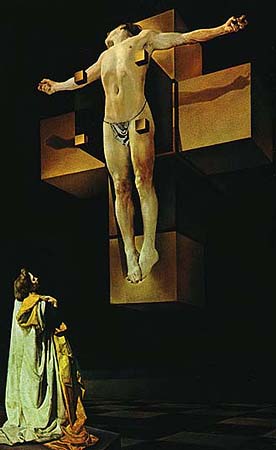
I would have thought artists like Dali and like Escher tried to develope and expand perspective capabilties of mind? To incorporate as much a “higher understanding” of the solid things, as we expect to understand all things around us?:)

Plato was pointing up for a reason, yet he believed in solid geometrical forms?

Posted in geometries, Polytopes | Tagged , | Leave a comment

The Recognition of Truth When the Hands Were Used

Plato’s theory of recollection explained why we simply recognize truths for what they are: the soul had seen them directly in an abstracter state, among the eternal Ideas, before we were born. Aristotle hedged these bets: some first principles were common to all the sciences, some were justified by the consequences they begot. All came from generalizing what we saw in the physical world. The Stoic philosophers a century later spoke of a “recognizable impression” which gave us our basic certainties. Our apprehensions first encounter a image as a open hand would a object: then begins to close around it in assent; next grasps it tightly-the fit of the hand to object was “recognition”- and finally (here the Stoic Zeno, teaching his students, would cap his clenched right fist with his left hand) holds it as knowledge.

Page 31 The Art of the Infinite, by Robert Kaplan and Ellen Kaplan, Oxford University Press

You see, I was attracted to the ideas imparted by the gestures of the hands, that I had seen these actions impart knowledge, from another time and place.

Posted in Art | Tagged | Leave a comment

Heisenberg’s Physics and Philosophies

In the famous simile of the cave Plato compares men to prisoners in a cave who are bound and can look in only one direction. They have a fire behind them and see on a wall the shadows of themselves and of objects behind them. Since they see nothing but the shadows, they regard those shadows as real and are not aware of the objects. Finally one of the prisoners escapes and comes from the cave into the light of the sun. For the first time he sees real things and realises that he had been deceived hitherto by the shadows. For the first time he knows the truth and thinks only with sorrow of his long life in the darkness. The real philosopher is the prisoner who has escaped from the cave into the light of truth, he is the one who possesses real knowledge. This immediate connection with truth or, we may in the Christian sense say, with God is the new reality that has begun to become stronger than the reality of the world as perceived by our senses. The immediate connection with God happens within the human soul, not in the world, and this was the problem that occupied human thought more than anything else in the two thousand years following Plato. In this period the eyes of the philosophers were directed toward the human soul and its relation to God, to the problems of ethics, and to the interpretation of the revelation but not to the outer world. It was only in the time of the Italian Renaissance that again a gradual change of the human mind could be seen, which resulted finally in a revival of the interest in nature.

[Socrates is speaking with Glaucon]

[Socrates:] And now, I said, let me show in a figure how far our nature is enlightened or unenlightened: –Behold! human beings living in a underground den, which has a mouth open towards the light and reaching all along the den; here they have been from their childhood, and have their legs and necks chained so that they cannot move, and can only see before them, being prevented by the chains from turning round their heads. Above and behind them a fire is blazing at a distance, and between the fire and the prisoners there is a raised way; and you will see, if you look, a low wall built along the way, like the screen which marionette players have in front of them, over which they show the puppets.

[Glaucon:] I see.

And do you see, I said, men passing along the wall carrying all sorts of vessels, and statues and figures of animals made of wood and stone and various materials, which appear over the wall? Some of them are talking, others silent.

You have shown me a strange image, and they are strange prisoners.

Like ourselves, I replied; and they see only their own shadows, or the shadows of one another, which the fire throws on the opposite wall of the cave?

True, he said; how could they see anything but the shadows if they were never allowed to move their heads?

And of the objects which are being carried in like manner they would only see the shadows?

Yes, he said.

http://www.ship.edu/~cgboeree/platoscave.html

Posted in Nothing, Socrates, Socratic Method, Sun | Tagged , , , | 2 Comments

Betrayal of Images" by Rene Magritte

I am expanding on the subject of the fifth dimension, and how I am percieving it.

The light behind, in the analogy of Plato’s cave, sets up the thinking in how issues from the source[the fire]( and here it might be referred to the fifth dimension)shines in its radiation. How is form realized?

Betrayal of Images” by Rene Magritte. 1929 painting on which is written “This is not a Pipe”

The jest here recognizes, that a picture of, and the real pipe are very different indeed. How is “form” percieved from perspective. The picture of the pipe and the real pipe are different things? And yet in this comparison, there is a third aspect as the idea?

So from the notion of the fire of things(creation)there is a progression towards reality?


Probabilties
(The Fifth Dimension)
|
|
Idea of the pipe
/ \
/ \
/ \
Picture of the pipe
/ \
/ \
/ \
The real pipe and form
Posted in Dimension, Plato's Cave | Tagged , | Leave a comment