TVO S James Gates on Does Reality have a Genetic Basis

_stwVar[“player”]= “generic_singlev2”;_stwVar[“width”]= “550”;_stwVar[“height”]= “360”;_stwVar[“autostart”]= “0”;_stwVar[“skintemplate”]= “stw_dark”;_stwVar[“clientid”]= “2121”;_stwVar[“clientcheck”]= “9Huudq3”;_stwVar[“mediaid”]= “570911”;_stwVar[“lang”]= “en”;_stwVar[“activesprinkler”]= “1”;_stwVar[“clientname”]= “perimeterinstitute”;_stwVar[“mediafileid”]= “893401”;embed();

from http://www.q2cfestival.com/play.php?l…

Lecture Series presented by KPMG – Does Reality Have a Genetic Basis?

The ultimate construction, as a basis for fundamental theoretical physics is an imperfectly understood structure called “M-Theory” or “Superstring/M-Theory” (SSMT). In a quest to create a rigorous mathematical background for SSMT, new mathematical structures called “Adinkras” have been proposed as the appropriate objects to study. This study has led to the possibility that there exist a “DNA of Reality” which will be presented in this talk.

Speaker Information

About S. James Gates Jr.

DRC University of Maryland

S. James Gates Jr., the Toll Physics Professor and Director of the Center for String and Particle Theory at the University of Maryland, serves on the Maryland State Board of Education and the US President’s Council of Advisors on Science and Technology. He is known for work on supersymmetry, supergravity, and Superstring/M-Theory.

See Also:

Posted in Uncategorized | Tagged | Leave a comment

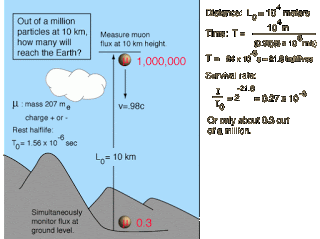
Muon Tomography

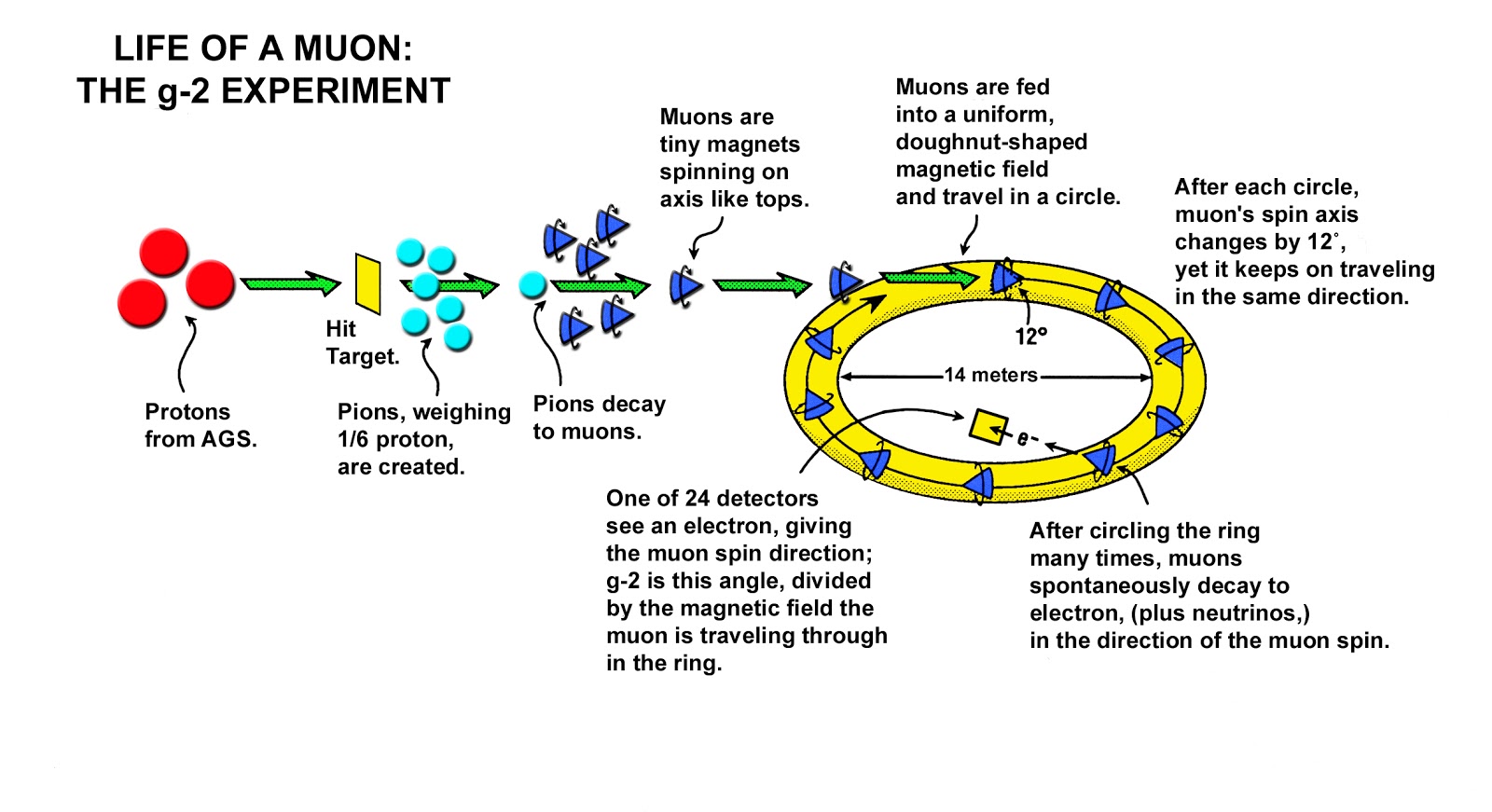
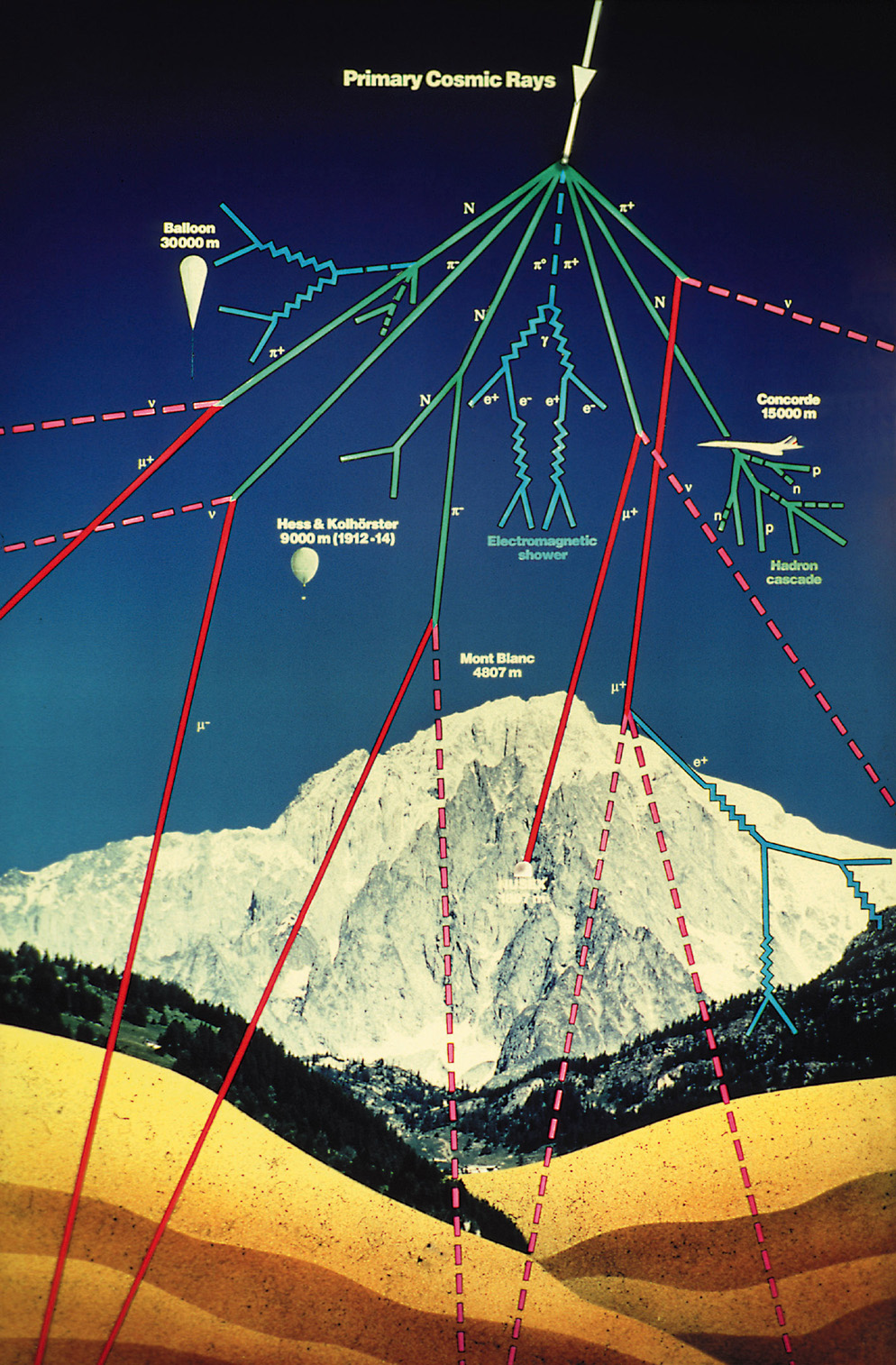
The same nuclear reaction described above (i.e. hadron-hadron impacts to produce pion beams, which then quickly decay to muon beams over short distances) is used by particle physicists to produce muon beams, such as the beam used for the muon g − 2 experiment

 Can you create relationships of Pierre Auger cosmic particle collision’s energy toward the level of energy being producing as these values in LHC? How many cosmic events can be directly related? These hold value in correlations as perceptions of relevance for me when it comes to what happens at point sources. Can we consistently say that such point source of this energetic value produce all the time QGP emissions which provide for the place that faster then light entities are possibly created?

You must know I have had a long journey in terms of putting the pieces together and of course I find it interesting that we can make use of and see into nature in ways that we had not seen before. The understanding of reducible elements makes it necessary to understanding the natural processes going on around us. To understand this Tommaso Dorigo brings the imaging back for us all to look at and possibly make use of new ways in which to measure radiative metals in amongst a full load of metal materials in a dump truck.

He reminds us of what has been sitting in the open reawakens the process of seeing  this decay chain as a necessary in the use of technologies as an example of what happens around being us caught naturally. To me this is part of the tracking I have been doing so as to see further then we had seen before.

It is really important that while I see the environment around earth as playing an instrumental part of the back drop measure of what we see as Cerenkov,  to me it asked for the evidences of things that go “Faster then the Speed of light.” I know the motto here, so it is not necessary to correct me on that issue.
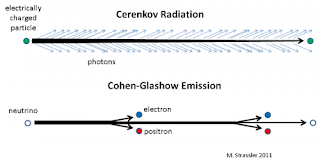
Fig. 1: Cerenkov radiation involves the nearly continuous emission of photons by a charged particle moving faster than the speed of light in its vicinity. The charged particle gradually radiates away its energy. Cohen-Glashow emission involves the occasional creation, near a speeding neutrino, of an electron-positron pair, in which the neutrino loses a large fraction of its energy in one step.Is the OPERA Speedy Neutrino Experiment Self-Contradictory?

 
 In such an environment of earth I find it appealing that this process is unfolding as we see the medium as allowing such transitions necessary as the after affect of the collision process that is taking place. So when the OPERA experiment results was announced,  I was of course interested in what they had to say. Suffice to say that such a thing as a loose wire did settle the issue once and for all.

Now of course it is important that where this collision process takes place with “the point in the environment with earth” such decimation reduced to decay change is necessarily seen. While we reproduce this naturally in our experimental processes we are also recording also in the AMS 02 outside our environment.

Blackholes

IN a vacuum the motto above about faster than light stands true here so it forces me to question that if such a case was possible then what says that what we see in the vent of information reliance toward blackhole emission would not show something in the nature of the universe that is connected that we do not understand? This then again may be a redundant factor for consideration while we wait for AMS 02 to reveal their results
Thus too,  it is of relevance that particle reductionism has taken us to that place where we wonder about the interconnectedness of the cosmos in ways that we did not understand before. It is important for this consideration to have such a point deliver the effect of QGP recognition that such traverses of particle decay as a relevant distribution point of all that we see here on earth. While it is dismissive that such emission would be quickly dispersive it is of natural consequence that we can see things here on earth such as muons as presented by Tommaso.

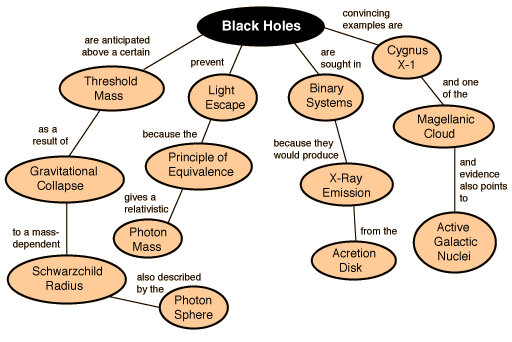
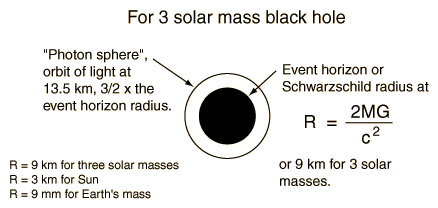
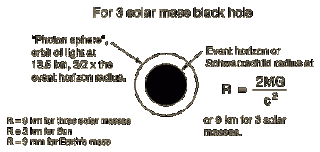
A black hole is an object so massive that even light cannot escape from it. This requires the idea of a gravitational mass for a photon, which then allows the calculation of an escape energy for an object of that mass. When the escape energy is equal to the photon energy, the implication is that the object is a “black hole”. 
See Also:

Posted in Uncategorized | Tagged , , | Leave a comment

See: Cern Accelerating Science

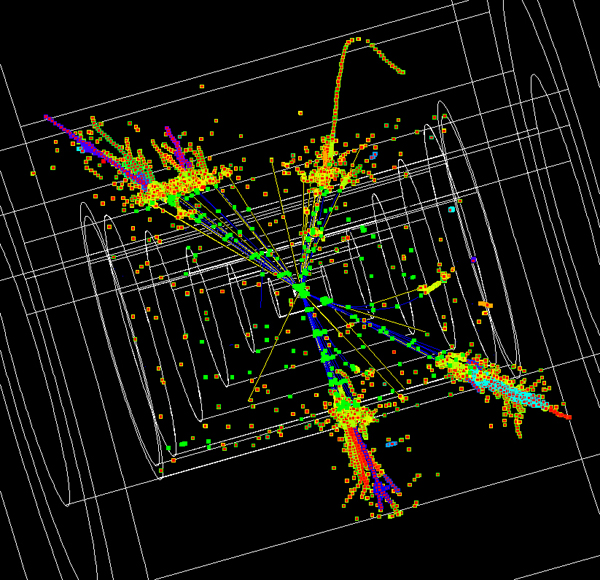
A simulation of the decay of a Higgs boson in a linear collider detector. (Image courtesy of Norman Graf.)

 Colliders Unite: Linear Colliders in New Partnership

See:
CERN Accelerating science

Posted in Uncategorized | Tagged | Leave a comment

Question: Are Blackholes Connected by Dark Matter?

Fermi observations of dwarf galaxies provide new insights on dark matter.

See Also:

Fermi Observations of Dwarf Galaxies Provide New Insights on Dark Matter

No one knows what dark matter is, but it constitutes 80 percent of the matter in our universe. By studying numerous dwarf galaxies — satellite systems that orbit our own Milky Way galaxy — NASA’s Fermi Gamma-ray Space Telescope has produced some of the strongest limits yet on the nature of the hypothetical particles suspected of making up dark matter. (Credit: NASA’s Goddard Space Flight Center)
› Download this video in broadcast quality formats from NASA Goddard’s Scientific Visualization Studio

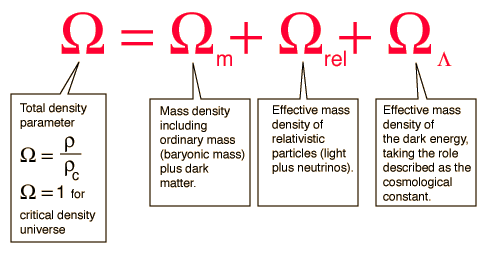
Density Parameter, Ω

  You must understand that the subject in context of question has been answered to some degree. The arguments for such an idea has its basis in science discussion already. What started this was the idea of cosmic strings that were first discussed to some degree back in 2005 and confirmation reading as as to the idea of such things in the early universe. What happens in galaxy clusters versus baryon versus non baryon relations. While this is fresh in my mind in terms of how relevant this is,  is the failing connotation of a mind who reads a lot and has a hard time of putting it together in a cohesive statement being ready for such an answer to the opening question on this blog entry.

Critical Density for the Expanding Universe

The Sun lies about 8.5 kpc from the galactic center of the Milky Way galaxy, and the visible spiral arms and globular clusters extend out to about 15 kpc. Radio frequency methods should detect gas and dust past this radius, but not much is found. It was expected that the orbital velocity of that matter which is detected should diminish, but it stays more or less constant well beyond any significant detectable mass concentrations. The orbital velocity data clearly indicates the presence of gravitational mass, and the term “dark matter” is used to describe it.

 We know as well that current questions about Dark Matter will be answered soon with AMS II? So I may find this article quickly redundant as to the question raised as some effort to what has been transposing in my own mind for some time. It is not a theory or something which I would claim as to providing some basis as to explaining the why of the omega of the universe,  but to further developed my undertaker at what lies at the edge of our current information.

Can a blackhole contain information and disperse it among the way in which our universe is forming and accelerating? These perceptions for me lie at what is happening in Di-Jet resonances as feasible explanations that are important toward the undertaking of what is happening in the universe.

At the same time again it is always in corrections that scientists will further explain that such an correlation may not be a good thing to consider here and is deceiving which is never my intent. As a student ever the examination of my thinking so as to provide a better understanding for sure.

In the above list I have excluded the case of quantum black holes (where the CMS limits are in the 4 to 5.3 TeV range and the ATLAS limits are in the 3.85-4.19 TeV range) because of the lack of a coincident set of assumptions in deriving the actual results, making it less meaningful to compare numbers. See: CMS Vs ATLAS On Dijet Resonances: Who Wins ?

You must know that the ideas that were forming in my head have directed my attention toward the reducible elemental considerations of particle physics and it’s manifestation a energy configurations. The essence of which is pointing me toward the latest research CMS updates and the questions of Di jet resonances that Tommaso Dorigo is talking about.

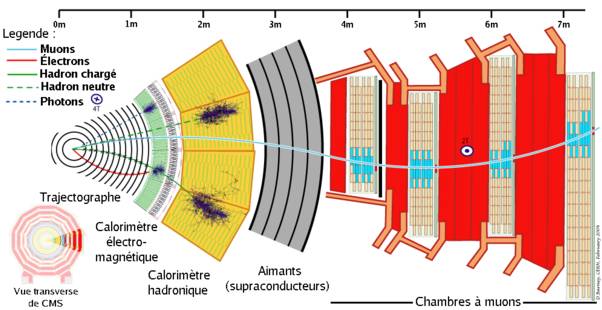
Tommaso Dorigo: A transverse cut-away view of the CMS detector is shown below, with the different signals that arise from the interaction of different particles.

I have come to rely on those scientist who are closest to what is leading in terms of experiment so as to understand not only the issue about the universe, but of what is microscopically happening in our immediate environs in terms of cosmic particle collisions.This is always an ongoing educational update for me so as to get the corrections needed in developing the ideas as they manifest, whether they are right or wrong, are leading as to the edge of where we have gone with that science.

Posted in Uncategorized | Tagged | Leave a comment

Virtual Photons Become Real in a Vacuum

Virtual Photons Become Real in a Vacuum

The zero-point energy stored in the modes of an electromagnetic cavity has experimentally detectable effects, giving rise to an attractive interaction between the opposite walls, the static Casimir effect. A dynamical version of this effect was predicted to occur when the vacuum energy is changed either by moving the walls of the cavity or by changing the index of refraction, resulting in the conversion of vacuum fluctuations into real photons. Here, we demonstrate the dynamical Casimir effect using a Josephson metamaterial embedded in a microwave cavity at 5.4 GHz. We modulate the effective length of the cavity by flux-biasing the metamaterial based on superconducting quantum interference devices (SQUIDs), which results in variation of a few percentage points in the speed of light. We extract the full 4 × 4 covariance matrix of the emitted microwave radiation, demonstrating that photons at frequencies symmetrical with respect to half of the modulation frequency are generated in pairs. At large detunings of the cavity from half of the modulation frequency, we find power spectra that clearly show the theoretically predicted hallmark of the Casimir effect: a bimodal, “sparrow-tail” structure. The observed substantial photon flux cannot be assigned to parametric amplification of thermal fluctuations; its creation is a direct consequence of the noncommutativity structure of quantum field theory. See: Dynamical Casimir effect in a Josephson metamaterial

  1. Pertti J. Hakonena
Posted in Uncategorized | Tagged | Leave a comment

What Will AMS-02 Reveal?

23% of the matter/energy balance of the universe is the form of dark matter, mysterious type of particles 6 times more abundant than normal matter which shape gravitationally all galaxies and dominates the evolution of the visible universe.Alpha Magnetic Spectrometer

One would always be curious as to what motivations help to drive the expansionary process of the universe as it is unfolding. What events in the cosmos allow us to reveal constituents entities of such expansionary process as dark energy/matter particles? Well hopefully such driven place in the cosmos is revealing of such motivational  process.

See Also:

Posted in Uncategorized | Tagged | Leave a comment

Cosmic Particle Creation

The husks of exploded stars produce some of the fastest particles in the cosmos. New findings by NASA’s Fermi show that two supernova remnants accelerate protons to near the speed of light. The protons interact with nearby interstellar gas clouds, which then emit gamma rays. Credit: NASA’s Goddard Space Flight Center See:Fermi Proves Supernova Remnants Make Cosmic Rays

See Also:

Posted in Uncategorized | Tagged , , , | Leave a comment

Loop Production on the Sun

On July 19, 2012, an eruption occurred on the sun that produced a moderately powerful solar flare and a dazzling magnetic display known as coronal rain. Hot plasma in the corona cooled and condensed along strong magnetic fields in the region. Magnetic fields, are invisible, but the charged plasma is forced to move along the lines, showing up brightly in the extreme ultraviolet wavelength of 304 Angstroms, and outlining the fields as it slowly falls back to the solar surface See: Raining Loops on the Sun

See Also:

Posted in Uncategorized | Tagged , , | Leave a comment

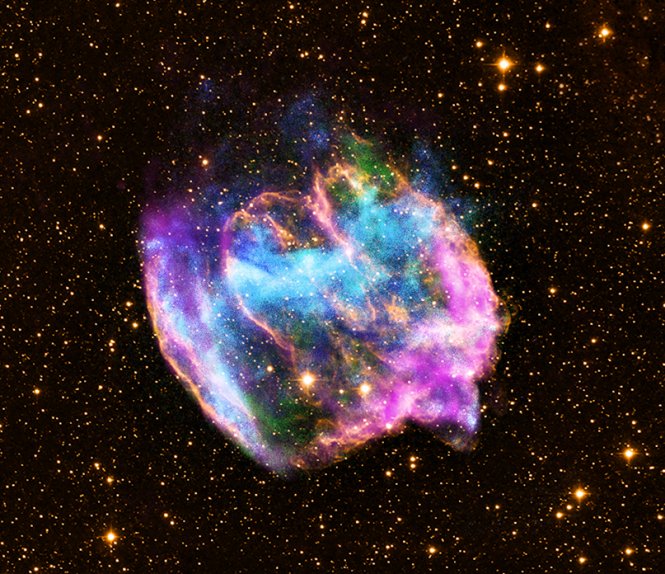
Supernova Remnant W49B

Credits: X-ray: NASA/CXC/MIT/L.Lopez et al; Infrared: Palomar; Radio: NSF/NRAO/VLA 

The highly distorted supernova remnant shown in this image may contain the most recent black hole formed in the Milky Way galaxy. The image combines X-rays from NASA’s Chandra X-ray Observatory in blue and green, radio data from the NSF’s Very Large Array in pink, and infrared data from Caltech’s Palomar Observatory in yellow.

The remnant, called W49B, is about a thousand years old, as seen from Earth, and is at a distance about 26,000 light years away.

The supernova explosions that destroy massive stars are generally symmetrical, with the stellar material blasting away more or less evenly in all directions. However, in the W49B supernova, material near the poles of the doomed rotating star was ejected at a much higher speed than material emanating from its equator. Jets shooting away from the star’s poles mainly shaped the supernova explosion and its aftermath.

By tracing the distribution and amounts of different elements in the stellar debris field, researchers were able to compare the Chandra data to theoretical models of how a star explodes. For example, they found iron in only half of the remnant while other elements such as sulfur and silicon were spread throughout. This matches predictions for an asymmetric explosion. Also, W49B is much more barrel-shaped than most other remnants in X-rays and several other wavelengths, pointing to an unusual demise for this star……. See:Supernova Remnant W49B


 See Also:

Posted in Uncategorized | Tagged , , , | Leave a comment

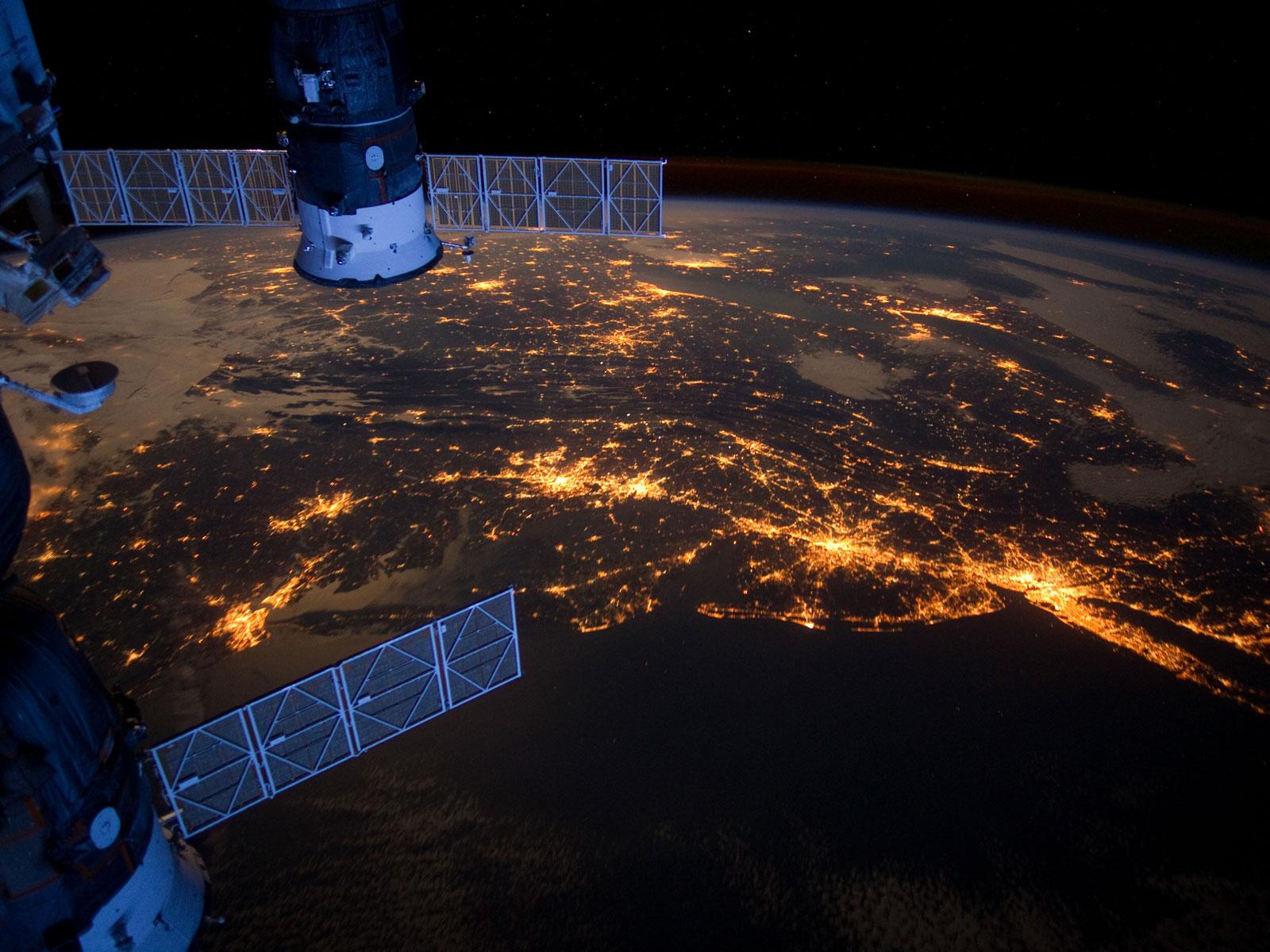
Nightlights from Coast of Eastern US

ISS030-E-078095 (6 Feb. 2012) — One of the Expedition 30 crew members aboard the International Space Station took this nighttime photograph of much of the eastern (Atlantic) coast of the United States. Large metropolitan areas and other easily recognizable sites from the Virginia/Maryland/Washington, D.C. area spanning almost to Rhode Island are visible in the scene. Boston is just out of frame at right. Long Island and the Greater Metropolitan area of New York City are visible in the lower right quadrant. Large cities in Pennsylvania (Philadelphia and Pittsburgh) are near center. Parts of two Russian vehicles parked at the orbital outpost are seen in left foreground.

Posted in Uncategorized | Tagged , , | Leave a comment