See: The hunt for the elusive Higgs
Dialogos of Eide
See: The hunt for the elusive Higgs

The Sun as viewed by the Solar Dynamics Observatory (SDO) in 193 angstrom. The verticle black area near the center is the coronal hole. Credit: NASA/SDO
› View larger UPDATE: 09.09.11 – A strong geomagnetic storm is in progress following the impact of a CME around 7:30 EDT on Sept. 9th. This could be the first of several hits from a series of CMEs expected to reach Earth during the weekend, related to the sunspot 1283 flares during the week. High-latitude sky watchers should be alert for auroras after nightfall.
A high-speed solar wind stream flowing from a large coronal hole should reach Earth on Sept. 11-12 sparking even more aurora.

The value of non-Euclidean geometry lies in its ability to liberate us from preconceived ideas in preparation for the time when exploration of physical laws might demand some geometry other than the Euclidean. Bernhard Riemann
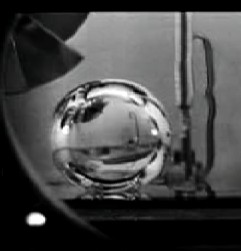 |
| See Water in Zero Gravity, by Backreaction |
Is it possible for us to get this “sense of being” without understanding what momentum is? Do we say it just feels right or do we say that something flows according to the way in which we think about time? If you were to say things must be discrete by nature then how would any logic flow from the idea of such particularization?
Can I realistically call such a sphere in space a spherical cow? For a moment consider that such a collapse will be of acoustical variety type that we can say in the absence of earths constraints we can see how the universe likes to appeal to our nature of particularization by producing particles for which we can examine the substructure of the world we live in, in science?
In the case of discrete measure how is it such a transfer can take place in mind that the experience becomes part and parcel of the greater reality “of moving in abstract spaces?” Do we say this is reality but one as such configured and mathematically devised so as to seek correlations in the world that make sense?
Today, however, we do have the opportunity not only to observe phenomena in four and higher dimensions, but we can also interact with them. The medium for such interaction is computer graphics. Computer graphic devices produce images on two-dimensional screens. Each point on the screen has two real numbers as coordinates, and the computer stores the locations of points and lists of pairs of points which are to be connected by line segments or more complicated curves. In this way a diagram of great complexity can be developed on the screen and saved for later viewing or further manipulationFrom Flatland to Hypergraphics: Interacting with Higher Dimensions
I am trying to formulate a response in regard to the opening question in title. So please be patient with me as things appear in this blog posting.
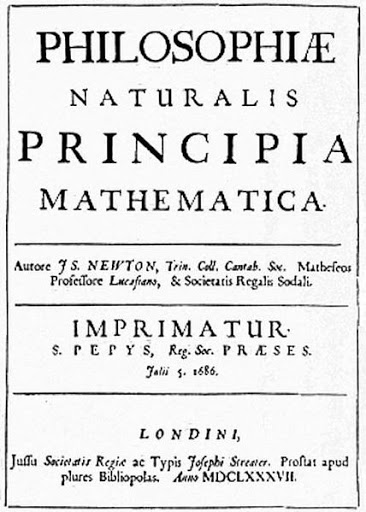 |
| Title page of the 1st edition of Isaac Newton‘s Principia defining the laws of motion. |
Mōmentum was not merely the motion, which was mōtus, but was the power residing in a moving object, captured by today’s mathematical definitions. A mōtus, “movement”, was a stage in any sort of change,[1] while velocitas, “swiftness”, captured only speed. The concept of momentum in classical mechanics was originated by a number of great thinkers and experimentalists. The first of these was Byzantine philosopher John Philoponus, in his commentary to Aristotle´s Physics. As regards the natural motion of bodies falling through a medium, Aristotle’s verdict that the speed is proportional to the weight of the moving bodies and indirectly proportional to the density of the medium is disproved by Philoponus through appeal to the same kind of experiment that Galileo was to carry out centuries later.[2] This idea was refined by the European philosophers Peter Olivi and Jean Buridan. Buridan referred to impetus being proportional to the weight times the speed.[3][4] Moreover, Buridan’s theory was different to his predecessor’s in that he did not consider impetus to be self dissipating, asserting that a body would be arrested by the forces of air resistance and gravity which might be opposing its impetus.[5]
Of course I am always interested in the history of what Momentum might mean. How this is built conceptually and historically so as to define this by a method by which we may measure some thing realistically.
The somatosensory system is a diverse sensory system composed of the receptors and processing centres to produce the sensory modalities such as touch, temperature, proprioception (body position), and nociception (pain). The sensory receptors cover the skin and epithelia, skeletal muscles, bones and joints, internal organs, and the cardiovascular system. While touch (also, more formally, tactition; adjectival form: “tactile” or “somatosensory”) is considered one of the five traditional senses, the impression of touch is formed from several modalities. In medicine, the colloquial term touch is usually replaced with somatic senses to better reflect the variety of mechanisms involved.
The system reacts to diverse stimuli using different receptors: thermoreceptors, nociceptors, mechanoreceptors and chemoreceptors. Transmission of information from the receptors passes via sensory nerves through tracts in the spinal cord and into the brain. Processing primarily occurs in the primary somatosensory area in the parietal lobe of the cerebral cortex.
 |
| The cortical homunculus was devised by Wilder Penfield |
At its simplest, the system works when activity in a sensory neuron is triggered by a specific stimulus such as heat; this signal eventually passes to an area in the brain uniquely attributed to that area on the body—this allows the processed stimulus to be felt at the correct location. The point-to-point mapping of the body surfaces in the brain is called a homunculus and is essential in the creation of a body image. This brain-surface (“cortical”) map is not immutable, however. Dramatic shifts can occur in response to stroke or injury.
 |
Brain Stretching |
Haptics in virtual reality
Haptics are gaining widespread acceptance as a key part of virtual reality systems, adding the sense of touch to previously visual-only solutions. Most of these solutions use stylus-based haptic rendering, where the user interfaces to the virtual world via a tool or stylus, giving a form of interaction that is computationally realistic on today’s hardware. Systems are also being developed to use haptic interfaces for 3D modeling and design that are intended to give artists a virtual experience of real interactive modeling. Researchers from the University of Tokyo have developed 3D holograms that can be “touched” through haptic feedback using “acoustic radiation” to create a pressure sensation on a user’s hands. (See Future Section) The researchers, led by Hiroyuki Shinoda, currently have the technology on display at SIGGRAPH 2009 in New Orleans.[15]


It is important that people realize that as much as topological seasoning is added to the world by myself, I see ourselves intrinsically linked to the inductive/deductive process. It is as if the tail of each is linked as a image of a our inner and outer relation with the world continually exchanged. We are the central process in this, as if link the past and the future together, as to the outcome in life. A self eventual recognition of the arche and our place on it as to the decision and acceptance of outcome according to our conclusions?
I think that Fig. 34.1 best expresses my position on this question, where each of three worlds, Platonic-mathematical, physical and mental-has it’s own kind of reality, and where each is (deeply and mysteriously) found in one that precedes it ( the worlds take cyclicly). I like to think that, in a sense the Platonic world may be the most primitive of the three, since mathematics is a kind of necessity, virtually conjuring its very existence through logic alone. Be that as it may, there is a further mystery, or paradox, of the cyclic aspect of these worlds , where each seems to be able to encompass the succeeding one in its entirety, while itself seeming to depend only upon a small part of its predecessor.”(Page 1028-The Road to Reality- Roger Penrose- Borzoi Book, Alfred A. Knoff- 2004)
For me, the visual helps to reinforce some the understanding that is required of how let’s say Sir Roger Penrose may look at the idea of “information transference?” How I may see this in individuals who are interacting with the world. I believe too, that how the universe is formulated into the Cyclical Universe is to direct our attention to the facets of time attached to the ideas of how this is formulated within ourselves as well. This are the same correlations of the past, as well as the future, in our now, in our universe(our neighborhood) as well.
 |
|
Plato’s problem is the term given by Noam Chomsky to the gap between knowledge and experience. It presents the question of how we account for our knowledge when environmental conditions seem to be an insufficient source of information. It is used in linguistics to refer to the “argument from poverty of the stimulus” (APS). In a more general sense, Plato’s Problem refers to the problem of explaining a “lack of input.”
Solving Plato’s Problem involves explaining the gap between what one knows and the apparent lack of substantive input from experience (the environment). Plato’s Problem is most clearly illustrated in the Meno dialogue, in which Socrates demonstrates that an uneducated boy nevertheless understands geometric principles.
The understanding here is that all knowledge exists in the universe and that we only have to awaken it within ourselves. This hasn’t changed my view on the universal access to information that we can tap into. How is this accomplished.
This view I carry to the world of science and look for correspondences in experimental associations. I believe the answers we are looking for already exist. It is just a matter of asking the right questions, as well as looking inside as to the truth of what we are looking at, as a potential in the discourse of our existence as human beings. The role we are playing as components of this reality to better ourselves.

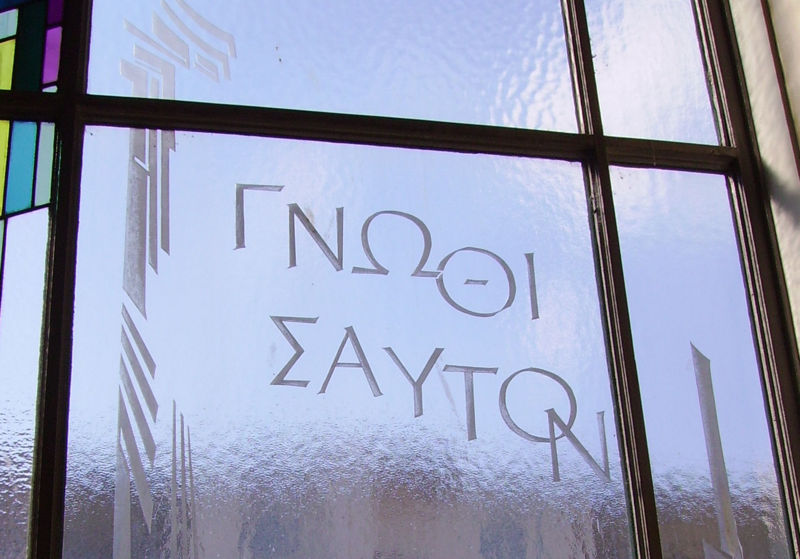 A stained glass window with the contracted version γνωθι σαυτόν.
The saying “Know thyself” may refer by extension to the ideal of understanding human behavior, morals, and thought, because ultimately to understand oneself is to understand other humans as well. However, the ancient Greek philosophers thought that no man can ever comprehend the human spirit and thought thoroughly, so it would have been almost inconceivable to know oneself fully. Therefore, the saying may refer to a less ambitious ideal, such as knowing one’s own habits, morals, temperament, ability to control anger, and other aspects of human behavior that we struggle with on a daily basis.
It may also have a mystical interpretation. ‘Thyself’, is not meant in reference to the egotist, but the ego within self, the I AM consciousness.
***
Delphi became the site of a major temple to Phoebus Apollo, as well as the Pythian Games and the famous prehistoric oracle. Even in Roman times, hundreds of votive statues remained, described by Pliny the Younger and seen by Pausanias. Supposedly carved into the temple were three phrases: γνωθι σεαυτόν (gnothi seauton = “know thyself”) and μηδέν άγαν (meden agan = “nothing in excess”), and Εγγύα πάρα δ’ατη (eggua para d’atē = “make a pledge and mischief is nigh”),[6] as well as a large letter E.[7] Among other things epsilon signifies the number 5. Plutarch’s essay on the meaning of the “E at Delphi” is the only literary source for the inscription. In ancient times, the origin of these phrases was attributed to one or more of the Seven Sages of Greece,[8] though ancient as well as modern scholars have doubted the legitimacy of such ascriptions.[9] According to one pair of scholars, “The actual authorship of the three maxims set up on the Delphian temple may be left uncertain. Most likely they were popular proverbs, which tended later to be attributed to particular sages
***

“Let no one destitute of geometry enter my doors.” Plato (c. 427 – 347 B.C.E.)
“[Geometry is] . . . persued for the sake of the knowledge of what eternally exists, and not of what comes for a moment into existence, and then perishes, …[it] must draw the soul towards truth and give the finishing touch to the philosophic spirit.“
III: The “Geometrical Problem” in the Meno.
Further along in the Meno occurs the celebrated case of the Geometrical Example at Meno 87, which in contrast to the previous mathematical illustration, has been twisted, tortured, and intentionally passed over for two centuries. Jebb said (loc.cit.) asven over a century ago:
The hypothesis appears to be rather trivial and to have no mathematical value. . . (which Raven echoes in 1965)
and here follow some barely intelligible geometrical details”.
Bluck however, in 1961 devotes an excursus of some sixteen pages to a complete review of views on the problem, which include an array or barely intelligible geometrical details. The passage is made more difficult of interpretation by the fact that Socrates introduces the geometrical example in a very summary manner, which some have felt was an indication or its relative unimportance.
I believe on the contrary that the almost schematic reference implies that the topic and the example were well known to the Platonic audience, and did not need explanation. Plato knows how to explain in full, and when he refrains we must understand the matter to be common knowledge. The problem as it occurs at Meno 87 a is briefly this:We will proceed from here on like the geometer who when asked if a given triangle can be inscribed in a given circle, will say:
‘I can’t say, but let us proceed hypothetically or experimentally, draw out one leg, swing the other two and see if it falls short or exceeds the rim of the circle.’
In making this paraphrase I have added the word “experimentally” for obvious reasons, and I have taken the noun chorion correctly as area (not rectangle or a triangle, as has been said, which means nothing) in a sense very well attested. So apparently with these conditions, the words themselves are not obscure or really unintelligible, although as yet the meaning has not yet come to the surface.
See: γνώθι σεαυτόν

Plato likened our view of the world to that of an ancient forebear watching shadows meander across a dimly lit cave wall. He imagined our perceptions to be but a faint inkling of a far richer reality that flickers beyond reach. Two millennia later, Plato’s cave may be more than a metaphor. To turn his suggestion on its head, reality—not its mere shadow—may take place on a distant boundary surface, while everything we witness in the three common spatial dimensions is a projection of that faraway unfolding. Reality, that is, may be akin to a hologram. Or, really, a holographic movie.
The journey to this peculiar possibility combines developments deep and far-flung—insights from general relativity; from research on black holes; from thermodynamics, quantum mechanics, and, most recently, string theory. The thread linking these diverse areas is the nature of information in a quantum universe.
Physicists Jacob Bekenstein and Stephen Hawking established that, for a black hole, the information storage capacity is determined not by the volume of its interior but by the area of its surface. But when the math says that a black hole’s store of information is measured by its surface area, does that merely reflect a numerical accounting, or does it mean that the black hole’s surface is where the information is actually stored? It’s a deep issue and has been pursued for decades by some of the most renowned physicists. The answer depends on whether you view the black hole from the outside or from the inside—and from the outside, there’s good reason to believe that information is indeed stored at the event horizon. This doesn’t merely highlight a peculiar feature of black holes. Black holes don’t just tell us about how black holes store information. Black holes inform us about information storage in any context. See:Our Universe May Be a Giant Hologram
See Also: Physics and Philosophie Pay attention too, #8. (And Stefan submits: What is the ontological status of AdS/CFT?)[also pay attention to comments relating to #8]

It’s an older article but definitely worth the read in context of spintronics technology.
 |
At I.B.M.’s research lab in San Jose, Calif., Stuart S. P. Parkin is working on a device that could increase chip data storage by 10 to 100 times.
Redefining the Architecture of Memory |


Time has no independent existence apart from the order of events by which we measure it. — Albert Einstein
While Event has since past, I hope the lecture itself will remain in public domain. It helps so as to see the context of the discussion provided by this conference with regard to that subject of time.
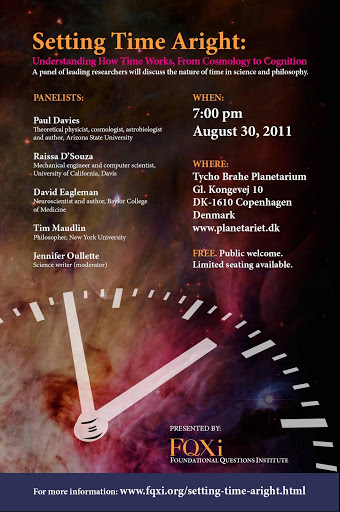
In 1952, in his book Relativity, Einstein writes:
Since there exists in this four dimensional structure [space-time] no longer any sections which represent “now” objectively, the concepts of happening and becoming are indeed not completely suspended, but yet complicated. It appears therefore more natural to think of physical reality as a four dimensional existence, instead of, as hitherto, the evolution of a three dimensional existence
.
If man thinks of the totality as constituted of independent fragments, then that is how his mind will tend to operate, but if he can include everything coherently and harmoniously in an overall whole that is undivided, unbroken, and without a border then his mind will tend to move in a similar way, and from this will flow an orderly action within the whole. (David Bohm, Wholeness and the Implicate Order, 1980)
The alternative is to disbelieve the arguments that time is emergent-which were never very convincing- and instead formulate quantum cosmology in such a way that time is always real. I would suggest that the Boltzman Brain’s paradox is the reducto ad absurdum of the notion that time is emergent and that rather than play with little fixes to it we should try to take seriously the opposite idea: that time is real.
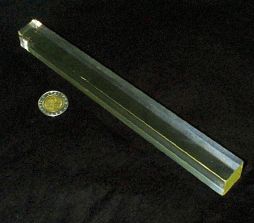 Bar of Lead Tungstate Source: A Quantum Diaries Survivor-Calorimeters for High Energy Physics experiments – part 1 April 6, 2008
Calorimeters measure the collective behavior of particles traveling along approximately the same path, and are thus naturally suited for the measurement of jets-Dorigo Tommaso
See:


How would you map this above?
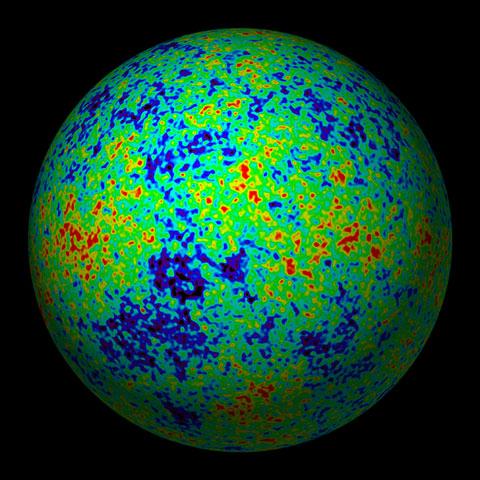 |
| WMAP image of the Cosmic Microwave Background Radiation |
Here’s the thing for those blog followers who are interested in the application of sound as a visual representation of an external world of senses.
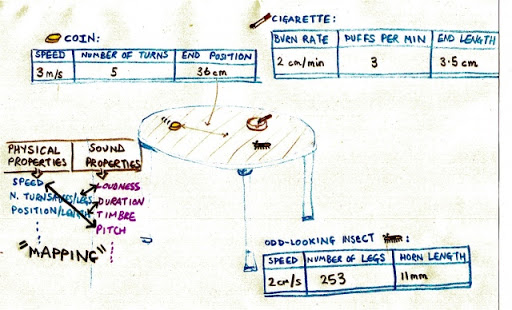
In this example I’m going to map speed to the pitch of the note, length/postion to the duration of the note and number of turns/legs/puffs to the loudness of the note.See: How to make sound out of anything.
I have my reasons for looking at the trail that began with Gravitational wave research and development. If we are accustom to seeing and concreting all that reality has for us, can a question be raised in mind with how one has been shocked by an anomaly?
I am not asking for anyone to abandon their views on the science of, just respect that while not following the rules of science here as to my motivational underpinnings, I have asked if science can see gravity in ways that have not be thought of before. This is not to counter anything that has been done before.
The historic approach to Gravitational Research was important as well, to trace it back to it’s beginning.
Can we use such measures to exemplify an understanding of the world we live according to a qualitative approach? This has occupied my thoughts back to when I first blogged about JosephWeber in 2005. Here is a 2000 article linked.
In the late 1950s, Weber became intrigued by the relationship between gravitational theory and laboratory experiments. His book, General Relativity and Gravitational Radiation, was published in 1961, and his paper describing how to build a gravitational wave detector first appeared in 1969. Weber’s first detector consisted of a freely suspended aluminium cylinder weighing a few tonnes. In the late 1960s and early 1970s, Weber announced that he had recorded simultaneous oscillations in detectors 1000 km apart, waves he believed originated from an astrophysical event. Many physicists were sceptical about the results, but these early experiments initiated research into gravitational waves that is still ongoing. Current gravitational wave experiments, such as the Laser Interferometer Gravitational Wave Observatory (LIGO) and Laser Interferometer Space Antenna (LISA), are descendants of Weber’s original work. See:Joseph Weber 1919 – 2000
Space, we all know what it looks like. We’ve been surrounded by images of space our whole lives, from the speculative images of science fiction to the inspirational visions of artists to the increasingly beautiful pictures made possible by complex technologies. But whilst we have an overwhelmingly vivid visual understanding of space, we have no sense of what space sounds like.
See previous entries on “Weber Bar” by typing in Search Feature on side bar. See also below.

Ya okay…all these opinions….it still begs the question of “What makes you you?“
Cells are just the building blocks of our body, like the bricks of a house, but who is the architect, who coordinates the building of this house. When someone has died, only mortal remains are left: only matter. But where is the director of the body?What about our consciousness when we die? Is someone his body, or do we “have” a body? About the Continuity of Our Consciousness
Even though there is a logical explanation for any argument saying “death is death” it can run to the contrary unless consciousness is understood?
See:Science of Consciousness
An interview with David Chalmers discussing his theory of consciousness, the hard problem, and the explanatory gap.
So David offers the point of view of recognizing all the constraints of communication as being eliminated except for what results as the book, listed here from Amazon, is written from the perspective of a “blink of the eye.”
What was the next step? But to recognize that consciousness may or could be communicated in some way beyond the blink of that eye? So we recognize a departure point needed for ways in which such communications may be attempted if all these means of expression had been removed. How could you communicate if someone was in a coma/ mentally expressive, is still consciously living and viable according to the measures given to the brain measure when activated but still having no way physical way with which to communicate?

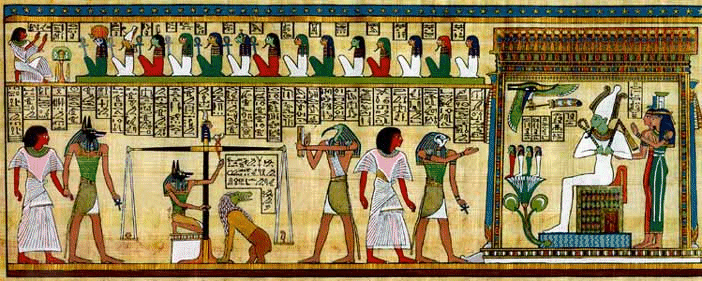
If the heart was free from the impurities of sin, and therefore lighter than the feather, then the dead person could enter the eternal afterlife.
Apps for any screen
A blog by the Institute for Quantum Information and Matter @ Caltech
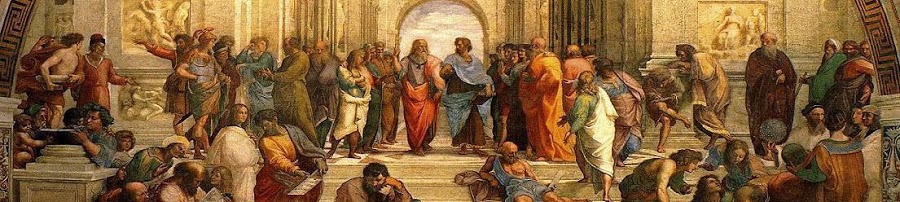
PLato said,"Look to the perfection of the heavens for truth," while Aristotle said "look around you at what is, if you would know the truth" To Remember: Eskesthai
A blog about physics... mostly.
Conversations About Science with Theoretical Physicist Matt Strassler
 Dialogos of Eide


