Being Able to See

How does one turn on the internal vision when we use our eyes to look at the day to day happenings with eyes wide open?

What made this interesting for me was the fact that sensory examination could have been used physically by people by no fault of their own under the auspice ofSynesthesia.. This is an examination where the internal wiring causes overlaps in sensory perceptions. So anyway the idea here is that we look at what intentionality means here in the progress toward science and examination of what we can gain in understanding a way in being able to see differently.

Experimental research

In recent years, there has been a large amount of work done on the concept of intentional action in experimental philosophy.[1] This work has aimed at illuminating and understanding the factors which influence people’s judgments of whether an action was done intentionally. For instance, research has shown that unintended side effects are often considered to be done intentionally if the side effect is considered bad and the person acting knew the side effect would occur before acting. Yet when the side effect is considered good, people generally don’t think it was done intentionally, even if the person knew it would occur before acting. The most well-known example involves a chairman who implements a new business program for the sole purpose to make money but ends up affecting the environment in the process. If he implements his business plan and in the process he ends up helping the environment, then people generally say he unintentionally helped the environment; if he implements his business plan and in the process he ends up harming the environment, then people generally say he intentionally harmed the environment. The important point is that in both cases his only goal was to make money.[2] While there have been many explanations proposed for why the “side-effect effect” occurs, researchers on this topic have not yet reached a consensus.

So we understand that there is a physiological effect to how perception can be altered by understanding the effect of  Synesthesia? Such alteration can be given to the idea that if we change the way we see experimental processes as in sound application what comparative analogy can be safe? Can we say that it would be acceptable to science?

For example, in 1704 Sir Isaac Newton struggled to devise mathematical formulas to equate the vibrational frequency of sound waves with a corresponding wavelength of light. He failed to find his hoped-for translation algorithm, but the idea of correspondence took root, and the first practical application of it appears to be the clavecin oculaire, an instrument that played sound and light simultaneously. It was invented in 1725. Charles Darwin’s grandfather, Erasmus, achieved the same effect with a harpsichord and lanterns in 1790, although many others were built in the intervening years, on the same principle, where by a keyboard controlled mechanical shutters from behind which colored lights shne. By 1810 even Goethe was expounding correspondences between color and other senses in his book, Theory of Color. Pg 53, The Man Who Tasted Shapes, by Richard E. Cytowic, M.D.

 What if you caused intentional blindness in the sense that you isolate the sensory effect of allowing eyes to be deprived of light. Force the condition to effect internalize vision to take place?  So, what happens in isolation? Does the mind then rely on the world constructs that we had had during our lifetimes to say that the whole internal world is then the effect of what we had gained in experience through seeing. How do you the separate the effect of or emotive states from the understanding that our perceptions colored the world of experience and then forced it toward a memory induced fabrication of what we had experienced?

Now you say, how did that happen? Such a fast shift from what is apparent in the looking at the world is to see that we had lost control of the visual capabilities of see reality as it is?  There is this understanding that without intentionality  a ruthless world of our emotive states can take over quite easily as we say that all of reality is clean and perfect without the recognition of what science is to mean.
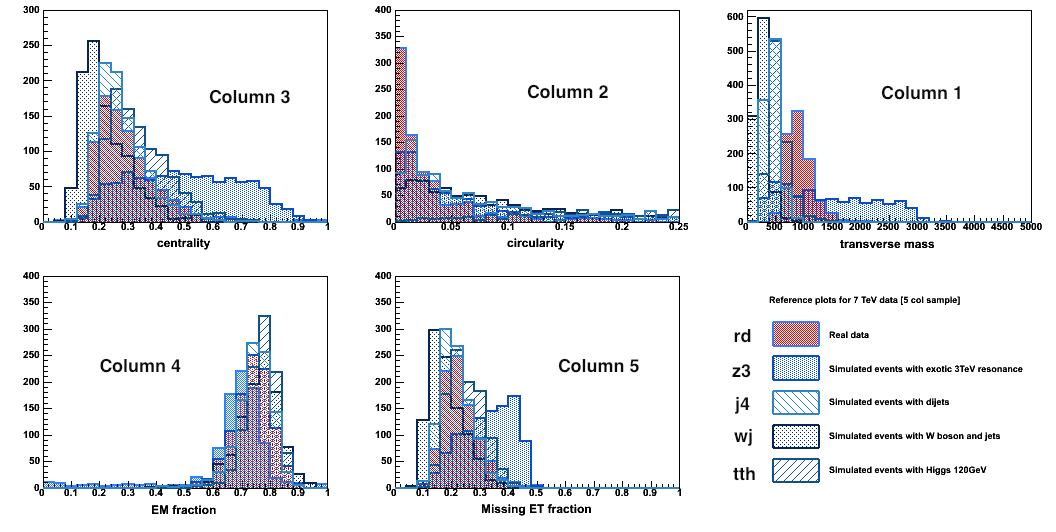
5 types of ATLAS event shape data

The data is first processed using the vast and all-powerful ATLAS software framework. This allows raw data (streams of ones and zeroes) to be converted step-by-step into ‘objects’ such as silicon detector hits and energy deposits. We can reconstruct particles using these objects. The next step is to convert the information into a file containing two or three columns of numbers known as a “breakpoint file”. It can also be used as a “note list”. This kind of file can be read by compositional software such as the Composers Desktop Project (CDP) and Csound software used for this project. See: How is Data Converted into Sounds

So while you do experiments it is important to have “intentionality” in regard to your experiments? If this is so then what you had done is prepare for the excursion to what you want to find out? You already had some idea? You want to put controls in the environment?

 How do you separate consciousness from the clean lines of experimentation and reality seeking? You can’t? Because without it you were not able to put the controls in that you need too,  in order to find something out. You are part of the vibrations.
 
The very fact that all of the environment is based on the factors of sound would have you believe then that such conversions are possible and that all sounds are envisioned within the context of the world of sound controlled?

I want to force you to be able to see differently. I want to convert the reality of existence of seeing in a vibrational mode. How does this translate then into consciousness and experimentation? What will we be able to find out if we change the constraints on or examinations of reality if we force the mind to see so?


Posted in Sonification, Sound, Synesthesia | Tagged , , , | Leave a comment

The Ganzfeld effect

The  Ganzfeld effect (from German for “complete field”) is a phenomenon of visual perception caused by staring at an undifferentiated and uniform field of color. The effect is described as the loss of vision as the brain cuts off the unchanging signal from the eyes. The result is “seeing black”[1] – apparent blindness.

History 


In the 1930s, research by psychologist Wolfgang Metzger established that when subjects gazed into a featureless field of vision they consistently hallucinated and their electroencephalograms changed.

The Ganzfeld effect is the result of the brain amplifying neural noise in order to look for the missing visual signals. The noise is interpreted in the higher visual cortex, and gives rise to hallucinations. This is similar to dream production because of the brain’s state of sensory deprivation during sleep.

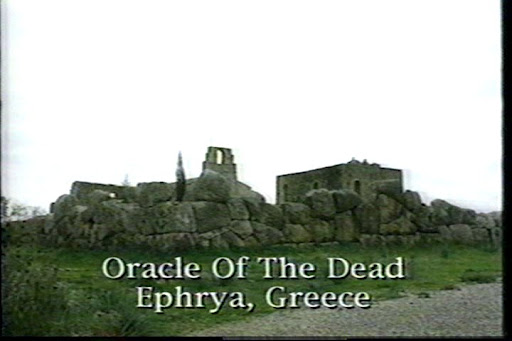
The Ganzfeld effect has been reported since ancient times. The adepts of Pythagoras retreated to pitch black caves to receive wisdom through their visions[2], known as the prisoner’s cinema. Miners trapped by accidents in mines frequently reported hallucinations, visions and seeing ghosts when they were in the pitch dark for days. Arctic explorers seeing nothing but featureless landscape of white snow for a long time also reported hallucinations and an altered state of mind.

The effect is a component of a Ganzfeld experiment, a technique used in the field of parapsychology.
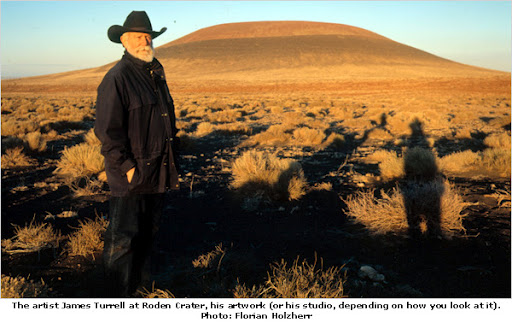
The artist James Turrell (partly inspired by clear blue skies) has created many such “Ganzfelds” throughout his oeuvre.

See also


References

  1. ^ Ramesh B. Ganzfeld Effect.
  2. ^ Ustinova, Yulia.Caves and the Ancient Greek Mind: Descending Underground in the Search for Ultimate Truth, Oxford University Press US, 2009. ISBN 0199548560
  • Wolfgang Metzger, “Optische Untersuchungen am Ganzfeld.” Psychologische Forschung 13 (1930) : 6-29. (the first psychophysiological study with regard to Ganzfelds)

 EGG: Did you reach this conclusion through more traditional media, like painting or sculpture?

JT: I haven’t had anything to do with either sculpture or painting. I have done works that look painted or works that have form and look like sculpture. I make these spaces that apprehend light for your perception. In a way, it’s like Plato’s cave, where we are sitting in the cave looking at the reflection of reality with our backs to reality. I make these spaces where the spaces themselves are perceivers or in some way pre-form perception. It’s a little bit like what the eye does. I mean, I look at the eye as the most exposed part of the brain, as something that is already forming perception. I make these rooms that are these camera-like spaces that in some way form light, apprehend it to be something that’s physically present.

EGG: What happens when you use space this way?

JT: This results in an art that is not about my seeing, it’s about your direct perception of the work. I’m interested in having a light that inhabits space, so that you feel light to be physically present. I mean, light is a substance that is, in fact, a thing, but we don’t attribute thing-ness to it. We use light to illuminate other things, something we read, sculpture, paintings. And it gladly does this. But the most interesting thing to find is that light is aware that we are looking at it, so that it behaves differently when we are watching it and when we’re not, which imbues it with consciousness. Often people say that they want to touch some of the work I do. Well, that feeling is actually coming from the fact that the eyes are touching, the eyes are feeling. And this happens because the eyes are quite sensitive only in low light, for which we were made. We’re actually made for this light of Plato’s cave, the light of twilight. See: Interview with James Turrell

psychomanteums

The room is set up to optimize psychological effects such as trance. Its key features are low light or near-darkness, flickering light, and a mirror. The dimness represents a form of visual sensory deprivation, a condition helpful to trance induction, the undifferentiated colour without horizon producing the Ganzfeld effect[4], a state of apparent “blindness”. The Ganzfeld experiment replicates the conditions of a psychomanteum where a state of trance may be induced by a uniform field of vision. In the way of strobe or flashing light, stimulus is provided by indirect, moving light in the psychomanteum. Flickering candles or lamps are sometimes recommended to induce hallucination. It is supposed the indeterminate depth of the mirror’s darkness allows the eyes to relax and become unfocused, a state that reduces alertness.[2]

Dr. Raymond Moody, author of the 1981 book about near death experiences, Life After Life, included the psychomanteum in his research trialling 300 subjects which he recorded in his 1993 book, Reunions. Moody viewed the room as a therapeutic tool to heal grief and bring insight.[2]

    Posted in Book of the Dead, Deep Play, Mind Maps, Plato's Cave | Tagged , , , | Leave a comment

    A Superset Universe?

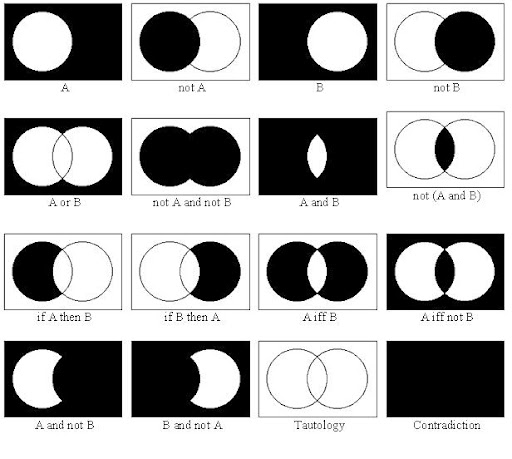
    How would you draw a Universe with all theories as being part of,  as a subset?

    Pictorial representations can be very useful in presenting information or assisting reasoning. Venn diagram is an example. Venn diagrams are used to represent classes of objects, and they can also assist us in reasoning about the relations between these classes. They are named after the English mathematician John Venn (1834 – 1923), who was a fellow at Cambridge University.

    A few may have taken in the link supplied to a lecture given by Thomas Campbell with regard to his MBT book he had written. Now, I was drawn to the idea of a Venn diagram presented in his lecture and the idea of how one might have use this diagram as a question about the universe and it’s subsets? How would you draw it?

    I give a current posting by Sean Carroll with regards to his opinion on a book written by Lawrence Krauss. So there all these theories about the nature of the universe and some scientists of course have their opinions.

    …………Or not, of course. We should be good empiricists and be open to the possibility that what we think of as the universe really does exist within some larger context. But then we could presumably re-define that as the universe, and be stuck with the same questions. As long as you admit that there is more than one conceivable way for the universe to be (and I don’t see how one could not), there will always be some end of the line for explanations. I could be wrong about that, but an insistence that “the universe must explain itself” or some such thing seems like a completely unsupportable a priori assumption. (Not that anyone in this particular brouhaha seems to be taking such a stance.) SEE:A Universe from Nothing?

    Physicists have proposed several theories to explain why Λ is so small. One of the most popular — the “anthropic principle” — states that Λ is randomly set and has very different values in different parts of the universe (figure 1). We happen to live in a rare region, or “bubble”, where Λ has the value we observe. This value has allowed stars, planets and therefore life to develop. However, this theory is also unsatisfactory for many scientists because it would be better to be able to calculate Λ from first principles.

    See also:

    Posted in Anthropic Principal, Cosmology, False Vacuum, Heisenberg, Sir Roger Penrose, Steven Weinberg, Symmetry, Symmetry Breaking, Virtual Reality | Tagged , , , , , , , , | 4 Comments

    Particle Constructs

    Several large experimental groups are hot on the trail of this elusive subatomic particle which is thought to explain the origins of particle mass.  Higgs Update Today

    What use the Higg’s Mechanism?

    Just as one might look at GRB examples of motivation that come to us in natural cosmic particle collisions, by looking back in time is it not to strange to wonder how such compositions are given to the contacts  and explorations of where any beginnings may materialize. So we are given clues?

    The structure is being detail as if in association to identifying the elements in between Mendeleev’s elemental table components? Seaborg’s octaves? It is an analogy in comparison as you might track LHC components of particle expressions?

    this increases his resistance to movement, in other words, he acquires mass, just like a particle moving through the Higgs field

    Latest research can pinpoint what I am saying yet it is through such expressions we might ask how is it an Einstein crossing the room can gather so many minds and ideas to it? Can we say then that consciousness is much the same, yet, it isn’t the idea of a heat death that such notions are not palatable with what happens in the brain but the idea that new ideas can enter. You see?

    See Also:

    Posted in Higgs, Jet Quenching, Quark Gluon PLasma | Tagged , , | 3 Comments

    Infographics: Magnifying the Universe

    I thought this kind of neat and wondered…..maybe a scientist could correct if any misrepresentation is evident in the following demonstration.

    The Universe made possible by Number Sleuth

    Posted in Uncategorized | Leave a comment

    Brian Greene: Why is our universe fine-tuned for life?

    At the heart of modern cosmology is a mystery: Why does our universe appear so exquisitely tuned to create the conditions necessary for life? In this tour de force tour of some of science’s biggest new discoveries, Brian Greene shows how the mind-boggling idea of a multiverse may hold the answer to the riddle.

    Brian Greene is perhaps the best-known proponent of superstring theory, the idea that minuscule strands of energy vibrating in a higher dimensional space-time create every particle and force in the universe.

    See Also

    Posted in dark energy, Lisa Randall, Multiverse, String Theory | Tagged , , , | Leave a comment

    Do Gamma rays hint at dark matter?

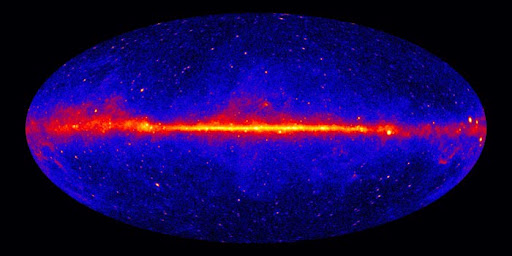
    Using a new statistical technique to analyse publicly available data from NASA’s Fermi Space Telescope, an astrophysicist in Germany says he may have spotted a tell-tale sign of exotic particles annihilating within the Milky Way. If proved to be real, this “gamma-ray line” would, he claims, be a “smoking-gun signature” of dark matter.

    There is a wide body of indirect observational evidence that an invisible substance accounts for some 80% of the matter in the universe. Although physicists can measure the effects that this dark matter has on the visible universe, they have very little understanding of what this mysterious stuff actually is. As well as looking for direct evidence of dark matter by detecting it – or even producing it – here on Earth, researchers are also scouring the skies for signs of the particles that dark matter might produce when self-annihilating. An excess of high-energy positrons (anti-electrons) observed by the Italian-led PAMELA spacecraft in 2008, and confirmed by Fermi last year, might be such a signature. However, it is possible that these positrons are produced by processes unrelated to dark matter. See:Gamma rays hint at dark matter

    Also a Physics World see: Has Fermi glimpsed dark matter?

    Posted in dark energy, dark matter | Tagged , | Leave a comment

    What Does the Higgs Jet Energy Sound Like?

    Top quark and anti top quark pair decaying into jets, visible as collimated collections of particle tracks, and other fermions in the CDF detector at Tevatron.

    HiggsJetEnergyProfileCrotale  and HiggsJetEnergyProfilePiano use only the energy of the cells in the jet to modulate the pitch, volume, duration and spatial position of each note. The sounds being modulated in these examples are crotales (baby cymbals) and a piano string struck with a soft beater, then shifted up in pitch by 1000 Hz and `dovetailed’.

    In HiggsJetRythSig we are simply travelling steadily along the axis of the jet of particles and hearing a ping of crotales for each point at which there is a significant energy deposit somewhere in the jet.

    HiggsJetEnergyGate  uses just the energy deposited in the jet’s cells. At each time point (defined by the distance from the point of collision) the energy is used to define the number of channels used from the piano sound file. So high energy can be heard as thick, burbly sound whilst low energy has a thinner sound. See: Listen to the decay of a god particle
    LHCsound (LHCsound) / CC BY 3.0

    See Also:

    Posted in LHC, Sonification | Tagged , | Leave a comment

    Songs of the Stars: the Real Music of the Spheres

    With the discovery of sound waves in the CMB, we have entered a new era of precision cosmology in which we can begin to talk with certainty about the origin of structure and the content of matter and energy in the universe.-Wayne Hu

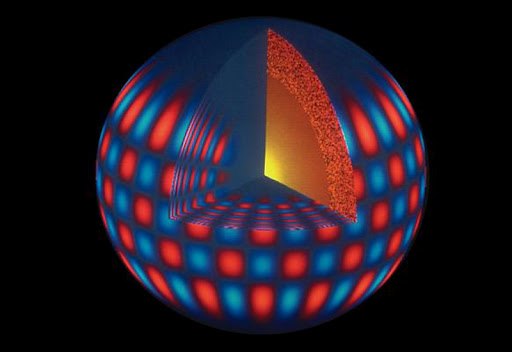
    The Pythagoreans 2500 years ago believed in a celestial “music of the spheres”, an idea that reverberated down the millennia in Western music, literature, art and science. Now, through asteroseismology (the study of the internal structure of pulsating stars), we know that there is a real music of the spheres. The stars have sounds in them that we use to see right to their very cores. This multi-media lecture looks at the relationship of music to stellar sounds. You will hear the real sounds of the stars and you will hear musical compositions where every member of the orchestra is a real (astronomical) star! You will also learn about some of the latest discoveries from the Kepler Space Mission that lets us “hear” the stars 100 times better than with telescopes on the ground See:Don Kurtz, University of Central Lancashire-Wednesday, May 2, 2012 at 7:00 pm

     See Also:

    Posted in Chaldni, Helioseismology, Sonification, Sonoluminence, Sun | Tagged , , , , | Leave a comment

    Near-Future Photon-Collider Setups

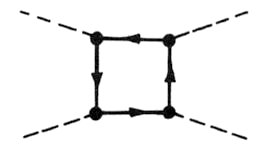
    In the search for a quantum theory of gravity it is crucial to find experimental access to quantum gravitational effects. Since these are expected to be very small at observationally accessible scales it is advantageous to consider processes with no tree-level contribution in the Standard Model, such as photon-photon scattering. We examine the implications of asymptotically safe quantum gravity in a setting with extra dimensions for this case, and point out that various near-future photon-collider setups, employing either electron or muon colliders, or even a purely laser-based setup, could provide a first observational window into the quantum gravity regime. Can we see quantum gravity? Photons in the asymptotic-safety scenario

    Experimental Search for Quantum Gravity: the hard facts 

    October 22-25, 2012
    Perimeter Institute

    Scientific area: quantum gravity

     Quantum Gravity tries to answer some of the most fundamental questions about the quantum nature of spacetime. To make progress in this area it is mandatory to establish a contact to observations and experiments and to learn what the “hard facts” on quantum gravity are, that nature provides us with.

    Quantum Gravity is a field where several approaches, based on different principles and assumptions, develop in parallel. At present it is not clear whether and how some of the approaches are compatible, and might share common properties. This meeting will draw on a diverse set of physicists who come to make proposals for quantum gravity phenomenology from a broad range of perspectives, including path-integral-inspired as well as canonical, and discrete as well as continuum-based approaches, providing a platform to exchange ideas with researchers working on theoretical and experimental aspects of different proposals.

    This will be the third in a series of meetings, the first of which was held at PI (2007), the second at NORDITA (2010).

    This meeting looks to the future and has two primary goals: 1) to assess the status of different proposals for QG phenomenology in the light of recent experimental results from Fermi, Auger, LHC etc. and 2) to discuss and stimulate new ideas and proposals, coming from a diverse set of viewpoints about quantum spacetime.

    In order to allow for a fruitful exchange of ideas across different approaches, and between experimental and theoretical researchers, the workshop will lay a main focus on structured discussion sessions with short (15 min.) presentations. These are mainly intended for an exchange of ideas, and a discussion and development of new possibilities, thus participants are strongly encouraged to present new ideas and work in progress.

    See Also:

    Posted in Quantum Gravity | Tagged | Leave a comment