Timeline:
- Nineteen Eighty-Four was published in 1949.
- Make Room! Make Room! was published in 1966.
- Soylent Green appeared in 1973.
So there is no direct historical connection.
Yet philosophically, the works share deep affinities.
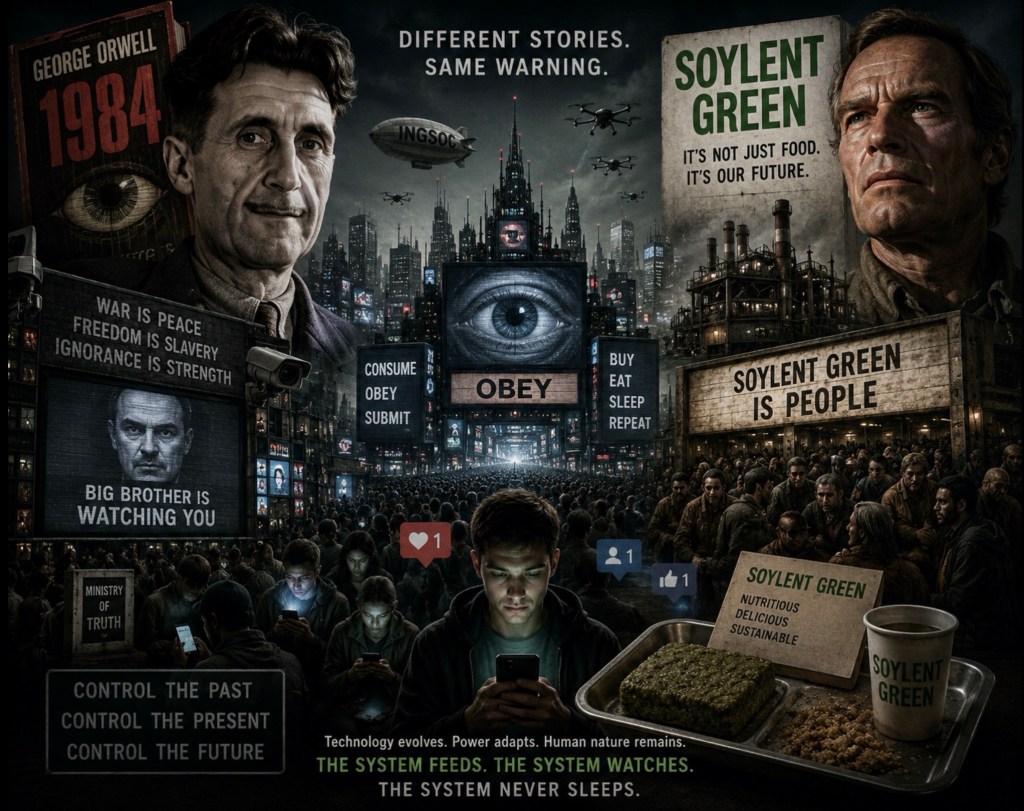
Orwell’s world in 1984 revolves around:
- manipulation of truth,
- control through scarcity,
- psychological domination,
- destruction of individuality,
- and institutional concealment.
Soylent Green revolves around:
- ecological collapse,
- overpopulation,
- industrialized survival,
- hidden consumption,
- and institutional concealment.
Both worlds share a central structure:
reality is managed for the population rather than revealed to it.
In Orwell:
- language itself is altered through “Newspeak,”
- history is rewritten,
- citizens are kept in controlled deprivation.
In Soylent Green:
- food systems are opaque,
- nature has nearly vanished,
- citizens depend on processed substitutes,
- truth about survival is hidden.
One might say:
- Orwell feared the political consumption of truth.
- Soylent Green feared the industrial consumption of humanity.
There is also an important symbolic overlap.
In 1984, human beings become material for the State’s power.
In Soylent Green, human beings literally become material for society’s survival.
Thus both stories ask:
What remains of humanity when systems value function above truth?
This is why modern audiences often mentally associate the two works even though they emerged from different decades and different anxieties:
- Orwell from totalitarian politics after World War II,
- Harrison from fears of ecological and population crisis during the 1960s.
Together they helped shape the modern dystopian imagination:
- a civilization technologically advanced,
- materially managed,
- spiritually diminished,
- and increasingly unable to distinguish nourishment from control.
The convergence of Nineteen Eighty-Four and Soylent Green into a broader cultural framework was not initially formalized as a single doctrine or movement. Rather, over decades, readers, filmmakers, political thinkers, technologists, and ordinary citizens gradually fused their themes into what is now commonly called “dystopian modernity” or “technocratic dystopia.”
This fusion became especially powerful because the fears complemented one another:
From Orwell came:
- surveillance,
- information control,
- engineered language,
- psychological management,
- centralized authority.
From Soylent Green came:
- ecological exhaustion,
- resource scarcity,
- depersonalized systems,
- commodification of human life,
- industrial survivalism.
Together they formed a larger archetype:
a civilization where human beings are administered rather than truly lived.
By the late 20th century, these themes merged with additional works:
- Brave New World
- Blade Runner
- The Matrix
- Fahrenheit 451
Each contributed another dimension:
- pleasure as control,
- artificial identity,
- simulated reality,
- suppression through distraction.
What emerged culturally was not merely “science fiction,” but a modern mythology of systemic alienation.
The public recognition of this convergence unfolded in stages:
1950s–1970s
Mostly intellectual and literary circles recognized these parallels. Orwell was discussed politically; Soylent Green environmentally.
1980s–1990s
The rise of computers, mass media, advertising systems, and corporate globalization caused people to combine the fears:
- surveillance + consumption,
- bureaucracy + technological mediation.
2000s onward
The internet age accelerated the synthesis dramatically:
- algorithmic influence,
- data harvesting,
- social engineering fears,
- processed digital identities,
- synthetic culture,
- ecological anxieties.
At this stage, phrases like:
- “Orwellian”
- “Soylent Green”
- “Matrix”
became shorthand metaphors in public discourse.
Not always accurately, but symbolically.
What is striking is that these stories endure because they speak less about specific governments or products than about recurring civilizational tendencies:
- abstraction replacing human relation,
- systems becoming self-preserving,
- truth mediated through institutions,
- efficiency overtaking wisdom.
Socratically viewed, the deeper concern beneath all these works is this:
Can a society become materially sophisticated while spiritually forgetting what a human being is?
That question is why these narratives continue to recombine across generations under new names:
- technocracy,
- hyperreality,
- surveillance capitalism,
- algorithmic governance,
- post-humanism,
- synthetic society.
The names change.
The structure of the anxiety remains recognizable.