Concepts Fade to Moments

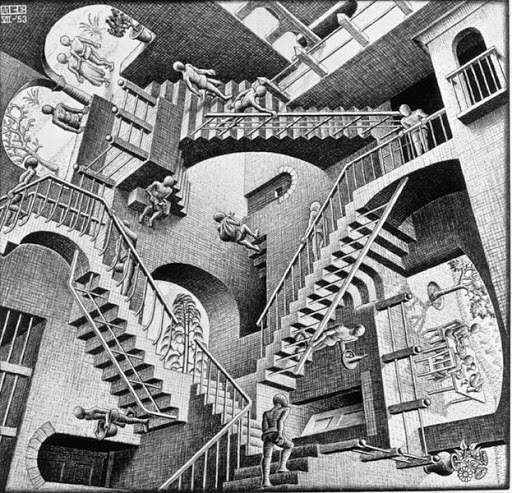
Relativity, by M. C. Escher. Lithograph, 1953.

Of course I struggle “with” as to be free and in liberation of, as if to liberate oneself from all the constraints that we have applied to our circumstance, “by choice.” Can this be done? Can a human being actually float and defy gravity? I mean, how ridiculous?:) No….not one of those meditating bouncing beans either.

So it is ever the exercise in my mind to clarify and to seek an understanding of something given that holds great meaning, and may help me to understand an experience that will not let go..
  

Lex III: Actioni contrariam semper et æqualem esse reactionem: sive corporum duorum actiones in se mutuo semper esse æquales et in partes contrarias dirigi.

I was given an image in mind a long time ago that has stayed close to me even while I concertize myself to the very explanations that science has to offer as a basis of fact. That if one could in a sense “experience an opposing force of another body,”  that “through playing” one can come into what I had learn about the sensing of, as to blend with opposition. So as to move accordingly, while knowing that it could reach an extreme, I could in turn, turn it back on itself.

A body’s mass also determines the degree to which it generates or is affected by a gravitational field. If a first body of mass m1 is placed at a distance r from a second body of mass m2, each body experiences an attractive force F whose magnitude is

 F = G\,\frac{m_1 m_2}{r^2} \, ,

where G is the universal constant of gravitation, equal to 6.67×10⁻¹¹ kg−1 m3 s−2. This is sometimes referred to as gravitational mass (when a distinction is necessary, M is used to denote the active gravitational mass and m the passive gravitational mass). Repeated experiments since the 17th century have demonstrated that inertial and gravitational mass are equivalent; this is entailed in the equivalence principle of general relativity.

If you have ever expressed this physically, as in some Martial Art Form,  some competitive edge in reaction, then it will have been grokked at it’s fullest, because you have blended the concept, with movement. It’s as if structurally you are given lines to follow, but now have to extend those lines into actually movements,  from the mind, into the physical body.
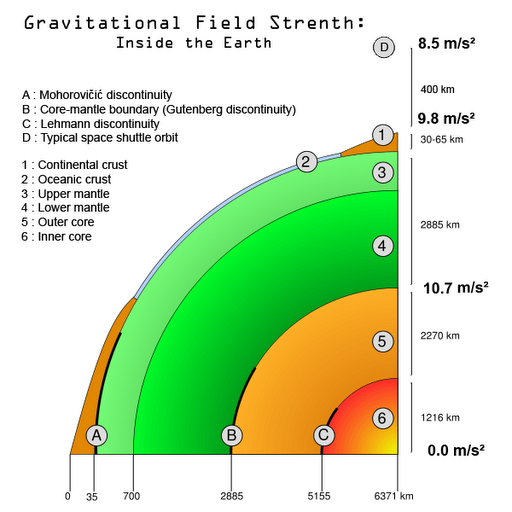
View of inner parts of earth. # continental crust # oceanic crust # upper mantle # lower mantle # outer core # inner core * A : Mohorovičić discontinuity * B : Core-mantle boundary (Gutenberg discontinuity) * C : Lehmann discontinuity * Author : KronicTOOL * Software : Photoshop (Click on Image for larger viewing)

Now one would have to assume there is some mathematical basis to this exchange, yet I would rather focus on the exchange, as to define this in our life as something “sensual in movement and form.” Is it perfectly systematical and symmetrical “that one side had to equal the other,” in order for me to explain something about life as an expressive attitude about our dealings in society? How “justice might work” as a balancing scale? A balancing scale, about life and it’s truths

Weight at Earth’s Core

Would your body weigh more or less if standing on the Earth’s core? What about above sea level?

As you go further inside the Earth, the force you feel due to gravity lessens, assuming the Earth is has a uniform density all the way throughout. Less force means you weigh less.

The reason is that the mass attracting you is inside a sphere, and is given by M = (4/3) * pi * (radius)3 * density

The force you feel is given by F = G * M * (your mass) / (radius)2

This means the net force is F = G * (4/3) * pi * radius * density * (your mass)

(pi=3.14159 and G = Newton’s gravitational constant)

So as you go further inside the Earth, the radius is decreasing, so the force you feel is decreasing. The mass above you oddly enough doesn’t contribute at all to any net force on your body.

In reality, of course, the Earth is not of uniform density, and there is a slight increase in force as you go down from the surface, before it begins to decrease again. Still, you weigh less standing on the Earth’s core.

As far as what happens above sea level – you must realize that what happens outside the Earth is different from what happens inside the Earth. Inside, as you go deeper and deeper, the mass attracting you is less and less (as stated). Above sea level (the surface of the Earth, specifically) as you go further and further away, the mass remains constant (obviously), but the distance gets larger and larger, which makes the force (given by F = G * M(Earth) * M(you) / r2) smaller.

Notice that the formula that applies inside the Earth is different from the one that applies outside.

Dr. Louis Barbier
(October 2003)

So there is this ancient notion about gravity being the same at all places on the earth, that slighting the idea of such minute differences, one would have to say “that it is not the same” and hence has left oneself “back in time” before it could be understood that  the earth can be looked at in another way? That the length and distance to it’s outer edge, as some inverse square law can be explained “of all things.” Systemically explaining away,  by understanding that gravity “is the same according to the weight of” is not the same in all places.

Truth, is that slight difference?

So how does one break free inside, between the understanding of Feather and Iron, versus Feather and Heart?

Structurally, building any foundation there are exactitude’s toward defining that space according to  dimensional attributes as to straight lines and angles of perception. If you actualize this in physical form, you may have constructed a building. There are rules according to Pythagorean theorem that allows you build square things.

The emergence of,  follows distinctive rules according to expression, artistically inclined, and for me, any point in space has such abilities. How structurally sound, any expressive display that for realities sake and purpose, we see where such expressions can arrive out of nothing? It was not logical and did not make sense to me that such expression can appear  out of nothing, to become something. So there is a bias here for me about what is being revealed in that point, as well as, of what is being revealed in that moment.

I am of course interested in the creative process of a scientist. I am trying to be as responsible as I can about our comparison of the Heart and Truth(Feather) on the same scale as to be lead by example so as to define this concept better as,  “If the heart was free from the impurities of sin,” not as some religious perspective about good and evil, but about the slight differences in the changes in the gravity of earth, and about the object that occupies that space, as well as,  the inherent nature of that truth.

Composition of Earth’s mantle in weight percent[16][citation needed]
Element Amount Compound Amount
O 44.8
Si 21.5 SiO2 46
Mg 22.8 MgO 37.8
Fe 5.8 FeO 7.5
Al 2.2 Al2O3 4.2
Ca 2.3 CaO 3.2
Na 0.3 Na2O 0.4
K 0.03 K2O 0.04
Sum 99.7 Sum 99.1

If I should point toward elemental considerations, each to its own,  then,  as some expression of some inverse square law toward that outer rim of physicality of earth’s domain, then  it is with this insight that I look toward  the “weight” of the concept with which “entrance to freedoms of eternal life” are nothing more then the recognition of “what weighs” according to those truths and what we adopt in our own lives according to the choices we make. If I say Heart, then it is wise that such entrances into the human being, is but a mental thing about how we weight things according to our set of criteria according Truth?
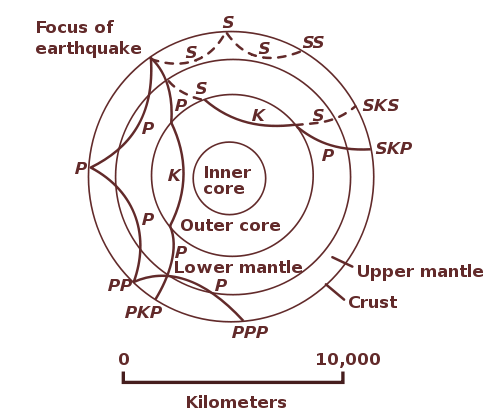
Cross section of the whole Earth, showing the complexity of paths of earthquake waves. The paths curve because the different rock types found at different depths change the speed at which the waves travel. Solid lines marked P are compressional waves; dashed lines marked S are shear waves. S waves do not travel through the core but may be converted to compressional waves (marked K) on entering the core (PKP, SKS). Waves may be reflected at the surface (PP, PPP, SS).

Seismographs detect the various types of waves. Analysis of such records reveals structures within the Earth.

Posted in Helioseismology, House Building | Tagged , | Leave a comment

Measure and Half Measures

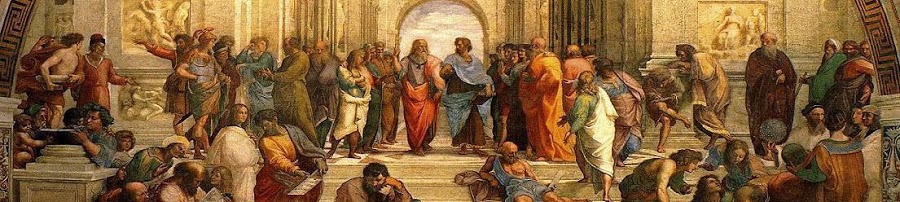
Pythagoras, the man in the center with the book, teaching music, in The School of Athens by Raphael

Most of  you will recognize the partial image of the much larger I have used as the heading of this blog.

The Greek Pythagoras, for instance, was able to use abstract but simple mathematics to describe a natural phenomenon very precisely. He discovered the fractions that govern the harmonious musical notes. For example, a stretched string on a violin that produces a C note when you strike it, will give a C an octave higher when you divide its length by two. (Similarly, when we cut of a quarter of the length of the original string, the new string will sound like an E note) This is a famous early example of the use of mathematics to describe a physical phenomenon accurately. Pythagoras used the mathematics of fractions to describe the frequency of musical notes. In the ages that followed, of Galilei, Kepler, Newton and Einstein, mathematics became the prime language to depict nature. The mathematics of numbers, sets, functions, surfaces et cetera turned out to be the most useful tool for those people that felt the urge to understand the laws governing nature. See: Beyond String Theory-Introduction-Natural Language

However esoteric the following may seem to you, I was always enchanted with the idea of sound  as a manifestation of the world we live in, or, as color,  as a meaningful expression of the nature of the world we live in. Not really the artist of sound and color, but much more the artist in conceptual makings of the relation of the world with such ideas, hence, the idea of “Color of gravity.”

Hence my interest in gravity, and what we as human beings can gather around our selves, in the ever quest for understanding the consequences of our causal relations to the events that follow us in the making of the reality we live.

The future consequences of probabilistic outcomes according to those positions adopted….can we say indeed that we are predictors of our futures and that at some level this predictability is a far reaching effect of understanding our choices and positions in life? We know this deep down within ourselves, “so as we think” we may become some “ball bouncing on the ocean of life?” Emotive consequences, without recourse to our choosing to excel from the primitive natures of our being in the moment?

Major scale

In music theory, the major scale or Ionian scale is one of the diatonic scales. It is made up of seven distinct notes, plus an eighth which duplicates the first an octavesolfege these notes correspond to the syllables “Do, Re, Mi, Fa, Sol, La, Ti/Si, (Do)”, the “Do” in the parenthesis at the end being the octave of the root. The simplest major scale to write or play on the piano is C major, the only major scale not to require sharps or flats, using only the white keys on the piano keyboard:

Could we every conceive of the human being as being one full Octave? I thought so as I read, and such comparisons however esoterically contrived by association I found examples to such “predictable outcomes” as ever wanting to be “divined by principle by such choices we can make.”  However unassociated these connections may seem.

I mean,  if one was a student of esoteric traditions and philosophies, it might have been “as traveling through a span and phase of one’s life time”  leads us to the issues where we sit,  where we are at,  in the presences of the sciences today. We demanded accountability of ourselves in  that presence within the world as to being responsible and true to ourselves on this quest for understanding.

So if I had ever given the comment as to some iconic symbol as the Seal of Solomon, not just on the context of any secular religion as ownership, it is with the idea that representation could have enshrine the relationship between what exists as a “trinity of the above”  with that of “the below,”  when we are centered as to choice being the position with that of the heart.

See also:New Synesthete Character on Heroes

It was with this understanding that the full Octave could be entranced as too, resonances in the human being, that we could be raised and raise ourselves from such a position, so as to be freed from our emotive and ancient predicaments arising from evolutionary states of beings of the past.

***

Monochord is a one-stringed instrument with movable bridges, used for measuring intervals. The first monochord is attributed to Pythagoras. 

The story is told that Pythagoras wished to invent an instrument to help the ear measure sounds the same way as a ruler or compass helps the eye to measure space or a scale to measure weights. As he was thinking these thoughts, he passed by a blacksmith’s shop. By a happy chance, he heard the iron hammers striking the anvil. The sounds he heard were all consonant to each other, in all combinations but one. He heard three concords, the diaspason (octave), the diapente (fifth), and the diatessaron (fourth). But between the diatessaron (fourth) and the diapente (fifth), he found a discord (second). This interval he found useful to make up the diapason (octave). Believing this happy discovery came to him from God, he hastened into the shop and, by experimenting a bit, found that the difference in sounds were determined by the weight of the hammers and not the force of the blows. He then took the weight of the hammers and went straight home. When he arrived home, he tied strings from the beams of his room. After that, he proceeded to hang weights from the strings equal to the weights he found in the smithy’s shop. Setting the strings into vibration, he discovered the intervals of the octave, fifth and fourth. He then transferred that idea into an instrument with pegs, a string and bridges. The monochord was the very instrument he had dreamed of inventing.
See: String Instruments including Oud, Folk Fiddle, and Monochord, dan bau, from Carousel Publications Ltd

***

So what is the theory, then?

Pythagoras could be called the first known string theorist. Pythagoras, an excellent lyre player, figured out the first known string physics — the harmonic relationship. Pythagoras realized that vibrating Lyre strings of equal tensions but different lengths would produce harmonious notesratio of the lengths of the two strings were a whole number. (i.e. middle C and high C) if the

   Pythagoras discovered this by looking and listening. Today that information is more precisely encoded into mathematics, namely the wave equation for a string with a tension T and a mass per unit length m. If the string is described in coordinates as in the drawing below, where x is the distance along the string and y is the height of the string, as the string oscillates in time t, 

See: Official String Theory Web Site

Posted in String Theory | Tagged , | Leave a comment

Feather and Iron?

Weight and amount

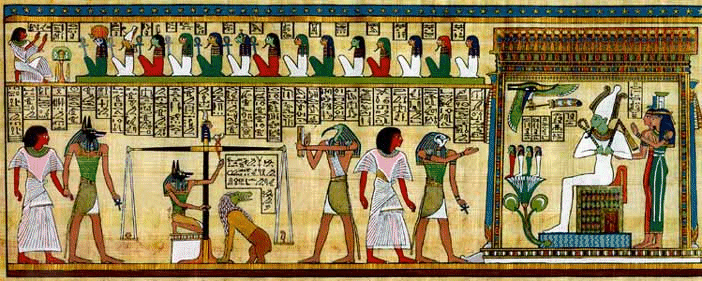
Anubis weighing the heart of Hunefer, 1285 BC


Weight, by definition, is a measure of the force which must be applied to support an object (i.e. hold it at rest) in a gravitational field. The Earth’s gravitational field causes items near the Earth to have weight. Typically, gravitational fields change only slightly over short distances, and the Earth’s field is nearly uniform at all locations on the Earth’s surface; therefore, an object’s weight changes only slightly when it is moved from one location to another, and these small changes went unnoticed through much of history. This may have given early humans the impression that weight is an unchanging, fundamental property of objects in the material world.

In the Egyptian religious illustration to the above, Anubis is using a balance scale to weigh the heart of Hunefer. A balance scale balances the force of one object’s weight against the force of another object’s weight. The two sides of a balance scale are close enough that the objects experience similar gravitational fields. Hence, if they have similar masses then their weights will also be similar. The scale, by comparing weights, also compares masses. The balance scale is one of the oldest known devices for measuring mass.

The concept of amount is very old and predates recorded history, so any description of the early development of this concept is speculative in nature. However, one might reasonably assume[citation needed] that humans, at some early era, realized that the weight of a collection of similar objects was directly proportional to the number of objects in the collection:

w_n \propto n,

where w is the weight of the collection of similar objects and n is the number of objects in the collection. Proportionality, by definition, implies that two values have a constant ratio:

\frac{w_n}{n} = \frac{w_m}{m}, or equivalently \frac{w_n}{w_m} = \frac{n}{m}.

Consequently, historical weight standards were often defined in terms of amounts. The Romans, for example, used the carob seed (carat or siliqua) as a measurement standard. If an object’s weight was equivalent to 1728 carob seeds, then the object was said to weigh one Roman pound. If, on the other hand, the object’s weight was equivalent to 144 carob seeds then the object was said to weigh one Roman ounce (uncia). The Roman pound and ounce were both defined in terms of different sized collections of the same common mass standard, the carob seed. The ratio of a Roman ounce (144 carob seeds) to a Roman pound (1728 carob seeds) was:

\frac{ounce}{pound} = \frac{w_{144}}{w_{1728}} = \frac{144}{1728} = \frac{1}{12}.

This example illustrates a fundamental principle of physical science: when values are related through simple fractions, there is a good possibility that the values stem from a common source.

Various atoms and molecules as depicted 

in John Dalton‘s A New System of Chemical Philosophy (1808).
 

The name atom comes from the Greek ἄτομος/átomos, α-τεμνω, which means uncuttable, something that cannot be divided further. The philosophical concept that matter might be composed of discrete units that cannot be further divided has been around for millennia. However, empirical proof and the universal acceptance of the existence of atoms didn’t occur until the early 20th century.

As the science of chemistry matured, experimental evidence for the existence of atoms came from the law of multiple proportions. When two or more elements combined to form a compound, their masses are always in a fixed and definite ratio. For example, the mass ratio of nitrogen to oxygen in nitric oxide is seven eights. Ammonia has a hydrogen to nitrogen mass ratio of three fourteenths. The fact that elemental masses combined in simple fractions implies that all elemental mass stems from a common source. In principle, the atomic mass situation is analogous to the above example of Roman mass units. The Roman pound and ounce were both defined in terms of different sized collections of carob seeds, and consequently, the two mass units were related to each other through a simple fraction. Comparatively, since all of the atomic masses are related to each other through simple fractions, then perhaps the atomic masses are just different sized collections of some common fundamental mass unit.

In 1805, the chemist John Dalton published his first table of relative atomic weights, listing six elements, hydrogen, oxygen, nitrogen, carbon, sulfur, and phosphorus, and assigning hydrogen an atomic weight of 1. And in 1815, the chemist William Prout concluded that the hydrogen atom was in fact the fundamental mass unit from which all other atomic masses were derived.

Carbon atoms in graphite (image obtained with a Scanning tunneling microscope)


If Prout’s hypothesis had proven accurate, then the abstract concept of mass, as we now know it, might never have evolved, since mass could always be defined in terms of amounts of the hydrogen atomic mass. Prout’s hypothesis; however, was found to be inaccurate in two major respects. First, further scientific advancements revealed the existence of smaller particles, such as electrons and quarks, whose masses are not related through simple fractions. And second, the elemental masses themselves were found to not be exact multiples of the hydrogen atom mass, but rather, they were near multiples. Einstein’s theory of relativity explained that when protons and neutrons come together to form an atomic nucleus, some of the mass of the nucleus is released in the form of binding energy. The more tightly bound the nucleus, the more energy is lost during formation and this binding energy loss causes the elemental masses to not be related through simple fractions.
Hydrogen, for example, with a single proton, has an atomic weight of 1.007825 u. The most abundant isotope of iron has 26 protons and 30 neutrons, so one might expect its atomic weight to be 56 times that of the hydrogen atom, but in fact, its atomic weight is only 55.9383 u, which is clearly not an integer multiple of 1.007825. Prout’s hypothesis was proven inaccurate in many respects, but the abstract concepts of atomic mass and amount continue to play an influential role in chemistry, and the atomic mass unit continues to be the unit of choice for very small mass measurements.

When the French invented the metric system in the late 18th century, they used an amount to define their mass unit. The kilogram was originally defined to be equal in mass to the amount of pure water contained in a one-liter container. This definition, however, was inadequate for the precision requirements of modern technology, and the metric kilogram was redefined in terms of a manmade platinum-iridium bar known as the international prototype kilogram.

Posted in Heart | Tagged | Leave a comment

How Observant is your Science Mind?

This image above I have discussed before on this website. It is also in the legend on the right hand side of this web page. Maybe you can see the “symmetry at play?”:)


Dürer Magic Square with Lines

Albrecht Durer and His Magic Square

***

For those scientifically minded you must see the outlay and thesis adaption of Prof.dr R.H. Dijkgraaf as he demonstrated the totality of the illumination of his thinking? While I captured a small part of it by referencing the magic square, there is lots more there for the observant eye to take hold of.

Melencolia II
[frontispiece of thesis, after Dürer 1514]by Prof.dr R.H. Dijkgraaf
Posted in Albrecht Durer | Tagged | Leave a comment

Cosmic Screens

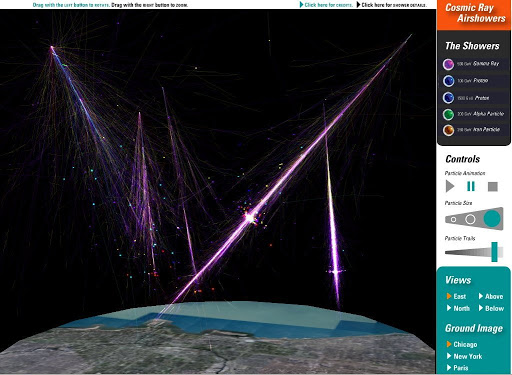
[Recommended] Five Showers (Windows only). This has five showers (alpha, proton. gamma, iron, etc) at 333 ns per time step, and with a much more user-friendly interface than the other showers below. The interface was made by Mark SubbaRao using a Director plugin written by Toshiyuki Takahei. 

See:COSMOS:AIRES Cosmic Ray Showers

***
Posted in Cosmic Rays | Tagged | Leave a comment

2010 ion run: completed!

First direct observation of jet quenching.

At the recent seminar, the LHC’s dedicated heavy-ion experiment, ALICE, confirmed that QGP behaves like an ideal liquid, a phenomenon earlier observed at the US Brookhaven Laboratory’s RHIC facility. This question was indeed one of the main points of this first phase of data analysis, which also included the analysis of secondary particles produced in the lead-lead collisions. ALICE’s results already rule out many of the existing theoretical models describing the physics of heavy-ions.

See: 2010 ion run: completed!

***

After a very fast switchover from protons to lead ions, the LHC has achieved performances that allowed the machine to exceed both peak and integrated luminosity by a factor of three. Thanks to this, experiments have been able to produce high-profile results on ion physics almost immediately, confirming that the LHC was able to keep its promises for ions as well as for protons.
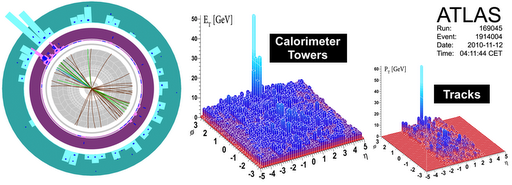
A seminar on 2 December was the opportunity for the ALICE, ATLAS and CMS collaborations to present their first results on ion physics in front of a packed auditorium. These results are important and are already having a major impact on the understanding of the physics processes that involve the basic constituents of matter at high energies.
In the ion-ion collisions, the temperature is so high that partons (quarks and gluons), which are usually constrained inside the nucleons, are deconfined to form a highly dense and hot soup known as quark-gluon plasma (QGP). This type of matter existed about 1 millionth of a second after the Big Bang. By studying it, scientists hope to understand the processes that led to the formation of nucleons, which in turn became the nuclei of atoms. See:LHC completes first heavy-ion run

See Also: Jets: Article Updated

Posted in Alice, Atlas, CMS, Jet Quenching, Quark Gluon PLasma | Tagged , , , , | Leave a comment

The Compact Muon Solenoid……

Coordinates: 46°18′34″N 6°4′37″E / 46.30944°N 6.07694°E / 46.30944; 6.07694

Large Hadron Collider (LHC)
LHC.svg
LHC experiments
ATLAS A Toroidal LHC Apparatus
CMS Compact Muon Solenoid
LHCb LHC-beauty
ALICE A Large Ion Collider Experiment
TOTEM Total Cross Section, Elastic Scattering and Diffraction Dissociation
LHCf LHC-forward
MoEDAL Monopole and Exotics Detector At the LHC
LHC preaccelerators
p and Pb Linear accelerators for protons (Linac 2) and Lead (Linac 3)
(not marked) Proton Synchrotron Booster
PS Proton Synchrotron
SPS Super Proton Synchrotron

View of the CMS endcap through the barrel sections. The ladder to the lower right gives an impression of scale.

……(CMS) experiment is one of two large general-purpose particle physics detectors built on the proton-proton Large Hadron Collider (LHC) at CERN in Switzerland and France. Approximately 3,600 people from 183 scientific institutes, representing 38 countries form the CMS collaboration who built and now operate the detector.[1] It is located in an underground cavern at Cessy in France, just across the border from Geneva.

Contents

Background

Recent collider experiments such as the now-dismantled Large Electron-Positron Collider at CERN and the (as of 2010) still running Tevatron at Fermilab have provided remarkable insights into, and precision tests of the Standard Model of Particle Physics. However, a number of questions remain unanswered.

A principal concern is the lack of any direct evidence for the Higgs Boson, the particle resulting from the Higgs mechanism which provides an explanation for the masses of elementary particles. Other questions include uncertainties in the mathematical behaviour of the Standard Model at high energies, the lack of any particle physics explanation for dark matter and the reasons for the imbalance of matter and antimatter observed in the Universe.

The Large Hadron Collider and the associated experiments are designed to address a number of these questions.

Physics goals

The main goals of the experiment are:

The ATLAS experiment, at the other side of the LHC ring is designed with similar goals in mind, and the two experiments are designed to complement each other both to extend reach and to provide corroboration of findings.

Detector summary

CMS is designed as a general-purpose detector, capable of studying many aspects of proton collisions at 14 TeV, the center-of-mass energy of the LHC particle accelerator. It contains subsystems which are designed to measure the energy and momentum of photons, electrons, muons, and other products of the collisions. The innermost layer is a silicon-based tracker. Surrounding it is a scintillating crystal electromagnetic calorimeter, which is itself surrounded with a sampling calorimeter for hadrons. The tracker and the calorimetry are compact enough to fit inside the CMS solenoid which generates a powerful magnetic field of 3.8 T. Outside the magnet are the large muon detectors, which are inside the return yoke of the magnet.

The set up of the CMS. In the middle, under the so-called barrel there is a man for scale. (HCAL=hadron calorimeter, ECAL=electromagnetic calorimeter)

CMS by layers

A slice of the CMS detector.

For full technical details about the CMS detector, please see the Technical Design Report.

The interaction point

This is the point in the centre of the detector at which proton-proton collisions occur between the two counter-rotating beams of the LHC. At each end of the detector magnets focus the beams into the interaction point. At collision each beam has a radius of 17 μm and the crossing angle between the beams is 285 μrad.
At full design luminosity each of the two LHC beams will contain 2,808 bunches of 1.15×10¹¹ protons. The interval between crossings is 25 ns, although the number of collisions per second is only 31.6 million due to gaps in the beam as injector magnets are activated and deactivated.

At full luminosity each collision will produce an average of 20 proton-proton interactions. The collisions occur at a centre of mass energy of 14 TeV. It is worth noting that the actual interactions occur between quarks rather than protons, and so the actual energy involved in each collision will be lower, as determined by the parton distribution functions.

The first which ran in September 2008 was expected to operate at a lower collision energy of 10 TeV but this was prevented by the 19 September 2008 shutdown. When at this target level, the LHC will have a significantly reduced luminosity, due to both fewer proton bunches in each beam and fewer protons per bunch. The reduced bunch frequency does allow the crossing angle to be reduced to zero however, as bunches are far enough spaced to prevent secondary collisions in the experimental beampipe.

Layer 1 – The tracker

The silicon strip tracker of CMS.

Immediately around the interaction point the inner tracker serves to identify the tracks of individual particles and match them to the vertices from which they originated. The curvature of charged particle tracks in the magnetic field allows their charge and momentum to be measured.

The CMS silicon tracker consists of 13 layers in the central region and 14 layers in the endcaps. The innermost three layers (up to 11 cm radius) consist of 100×150 μm pixels, 66 million in total.
The next four layers (up to 55 cm radius) consist of 10 cm × 180 μm silicon strips, followed by the remaining six layers of 25 cm × 180 μm strips, out to a radius of 1.1 m. There are 9.6 million strip channels in total.
During full luminosity collisions the occupancy of the pixel layers per event is expected to be 0.1%, and 1–2% in the strip layers. The expected SLHC upgrade will increase the number of interactions to the point where over-occupancy may significantly reduce trackfinding effectiveness.

This part of the detector is the world’s largest silicon detector. It has 205 m2 of silicon sensors (approximately the area of a tennis court) comprising 76 million channels.[2]

Layer 2 – The Electromagnetic Calorimeter

The Electromagnetic Calorimeter (ECAL) is designed to measure with high accuracy the energies of electrons and photons.

The ECAL is constructed from crystals of lead tungstate, PbWO4. This is an extremely dense but optically clear material, ideal for stopping high energy particles. It has a radiation length of χ0 = 0.89 cm, and has a rapid light yield, with 80% of light yield within one crossing time (25 ns). This is balanced however by a relatively low light yield of 30 photons per MeV of incident energy.

The crystals used have a front size of 22 mm × 22 mm and a depth of 230 mm. They are set in a matrix of carbon fibre to keep them optically isolated, and backed by silicon avalanche photodiodes for readout. The barrel region consists of 61,200 crystals, with a further 7,324 in each of the endcaps.

At the endcaps the ECAL inner surface is covered by the preshower subdetector, consisting of two layers of lead interleaved with two layers of silicon strip detectors. Its purpose is to aid in pion-photon discrimination.

Layer 3 – The Hadronic Calorimeter

Half of the Hadron Calorimeter

The purpose of the Hadronic Calorimeter (HCAL) is both to measure the energy of individual hadrons produced in each event, and to be as near to hermetic around the interaction region as possible to allow events with missing energy to be identified.

The HCAL consists of layers of dense material (brass or steel) interleaved with tiles of plastic scintillators, read out via wavelength-shifting fibres by hybrid photodiodes. This combination was determined to allow the maximum amount of absorbing material inside of the magnet coil.

The high pseudorapidity region (3.0 < | η | < 5.0) is instrumented by the Hadronic Forward detector. Located 11 m either side of the interaction point, this uses a slightly different technology of steel absorbers and quartz fibres for readout, designed to allow better separation of particles in the congested forward region.
The brass used in the endcaps of the HCAL used to be Russian artillery shells.[3]

Layer 4 – The magnet

Like most particle physics detectors, CMS has a large solenoid magnet. This allows the charge/mass ratio of particles to be determined from the curved track that they follow in the magnetic field. It is 13 m long and 6 m in diameter, and its refrigerated superconducting niobium-titanium coils were originally intended to produce a 4 T magnetic field. It was recently announced that the magnet will run at 3.8 T instead of the full design strength in order to maximize longevity.[4]

The inductance of the magnet is 14 Η and the nominal current for 4 T is 19,500 A, giving a total stored energy of 2.66 GJ, equivalent to about half-a-tonne of TNT. There are dump circuits to safely dissipate this energy should the magnet quench. The circuit resistance (essentially just the cables from the power converter to the cryostat) has a value of 0.1 mΩ which leads to a circuit time constant of nearly 39 hours. This is the longest time constant of any circuit at CERN. The operating current for 3.8 T is 18,160 A, giving a stored energy of 2.3 GJ.

Layer 5 – The muon detectors and return yoke

To identify muons and measure their momenta, CMS uses three types of detector: drift tubes (DT), cathode strip chambers (CSC) and resistive plate chambers (RPC). The DTs are used for precise trajectory measurements in the central barrel region, while the CSCs are used in the end caps. The RPCs provide a fast signal when a muon passes through the muon detector, and are installed in both the barrel and the end caps.

Collecting and collating the data

Pattern recognition

Testing the data read-out electronics for the tracker.

New particles discovered in CMS will be typically unstable and rapidly transform into a cascade of lighter, more stable and better understood particles. Particles travelling through CMS leave behind characteristic patterns, or ‘signatures’, in the different layers, allowing them to be identified. The presence (or not) of any new particles can then be inferred.

Trigger system

To have a good chance of producing a rare particle, such as a Higgs boson, a very large number of collisions are required. Most collision events in the detector are “soft” and do not produce interesting effects. The amount of raw data from each crossing is approximately 1 MB, which at the 40 MHz crossing rate would result in 40 TB of data a second, an amount that the experiment cannot hope to store or even process properly. The trigger system reduces the rate of interesting events down to a manageable 100 per second.
To accomplish this, a series of “trigger” stages are employed. All the data from each crossing is held in buffers within the detector while a small amount of key information is used to perform a fast, approximate calculation to identify features of interest such as high energy jets, muons or missing energy. This “Level 1” calculation is completed in around 1 µs, and event rate is reduced by a factor of about thousand down to 50 kHz. All these calculations are done on fast, custom hardware using reprogrammable FPGAs.

If an event is passed by the Level 1 trigger all the data still buffered in the detector is sent over fibre-optic links to the “High Level” trigger, which is software (mainly written in C++) running on ordinary computer servers. The lower event rate in the High Level trigger allows time for much more detailed analysis of the event to be done than in the Level 1 trigger. The High Level trigger reduces the event rate by a further factor of about a thousand down to around 100 events per second. These are then stored on tape for future analysis.

Data analysis

Data that has passed the triggering stages and been stored on tape is duplicated using the Grid to additional sites around the world for easier access and redundancy. Physicists are then able to use the Grid to access and run their analyses on the data.
Some possible analyses might be:

  • Looking at events with large amounts of apparently missing energy, which implies the presence of particles that have passed through the detector without leaving a signature, such as neutrinos.
  • Looking at the kinematics of pairs of particles produced by the decay of a parent, such as the Z boson decaying to a pair of electrons or the Higgs boson decaying to a pair of tau leptons or photons, to determine the properties and mass of the parent.
  • Looking at jets of particles to study the way the quarks in the collided protons have interacted.

Milestones

1998 Construction of surface buildings for CMS begins.
2000 LEP shut down, construction of cavern begins.
2004 Cavern completed.
10 September 2008 First beam in CMS.
23 November 2009 First collisions in CMS.
30 March 2010 First 7 TeV collisions in CMS.

See also

References

  1. ^ [1]
  2. ^ CMS installs the world’s largest silicon detector, CERN Courier, Feb 15, 2008
  3. ^ CMS HCAL history – CERN
  4. ^ http://iopscience.iop.org/1748-0221/5/03/T03021/pdf/1748-0221_5_03_T03021.pdf Precise mapping of the magnetic field in the CMS barrel yoke using cosmic rays

External links

Posted in AMS, Atlas, CMS, Muons, Triggering | Tagged , , , , | Leave a comment

Antarctic Muon And Neutrino Detector Array….

Diagram of IceCube. IceCube will occupy a volume of one cubic kilometer. Here we depict one of the 80 strings of opctical modules (number and size not to scale). IceTop located at the surface, comprises an array of sensors to detect air showers. It will be used to calibrate IceCube and to conduct research on high-energy cosmic rays. Author: Steve Yunck, Credit: NSF

…..(AMANDA) is a neutrino telescope located beneath the Amundsen-Scott South Pole Station. In 2005, after nine years of operation, AMANDA officially became part of its successor project, IceCube.

AMANDA consists of optical modules, each containing one photomultiplier tube, sunk in Antarctic ice cap at a depth of about 1500 to 1900 meters. In its latest development stage, known as AMANDA-II, AMANDA is made up of an array of 677 optical modules mounted on 19 separate strings that are spread out in a rough circle with a diameter of 200 meters. Each string has several dozen modules, and was put in place by “drilling” a hole in the ice using a hot-water hose, sinking the cable with attached optical modules in, and then letting the ice freeze around it.

AMANDA detects very high energy neutrinos (50+ GeV) which pass through the Earth from the northern hemisphere and then react just as they are leaving upwards through the Antarctic ice. The neutrino collides with nuclei of oxygen or hydrogen atoms contained in the surrounding water ice, producing a muon and a hadronic shower. The optical modules detect the Cherenkov radiation from these latter particles, and by analysis of the timing of photon hits can approximately determine the direction of the original neutrino with a spatial resolution of approximately 2 degrees.

AMANDA’s goal was an attempt at neutrino astronomy, identifying and characterizing extra-solar sources of neutrinos. Compared to underground detectors like Super-Kamiokande in Japan, AMANDA was capable of looking at higher energy neutrinos because it is not limited in volume to a manmade tank; however, it had much less accuracy because of the less controlled conditions and wider spacing of photomultipliers. Super-Kamiokande can look at much greater detail at neutrinos from the Sun and those generated in the Earth’s atmosphere; however, at higher energies, the spectrum should include neutrinos dominated by those from sources outside the solar system. Such a new view into the cosmos could give important clues in the search for Dark Matter and other astrophysical phenomena.

After two short years of integrated operation as part of IceCube[1], the AMANDA counting house (in the Martin A. Pomerantz Observatory) was finally decommissioned in July and August of 2009.

See also

References

  1. ^ http://icecube.wisc.edu/science/publications/pdd/pdd12.php

External links

****

When a neutrino collides with a water molecule deep in Antarctica’s ice, the particle it produces radiates a blue light called Cerenkov radiation, which IceCube will detect (Steve Yunck/NSF)

See:Dual Nature From Microstate Blackhole Creation?

Posted in IceCube, Martin Rees, Muons, SuperKamiokande | Tagged , , , | Leave a comment

Muons reveal the interior of volcanoes

The location of the muon detector on the slopes of the Vesuvius volcano.

Like X-ray scans of the human body, muon radiography allows researchers to obtain an image of the internal structures of the upper levels of volcanoes. Although such an image cannot help to predict ‘when’ an eruption might occur, it can, if combined with other observations, help to foresee ‘how’ it could develop and serves as a powerful tool for the study of geological structures.

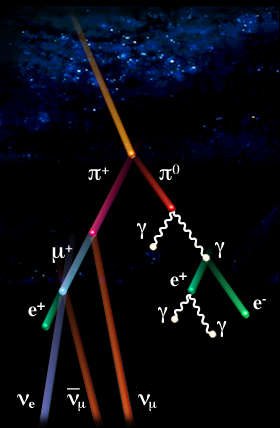
Muons come from the interaction of cosmic rays with the Earth’s atmosphere. They are able to traverse layers of rock as thick as one kilometre or more. During their trip, they are partially absorbed by the material they go through, very much like X-rays are partially absorbed by bones or other internal structures in our body. At the end of the chain, instead of the classic X-ray plate, is the so-called ‘muon telescope’, a special detector placed on the slopes of the volcano.

See: Muons reveal the interior of volcanoes

***

MU-RAY project 
MUon RAdiographY

A. Kircher (1601-1680), “The interior of Vesuvius”  
A. Kircher (1601-1680): “The interior of Vesuvius” (1638)
Read more about Athanasius Kircher on Wikipedia.

Cosmic ray muon radiography is a technique capable of imaging variations of density inside a hundreds of meters of rock. With resolutions up to tens of meters in optimal detection conditions, muon radiography can give us images of the top region of a volcano edifice with a resolution that is significantly better than the one typically achieved with conventional gravity methods and in this way can give us information on anomalies in the density distribution, such as expected from dense lava conduits, low density magma supply paths or the compression with depth of the overlying soil.
The MU-RAY project is aimed toward the study of the internal structure of Stromboli and Vesuvius volcanoes using this technique.

Posted in Gran Sasso, Muons, Volcanoes | Tagged , , | Leave a comment

When Muons Collide

By Leah Hesla

photo
Illustration: Sandbox Studio

When Fermilab physicist Steve Geer agreed to perform a calculation as part of a muon collider task force 10 years ago, he imagined he would show that the collider’s technical challenges were too difficult to be solved and move on to other matters. But as he delved further into the problem, he realized that the obstacles he had envisioned could in principle be overcome.

“I started as a skeptic,” he says. “But the more I studied it, I realized it might be a solvable problem.”

A muon collider—a machine that currently exists only in computer simulation—is a relative newcomer to the world of particle accelerators. At the moment, the reception from the particle physics community to this first-of-its-kind particle smasher is “polite,” says Fermilab physicist Alan Bross.

Politeness will suffice for now: research and development on the machine are gearing up thanks to funding from the US Department of Energy. In August, a DOE review panel supported the launch of the Muon Accelerator Program, or MAP, an international initiative led by Fermilab. Scientists hope the program will receive about $15 million per year over seven years to examine the collider’s feasibility and cost effectiveness. See more on Caption of Blog Post

***


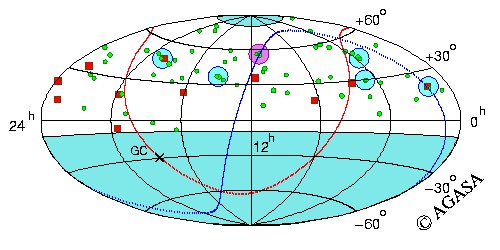
shows arrival directions of cosmic rays with energies above 4 x 10¹⁹eV. Red squares and green circles represent cosmic rays with energies of > 1020eV , and (4 – 10) x 1019eV , respectively.

We observed muon components in the detected air showers and studied their characteristics. Generally speaking, more muons in a shower cascade favors heavier primary hadrons and measurement of muons is one of the methods used to infer the chemical composition of the energetic cosmic rays. Our recent measurement indicates no systematic change in the mass composition from a predominantly heavy to a light composition above 3 x 10¹⁷eV claimed by the Fly’s Eye group.

***

Also see:

Muons 

Posted in Muons | Tagged | 13 Comments