ATLAS INCLUSIVE SEARCHES FOR SUSY AND DARK MATTER
Sascha Caron (Radboud University Nijmegen and NIKHEF)

See Also:Implications of LHC results for TeV-scale physics

-Information to Conference supplied by Theoretical Physicist Matt Strassler

Posted in dark matter | Tagged | Leave a comment

Fermi Provides Insights?

 There’s more to the cosmos than meets the eye. About 80 percent of the matter in the universe is invisible to telescopes, yet its gravitational influence is manifest in the orbital speeds of stars around galaxies and in the motions of clusters of galaxies. Yet, despite decades of effort, no one knows what this “dark matter” really is. Many scientists think it’s likely that the mystery will be solved with the discovery of new kinds of subatomic particles, types necessarily different from those composing atoms of the ordinary matter all around us. The search to detect and identify these particles is underway in experiments both around the globe and above it.

Scientists working with data from NASA’s Fermi Gamma-ray Space Telescope have looked for signals from some of these hypothetical particles by zeroing in on 10 small, faint galaxies that orbit our own. Although no signals have been detected, a novel analysis technique applied to two years of data from the observatory’s Large Area Telescope (LAT) has essentially eliminated these particle candidates for the first time. See: Fermi Observations of Dwarf Galaxies Provide New Insights on Dark Matter04.02.12

NGC 147, a dwarf spheroidal galaxy of the Local Group


Dwarf spheroidal galaxy (dSph) is a term in astronomy applied to low luminosity galaxies that are companions to the Milky Way and to the similar systems that are companions to the Andromeda Galaxy M31. While similar to dwarf elliptical galaxies in appearance and properties such as little to no gas or dust or recent star formation, they are approximately spheroidal in shape, generally lower luminosity, and are only recognized as satellite galaxies in the Local Group.[1]

While there were nine “classical” dSph galaxies discovered up until 2005, the Sloan Digital Sky Survey has resulted in the discovery of 11 more dSph galaxies—this has radically changed the understanding of these galaxies by providing a much larger sample to study.[2]

Recently, as growing evidence has indicated that the vast majority of dwarf ellipticals have properties that are not at all similar to elliptical galaxies, but are closer to irregular and late-type spiral galaxies, this term has been used to refer to all of the galaxies that share the properties of those above. These sorts of galaxies may in fact be the most common type of galaxies in the universe, but are much harder to see than other types of galaxies because they are so faint.

Because of the faintness of the lowest luminosity dwarf spheroidals and the nature of the stars contained within them, some astronomers suggest that dwarf spheroidals and globular clusters may not be clearly separate and distinct types of objects.[3] Other recent studies, however, have found a distinction in that the total amount of mass inferred from the motions of stars in dwarf spheroidals is many times that which can be accounted for by the mass of the stars themselves. In the current predominantly accepted \Lambda Cold Dark Matter cosmology, this is seen as a sure sign of dark matter, and the presence of dark matter is often cited as a reason to classify dwarf spheroidals as a different class of object from globular clusters (which show little to no signs of dark matter). Because of the extremely large amounts of dark matter in these objects, they may deserve the title “most dark matter-dominated galaxies” [4]

See also


External links


References

  1. ^ Mashchenko, Sergey; Sills, Alison; Couchman, H. M. (March 2006), “Constraining Global Properties of the Draco Dwarf Spheroidal Galaxy”, The Astrophysical Journal 640 (1): 252–269, arXiv:astro-ph/0511567, Bibcode 2006ApJ…640..252M, DOI:10.1086/499940
  2. ^ Simon, Josh; Geha, Marla (November 2007), “The Kinematics of the Ultra-faint Milky Way Satellites: Solving the Missing Satellite Problem”, The Astrophysical Journal 670 (1): 313–331, Bibcode 2007ApJ…670..313S, DOI:10.1086/521816
  3. ^ van den Bergh, Sidney (November 2007), “Globular Clusters and Dwarf Spheroidal Galaxies”, MNRAS (Letters), in press 385 (1): L20, arXiv:0711.4795, Bibcode 2008MNRAS.385L..20V, DOI:10.1111/j.1745-3933.2008.00424.x
  4. ^ Strigari, Louie; Koushiappas, et al; Bullock, James S.; Kaplinghat, Manoj; Simon, Joshua D.; Geha, Marla; Willman, Beth (September 2007), “The Most Dark Matter Dominated Galaxies: Predicted Gamma-ray Signals from the Faintest Milky Way Dwarfs”, The Astrophysical Journal 678 (2): 614, arXiv:0709.1510, Bibcode 2008ApJ…678..614S, DOI:10.1086/529488

See Also:

Posted in dark energy, dark matter, Xenon | Tagged , , | 1 Comment

NASA’s Hubble Views a Cosmic Skyrocket

NASA
Source: Hubblesite.org

July 3, 2012: Resembling a Fourth of July skyrocket, Herbig-Haro 110 is a geyser of hot gas from a newborn star that splashes up against and ricochets from the dense core of a cloud of molecular hydrogen. This image was taken with Hubble’s Advanced Camera for Surveys in 2004 and 2005 and the Wide Field Camera 3 in April 2011. See: NASA’s Hubble Views a Cosmic Skyrocket

Posted in Hubble | Tagged , , | Leave a comment

Volcano and Aurora

Volcano and Aurora in Iceland
Image Credit & Copyright: Sigurdur H. Stefnisson

Explanation: Sometimes both heaven and Earth erupt. In Iceland in 1991, the volcano Hekla erupted at the same time that auroras were visible overhead. Hekla, one of the most famous volcanoes in the world, has erupted at least 20 times over the past millennium, sometimes causing great destruction. The last eruption occurred only twelve years ago but caused only minor damage. The green auroral band occurred fortuitously about 100 kilometers above the erupting lava. Is Earththe Solar System’s only planet with both auroras and volcanos? See: Astronomy Picture of the Day

It is of great consequence that while we understand the sun has it’s place in the sky,  do we understand the interactions that are taking place as the Earth radiates as well? If thunderstorms can releases information for us,  then it puts a whole new spin on what is happening within Earth’s space.

See:

Also See:

Posted in Aurora, Fermi, Space Weather, Volcanoes | Tagged , , , | Leave a comment

Latest SDO IMage

This image taken by SDO’s AIA instrument at 171 Angstrom shows the current conditions of the quiet corona and upper transition region of the Sun.

Active Region 1515 released an M6.9 class flare beginning at 12:23 PM EDT and peaking at 12:32 on July 7, 2012. This region has been the source of much solar activity since July 2.

See: Today’s Space Weather

This plot shows 3-days of 5-minute solar x-ray flux values measured on the SWPC primary GOES satellite. One low value may appear prior to eclipse periods. Click on the plot to open an updating secondary window. 6-hour 1-min Solar X-ray Flux plot.
Posted in SDO, SOHO, Space Weather, Sun | Tagged , , , | Leave a comment

Our Backyard Chickens

As you can see the picture is from 2010 so we have had them for a few years now. We have had chickens in the past, but not in as elaborate set up as we have now.

As you can see it only took a couple of days. Sort of designed it our selves.

This is Buddy our Rooster. Nancy beside him and in the background they are called the Divas as we cannot tell whose who as a account we cannot tell them apart.

So yes after being completed a home.

 This years we let the hen incubate 4 eggs and only two survived.  That’s them four weeks old after hatching.

Posted in Birds, Wildlife | Tagged , | 2 Comments

Higgs Search History

Status of Standard Model Higgs Searches in Atlas

See: F. Gianotti, ATLAS talk at Latest update in the searchfor the Higgs boson at CERN, July 4, 2012.


 The recent discovery at the LHC by the CMS and ATLAS collaborations of the Higgs boson presents, at long last, direct probes of the mechanism for electroweak symmetry breaking. While it is clear from the observations that the new particle plays some role in this process, it is not yet apparent whether the couplings and widths of the observed particle match those predicted by the Standard Model. In this paper, we perform a global t of the Higgs results from the LHC and Tevatron. While these results could be subject to as-yet-unknown systematics, we nd that the data are signi cantly better t by a Higgs with a suppressed width to gluon-gluon and an enhanced width to, relative to the predictions of the Standard Model. After considering a variety of new physics scenarios which could potenially modify these widths, we nd that the most promising possibility is the addition of a new colored, charged particle, with a large coupling to the Higgs. Of particular interest is a light, and highly mixed, stop, which we show can provide the required alterations to the combination of gg and widths. See Are There Hints of Light Stops in Recent Higgs Search Results?
Posted in Higgs | Tagged | Leave a comment

Majorana Particles in Computation

An artist’s conception of the Majorana – a previously elusive subatomic particle whose existence has never been confirmed – until now. Dutch nano-scientists at the technological universities of Delft and Eindhoven, say they have found evidence of the particle. To find it, they devised miniscule circuitry around a microscopic wire in contact with a semiconductor and a superconductor. Lead researcher Leo Kouwenhoven. SOUNDBITE (English), NANOSCIENTIST OF DELFT UNIVERSITY, LEO KOUWENHOVEN, SAYING: “The samples that we use for measuring the Majorana fermions are really very small, you can see the holder of the sample, the sample is actually inside here and if you zoom in, you can actually see little wires and if you zoom in more, you see a very small nano-meter scale sample, where we detected one pair of Majoranas.” When a magnetic field was applied along the the ‘nanowire’, electrons gathered together in synchrony as a Majorana particle. These subatomic particles could be used to encode information, turning them into data to be used inside a tiny, quantum computer. SOUNDBITE (English), NANOSCIENTIST OF DELFT UNIVERSITY, LEO KOUWENHOVEN, SAYING: “The goal is actually to develop those nano-scale devices into little circuits and actually make something like a quantum computer out of it, so they have special properties that could be very useful for computation, a particural kind of computation which we call quantum computation, which would replace actually our current computers by computers that are much more efficient than what we have now.” The Majorana fermion’s existence was first predicted 75 years ago by Italian Ettore Majorana. Probing the Majorana’s particles could allow scientists to understand better the mysterious realm of quantum mechanics. Other groups working in solid state physics are thought to be close to making similar announcements….heralding a new era in super-powerful computer technology. Were he alive today Majorana may well be amazed at the sophisticated computer technology available to ordinary people in every day life. But compared to the revolution his particle may be about to spark, it will seem old fashioned in the not too distant future. Jim Drury, Reuters

Majorana fermion

Composition Elementary
Statistics Fermionic
Status Hypothetical
Antiparticle Itself
Theorised Ettore Majorana, 1937

A Majorana fermion is a fermion that is its own anti-particle. The term is sometimes used in opposition to Dirac fermion, which describes particles that differ from their antiparticles. It is common that bosons (such as the photon) are their own anti-particle. It is also quite common that fermions can be their own anti-particle, such as the fermionic quasiparticles in spin-singlet superconductors (where the quasiparticles/Majorana-fermions carry spin-1/2) and in superconductors with spin-orbital coupling, such as Ir, (where the quasiparticles/Majorana-fermions do not carry well defined spins).

Contents


Theory

The concept goes back to Ettore Majorana‘s 1937 suggestion[1] that neutral spin-1/2 particles can be described by a real wave equation (the Majorana equation), and would therefore be identical to their antiparticle (since the wave function of particle and antiparticle are related by complex conjugation).

The difference between Majorana fermions and Dirac fermions can be expressed mathematically in terms of the creation and annihilation operators of second quantization. The creation operator γj creates a fermion in quantum state j, while the annihilation operator γj annihilates it (or, equivalently, creates the corresponding antiparticle). For a Dirac fermion the operators γj and γj are distinct, while for a Majorana fermion they are identical.


Elementary particle

No elementary particle is known to be a Majorana fermion. However, the nature of the neutrino is not yet definitely settled; it might be a Majorana fermion or it might be a Dirac fermion. If it is a Majorana fermion, then neutrinoless double beta decay is possible; experiments are underway to search for this type of decay.
The hypothetical neutralino of supersymmetric models is a Majorana fermion.


Quasiparticle

In superconducting materials, Majorana fermions can emerge as (non-fundamental) quasiparticles.[2] (People also name protected zero-energy mode as Majorana fermion. The discussions in the rest of this article are actually about such protected zero-energy mode, which is quite different from the propagating particle introduced by Majorana.) The superconductor imposes electron hole symmetry on the quasiparticle excitations, relating the creation operator γ(E) at energy E to the annihilation operator γ(−E) at energy −E. At the Fermi level E=0, one has γ=γ so the excitation is a Majorana fermion. Since the Fermi level is in the middle of the superconducting gap, these are midgap states. A quantum vortex in certain superconductors or superfluids can trap midgap states, so this is one source of Majorana fermions.[3][4][5] Shockley states at the end points of superconducting wires or line defects are an alternative, purely electrical, source.[6] An altogether different source uses the fractional quantum Hall effect as a substitute for the superconductor.[7]

It was predicted that Majorana fermions in superconductors could be used as a building block for a (non-universal) topological quantum computer, in view of their non-Abelian anyonic statistics.[8]


Experiments in superconductivity

In 2008 Fu and Kane provided a groundbreaking development by theoretically predicting that Majorana fermions can appear at the interface between topological insulators and superconductors.[9][10] Many proposals of a similar spirit soon followed. An intense search to provide experimental evidence of Majorana fermions in superconductors[11][12] first produced some positive results in 2012.[13][14] A team from the Kavli Institute of Nanoscience at Delft University of Technology in the Netherlands reported an experiment involving indium antimonide nanowires connected to a circuit with a gold contact at one end and a slice of superconductor at the other. When exposed to a moderately strong magnetic field the apparatus showed a peak electrical conductance at zero voltage that is consistent with the formation of a pair of Majorana quasiparticles, one at either end of the region of the nanowire in contact with the superconductor.[15]

This experiment from Delft marks a possible verification of independent theoretical proposals from two groups[16][17] predicting the solid state manifestation of Majorana fermions in semiconducting wires.

It is important to note that the solid state manifestations of Majorana fermions are emergent low-energy localized modes of the system (quasiparticles) which are not fundamental new elementary particles as originally envisioned by Majorana (or as the neutrino would be if it turns out to be a Majorana fermion), but are effective linear combinations of half-electrons and half-holes which are topological anyonic objects obeying non-Abelian statistics.[8] The terminology “Majorana fermion” is thus not a good nomenclature for these solid state Majorana modes.


References

  1. ^ E. Majorana (1937). “Teoria simmetrica dell’elettrone e del positrone” (in Italian). Nuovo Cimento 14: 171. English translation.
  2. ^ F. Wilczek (2009). “Majorana returns”. Nature Physics 5 (9): 614. Bibcode 2009NatPh…5..614W. DOI:10.1038/nphys1380.
  3. ^ N.B. Kopnin; Salomaa (1991). “Mutual friction in superfluid 3He: Effects of bound states in the vortex core”. Physical Review B 44 (17): 9667. Bibcode 1991PhRvB..44.9667K. DOI:10.1103/PhysRevB.44.9667.
  4. ^ G.E. Volovik (1999). “Fermion zero modes on vortices in chiral superconductors”. JETP Letters 70 (9): 609. Bibcode 1999JETPL..70..609V. DOI:10.1134/1.568223.
  5. ^ N. Read; Green (2000). “Paired states of fermions in two dimensions with breaking of parity and time-reversal symmetries and the fractional quantum Hall effect”. Physical Review B 61 (15): 10267. Bibcode 2000PhRvB..6110267R. DOI:10.1103/PhysRevB.61.10267.
  6. ^ A. Yu. Kitaev (2001). “Unpaired Majorana fermions in quantum wires”. Physics-Uspekhi (supplement) 44 (131): 131. Bibcode 2001PhyU…44..131K. DOI:10.1070/1063-7869/44/10S/S29.
  7. ^ G. Moore; Read (1991). “Nonabelions in the fractional quantum Hall effect”. Nuclear Physics B 360 (2–3): 362. Bibcode 1991NuPhB.360..362M. DOI:10.1016/0550-3213(91)90407-O.
  8. ^ a b C. Nayak, S. Simon, A. Stern, M. Freedman, and S. Das Sarma (2008). “Non-Abelian anyons and topological quantum computation”. Reviews of Modern Physics 80: 1083.
  9. ^ L. Fu; C. L. Kane (2008). “Superconducting Proximity Effect and Majorana Fermions at the Surface of a Topological Insulator”. Physical Review Letters 10 (9): 096407. DOI:10.1103/PhysRevLett.100.096407.
  10. ^ L. Fu; C. L. Kane (2009). “Josephson current and noise at a superconductor/quantum-spin-Hall-insulator/superconductor junction”. Physical Review B 79 (16): 161408. DOI:10.1103/PhysRevB.79.161408.
  11. ^ J. Alicea. New directions in the pursuit of Majorana fermions in solid state systems. arXiv:1202.1293.
  12. ^ C. W. J. Beenakker. Search for Majorana fermions in superconductors. arXiv:1112.1950.
  13. ^ E. S. Reich (28 February 2012). “Quest for quirky quantum particles may have struck gold”. Nature News. DOI:10.1038/nature.2012.10124.
  14. ^ Jonathan Amos (13 April 2012). “Majorana particle glimpsed in lab”. BBC News. Retrieved 15 April 2012.
  15. ^ V. Mourik; K. Zuo; S.M. Frolov; S.R. Plissard; E.P.A.M. Bakkers; L.P. Kouwenhoven (12 April 2012). “Signatures of Majorana fermions in hybrid superconductor-semiconductor nanowire devices”. Science. arXiv:1204.2792. DOI:10.1126/science.1222360.
  16. ^ R. Lutchyn; J. Sau; S. Das Sarma (2010). “Majorana Fermions and a Topological Phase Transition in Semiconductor-Superconductor Heterostructures”. Physical Review Letters 105 (7): 077001. Bibcode 2010PhRvL.105g7001L. DOI:10.1103/PhysRevLett.105.077001.
  17. ^ Y. Oreg; G. Refael; F. von Oppen (2010). “Helical Liquids and Majorana Bound States in Quantum Wires”. Physical Review Letters 105 (17): 177002. DOI:10.1103/PhysRevLett.105.177002.

The Majorana experiment will search for neutrinoless double-beta decay of 76Ge. The discovery of this process would imply that the neutrino is a Majorana fermion (its own anti-particle) and allow a measurement of the effective Majorana neutrino mass. The first stage of the experiment, the Majorana Demonstrator, will consist of 60kg of germanium crystal detectors in three cryostats. Half of these will be made from natural germanium and half from germanium enriched in 76Ge. The goals of the Demonstrator are to test a claim for measurement of neutrinoless double beta-decay by Klapdor-Kleingrothaus et al. (2006), to demonstrate a low enough background to justify the construction of a larger tonne-scale experiment, and to demonstrate the scalability of the technology to the tonne scale. The experiment will be located at the 4850 ft level of the Sanford Laboratory in Lead, South Dakota. See: The Majorana neutrinoless double beta-decay experiment

See Also: Sounding Off on the Dark Matter Issue

Posted in Cdms, Majorana Particles | Tagged , , | Leave a comment

The Bolshoi simulation

A virtual world?

 The more complex the data base the more accurate one’s simulation is achieved. The point is though that you have to capture scientific processes through calorimeter examinations just as you do in the LHC.

So these backdrops are processes in identifying particle examinations as they approach earth or are produced on earth. See Fermi and capture of thunder storms and one might of asked how Fermi’s picture taking would have looked had they pointed it toward the Fukushima Daiichi nuclear disaster?

So the idea here is how you map particulates as a measure of natural processes? The virtual world lacks the depth of measure with which correlation can exist in the natural world? Why? Because it asks the designers of computation and memory to directly map the results of the experiments. So who designs the experiments to meet the data?

 How did they know the energy range that the Higg’s Boson would be detected in?

The Bolshoi simulation is the most accurate cosmological simulation of the evolution of the large-scale structure of the universe yet made (“bolshoi” is the Russian word for “great” or “grand”). The first two of a series of research papers describing Bolshoi and its implications have been accepted for publication in the Astrophysical Journal. The first data release of Bolshoi outputs, including output from Bolshoi and also the BigBolshoi or MultiDark simulation of a volume 64 times bigger than Bolshoi, has just been made publicly available to the world’s astronomers and astrophysicists. The starting point for Bolshoi was the best ground- and space-based observations, including NASA’s long-running and highly successful WMAP Explorer mission that has been mapping the light of the Big Bang in the entire sky. One of the world’s fastest supercomputers then calculated the evolution of a typical region of the universe a billion light years across.

The Bolshoi simulation took 6 million cpu hours to run on the Pleiades supercomputer—recently ranked as seventh fastest of the world’s top 500 supercomputers—at NASA Ames Research Center. This visualization of dark matter is 1/1000 of the gigantic Bolshoi cosmological simulation, zooming in on a region centered on the dark matter halo of a very large cluster of galaxies.Chris Henze, NASA Ames Research Center-Introduction: The Bolshoi Simulation

Snapshot from the Bolshoi simulation at a red shift z=0 (meaning at the present time), showing filaments of dark matter along which galaxies are predicted to form.
CREDIT: Anatoly Klypin (New Mexico State University), Joel R. Primack (University of California, Santa Cruz), and Stefan Gottloeber (AIP, Germany).

 THREE “BOLSHOI” SUPERCOMPUTER SIMULATIONS OF THE EVOLUTION OF THE UNIVERSE ANNOUNCED BY AUTHORS FROM UNIVERSITY OF CALIFORNIA, NEW MEXICO STATE UNIVERSITY

Pleiades Supercomputer

 MOFFETT FIELD, Calif. – Scientists have generated the largest and most realistic cosmological simulations of the evolving universe to-date, thanks to NASA’s powerful Pleiades supercomputer. Using the “Bolshoi” simulation code, researchers hope to explain how galaxies and other very large structures in the universe changed since the Big Bang.

To complete the enormous Bolshoi simulation, which traces how largest galaxies and galaxy structures in the universe were formed billions of years ago, astrophysicists at New Mexico State University Las Cruces, New Mexico and the University of California High-Performance Astrocomputing Center (UC-HIPACC), Santa Cruz, Calif. ran their code on Pleiades for 18 days, consumed millions of hours of computer time, and generating enormous amounts of data. Pleiades is the seventh most powerful supercomputer in the world.

“NASA installs systems like Pleiades, that are able to run single jobs that span tens of thousands of processors, to facilitate scientific discovery,” said William Thigpen, systems and engineering branch chief in the NASA Advanced Supercomputing (NAS) Division at NASA’s Ames Research Center. See|:NASA Supercomputer Enables Largest Cosmological Simulations

See Also: Dark matter’s tendrils revealed

Posted in Calorimeters, Fermi, Muons, SNO, SuperKamiokande, Tscan, Virtual Reality, Xenon | Tagged , , , , , , , , | Leave a comment

Darkside

Image credit: Yury Suvorov for the DarkSide collaboration

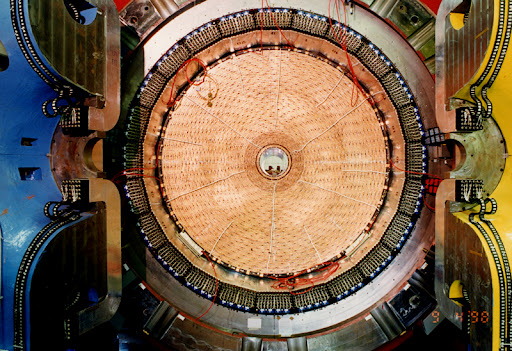
A leading candidate explanation, motivated by supersymmetry theory, is that dark matter is comprised of as yet undiscovered Weakly Interacting Massive Particles (WIMPs) formed in the early universe and subsequently gravitationally clustered in association with baryonic matter. WIMPs could in principle be detected in terrestrial experiments through their collisions with ordinary nuclei, giving observable low-energy (<100 keV) nuclear recoils. The predicted low collision rates require ultra-low background detectors with large (0.1–10 ton) target masses, located in deep underground sites to eliminate neutron background from cosmic ray muons.The Darkside of Gran Sasso

Also See: Cern Courier: The DarkSide of Gran Sasso

Posted in Uncategorized | Leave a comment