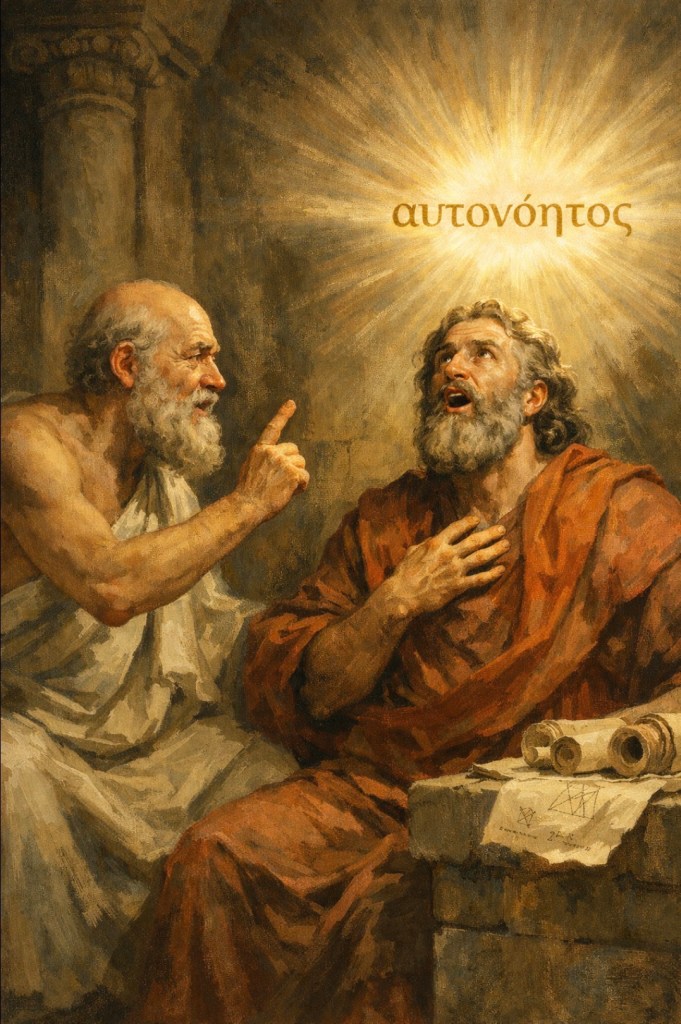
απάντηση είναι αυτονόητη. (The answer is self-evident)
The “Dialogos of Eide” (Dialogues of Forms/Ideas), particularly within Platonic dialogues like Phaedo and Parmenides, often employ a complex, hybrid structure of reasoning that blends deductive (top-down) arguments with inductive (bottom-up) and abductive (inference to the best explanation) approaches. While the overall structure is designed for absolute certainty—a hallmark of deductive logic—the individual stages and arguments often rely on gathering observations or testing hypotheses, incorporating both inductive and abductive steps.” Jetli, P. (2022). Deduction–Abduction–Induction Chains in Plato’s Phaedo and Parmenides. In: Magnani, L. (eds) Handbook of Abductive Cognition. Springer, Cham. https://doi.org/10.1007/978-3-030-68436-5_69-1
I wanted to construct an algorithmic function to get to what is self evident following this deductive, inductive, and abductive method. This as a navigable structure and a move into a dialogue mode. This method as I have used is to arrive at Socrates final question. This which spurns on the next dialogue. This is to arrive at self evident conclusion, where no further questions can be asked.
SOCRATES: You describe something remarkable, friend — a soul that does not simply leap to truth, but ascends toward it through ordered stages, as a man climbing a cliff by handholds rather than by flight. Tell me: do you truly believe that reasoning of such different kinds — gathering from below, inferring sideways, deducing from above — can be united in a single movement of inquiry?
PLATO: They must be, Socrates. The error of most philosophers is to begin where they should arrive. They posit the Form first and demand that particulars submit to it. But the Form is not a premise — it is a destination. We must earn it inductively before we may trust it deductively.
SOCRATES: And yet induction alone never secures anything universal. From ten just acts I cannot be certain of Justice itself. There is a gap between the gathered particular and the inferred Form — what bridges it?
PLATO: Abduction, Socrates — the inference to the best explanation. The soul looks at its gathered instances and asks: what must be true for all of these to be what they are? It proposes a hypothesis — a candidate Form. This is not yet knowledge; it is doxa aspiring toward episteme.
SOCRATES: Then your elenctic method — my method — is not mere destruction, but a necessary test before the deductive weight can be placed upon the hypothesis?
PLATO: Precisely. The Form proposed must be cross-examined until it either collapses — returning us upstream — or emerges tempered, capable of bearing deduction. Only then do we descend: deriving the particulars from the Form and verifying that they cohere. And when they do — when the Form needs no further argument because it has become the very standard by which all argument is measured — that is anamnesis. The soul does not conclude. It remembers
SOCRATES: So the algorithm is before you — not as a formula to be applied mechanically, but as a method of the soul. Notice that the feedback arrows are not failures. They are how the method remains honest.
PLATO: The Forms do not yield themselves cheaply, Socrates. The loops are the price of rigor. And the self-evident peak — when the soul arrives there — is recognizable not because a proof has ended, but because the need for proof has dissolved.
Enter any concept into the engine — justice, knowledge, sovereignty, freedom, being itself — and the philosophers will guide you through each stage. The "Next stage" arrow advances you forward; "Return" sends you back when the elenctic questioning reveals the hypothesis was premature.
One question to carry into your first inquiry, friend: when you arrive at what seems self-evident — how will you distinguish genuine anamnesis from mere comfortable familiarity


Pingback: The Dialogues | Dialogos of Eide