Vacationing On Vancouver Island

 Along the beach in Parksville there was a sand sculpture contest going on. Here is a video of the sculptures and how they were being made. They all  looked pretty neat. Here are some pictures I took of the finished product  below.

My wife and I are vacationing right now and are staying not to far from the event.

We meet here on Vancouver Island about 36 years ago and this is kind of a homecoming for us. The ferry ride over brought back a lot of good memories traveling from the mainland.

Posted in Uncategorized | Tagged | Leave a comment

Process Fractal vs Geometry Fractals

Let proportion be found not only in numbers, but also in sounds, weights, times and positions, and whatever force there is.Leonardo Da Vinci

The Mandelbrot set, seen here in an image generated by NOVA, epitomizes the fractal. Photo credit: © WGBH Educational Foundation

 “Clouds are not spheres, mountains are not cones, coastlines are not circles, and bark is not smooth, nor does lightning travel in a straight line.” So writes acclaimed mathematician Benoit Mandelbrot in his path-breaking book The Fractal Geometry of Nature. Instead, such natural forms, and many man-made creations as well, are “rough,” he says. To study and learn from such roughness, for which he invented the term fractal, Mandelbrot devised a new kind of visual mathematics based on such irregular shapes. Fractal geometry, as he called this new math, is worlds apart from the Euclidean variety we all learn in school, and it has sparked discoveries in myriad fields, from finance to metallurgy, cosmology to medicine. In this interview, hear from the father of fractals about why he disdains rules, why he considers himself a philosopher, and why he abandons work on any given advance in fractals as soon as it becomes popular. A Radical Mind

As I watch the dialogue between Bruce Lipton and Tom Campbell here, there were many things that helped my perspective understand the virtual world in relation to how the biology subject was presented. It is obvious then why Bruce Lipton likes the analogies Tom Campbell has to offer. The epiphanies Bruce is having along the road to his developing biological work is very important. It is how each time a person makes the leap that one must understand how individuals change, how societies change.

Okay so for one,  the subject of fractals presents itself and the idea of process fractals and Geometry Fractals were presented in relation to each other. Now the talk moved onto the very thought of geometry presented in context sort of raised by ire even though I couldn’t distinguish the differences. The virtual world analogy is still very unsettling to me.

So ya I have something to learn here.

I think my problem was with how such iteration may be schematically driven so as toidentify the pattern. Is to see this process reveal itself on a much larger scale. So when I looked at the Euclidean basis as a Newtonian expression the evolution toward relativity had to include the idea of Non Euclidean geometries. This was the natural evolution of the math that lies at the basis of graduating from a Euclidean world. It is the natural expression of understanding how this geometry can move into  a dynamical world.

So yes the developing perspective for me is that even though we are talking abut mathematical structures here we see some correspondence in nature . This has been my thing so as to discover the starting point?

A schematic of a transmembrane receptor

It the truest sense I had already these questions in my mind as  I was going through the talk. The starting point for Bruce is his biology and the cell. For Tom, he has not been explicit here other then to say that it is his studies with Monroe that he developed his thoughts around the virtual world as it relates to the idea of what he found working with Monroe.

So it is an exploration I feel of the work he encountered and has not so far as I seen made a public statement to that effect. It needs to be said and he needs to go back and look over how he had his epiphanies. For me this is about the process of discovery and creativity that I have found in my own life. Can one feel so full as to have found ones wealth in being that you can look everywhere and see the beginnings of many things?

This wealth is not monetary for me although I recognized we had to take care of or families and made sure they were ready to be off on their own. To be productive.

The Blind Men and the Elephant
John Godfrey Saxe (1816-1887)

 So for me the quest for that starting point is to identify the pattern that exists in nature as much as many have tried various perspective in terms of quantum gravity. Yes, we are all sort of like blind men trying to explain the reality of the world in our own way and in the process we may come up with our epiphanies.

These epiphanies help us to the next level of understanding as if we moved outside of our skeletal frame to allow the membrane of the cell to allow receptivity of what exist in the world around as information. We are not limited then to the frame of the skeleton hardened too, that we cannot progress further. The surface area of the membrane then becomes a request to open the channels toward expansion of the limitations we had applied to ourselves maintaining a frame of reference.

Posted in Deep Play, Euclid, geometries, Giovanni Girolamo Saccheri, Heart, Non Euclidean, Quasicrystals | Tagged , , , , , , , | 15 Comments

Brian Clegg: Gravity

A history of gravity, and a study of its importance and relevance to our lives, as well as its influence on other areas of science. 
Physicists will tell you that four forces control the universe. Of these, gravity may the most obvious, but it is also the most mysterious. Newton managed to predict the force of gravity but couldn’t explain how it worked at a distance. Einstein picked up on the simple premise that gravity and acceleration are interchangeable to devise his mind-bending general relativity, showing how matter warps space and time. Not only did this explain how gravity worked – and how apparently simple gravitation has four separate components – but it predicted everything from black holes to gravity’s effect on time. Whether it’s the reality of anti-gravity or the unexpected discovery that a ball and a laser beam drop at the same rate, gravity is the force that fascinates. Gravity: How the Weakest Force in the Universe Shaped Our Lives

It is an interesting read so far. I have always had a fondness of the historical take information can  provide from that historical sense.  Each time an author can enlighten the world with our science forbears it makes for a deeper feel of what came out of these scientists as precursors to where we are today. I enjoy how Brian Clegg can fill in the gaps with what I had learn of Sir Isaac Newton. The historical progress from the ancient Greeks to what has transpire to today in terms of our definition of Gravity.

It allows one to look at around them and the way in which early ideas became foundations points from which development move on toward the world of the science we have today in terms of that gravity.

Posted in Gravity, Kip Thorne, LIGO, Ronald Mallet, Sir Isaac Newton | Tagged , , , , | Leave a comment

Where is Our Starting Point?

“The end he (the artist) strives for is something else than a perfectly executed print. His aim is to depict dreams, ideas, or problems in such a way that other people can observe and consider them.” – M.C. Escher

Can you trace the patterns in nature toward matter manifestations?

To them, I said,
the truth would be literally nothing
but the shadows of the images.
Plato, The Republic (Book VII)

The idea here is about how one’s observation and model perceptions arises from some ordered perspective. Some use a starting point as an assumption of position. Do recognize “the starting point” in the previous examples?

 Cycle of Birth, Life, and Death-Origin, Indentity, and Destiny by Gabriele Veneziano

In one form or another, the issue of the ultimate beginning has engaged philosophers and theologians in nearly every culture. It is entwined with a grand set of concerns, one famously encapsulated in an 1897 painting by Paul Gauguin: D’ou venons-nous? Que sommes-nous? Ou allons-nous? “Where do we come from? What are we? Where are we going?”

The effective realization that particle constructs are somehow smaller windows of a much larger perspective fails to take in account this idea that I am expressing as a foundational approach to that starting point.

If you do not go all the way toward defining of that “point of equilibrium” how are you to understand how information is easily transferred to the individual from a much larger reality of existence? One would assume information is all around us? That there are multitudes of pathways that allow us to arrive at some some probability density configuration as some measure of an Pascalian ideal.

Of course there are problems with this in terms of our defining a heat death in individuals?

That’s not possible so one is missing the understanding here about equilibrium. I might have said we are positional in terms of the past and the future with regard to memory and the anticipated future? How is that heat death correlated? It can’t.

So you have to look for examples in relation to how one may arrive at that beginning point. Your theory may not be sufficiently dealing with the information as it is expressed in terms of your approach to the small window?

There are mathematical inspections here that have yet to be associated with more then discrete functions of reality as expressive building blocks of interpretation. The basic assumption of discrete function still exists in contrast to continuity of expression. This is the defining realization in assuming the model that MBT provides. I have meet the same logic in the differences of scientific approach toward the definition of what is becoming?

On the one hand, a configuration space as demonstrated by Tom that is vastly used in science. On the other, a recognition of how thick in measure viscosity is realized and what the physics is in this association. Not just the physical manifestation of, but of what happens when equilibrium is reached. Hot or very cold. Temperature, is not a problem then?

See my problem is that I can show you levitation of objects using superconductors but I cannot produce this in real life without that science. Yet, in face of that science I know that something can happen irregardless of what all the science said, so I am looking as well to combining the meta with the physical to realize that such a conditions may arise in how we as a total culture have accepted the parameters of our thinking.

So by dealing with those parameters I too hoped to see a cultural shift(paradigm and Kuhn) by adoption of the realization as we are with regard to the way in which we function in this reality. So if your thinking abut gravity how is this possible within the “frame work” to have it encroach upon our very own psychological makeup too?

Posted in Dimension, Foundation, Quasicrystals, Riemann Hypothesis, Socratic Method, Symmetry, Veneziano | Tagged , , , , , , | 8 Comments

Project Glass: I Can See Your Thoughts?

We believe technology should work for you — to be there when you need it and get out of your way when you don’t. A team within our Google[x] group started Project Glass to build this kind of technology, one that helps you explore and share your world, putting you back in the moment. Follow along with us at http://g.co/projectglass as we share some of our ideas and stories. We’d love to hear yours, too. What would you like to see from Project Glass?

An image of a cat that a neural network taught itself to recognize.

MOUNTAIN VIEW, Calif. — Inside Google’s secretive X laboratory, known for inventing self-driving cars and augmented reality glasses, a small group of researchers began working several years ago on a simulation of the human brain.


Andrew Y. Ng, a Stanford computer scientist, is cautiously optimistic about neural networks. 

There Google scientists created one of the largest neural networks for machine learning by connecting 16,000 computer processors, which they turned loose on the Internet to learn on its own. 

Presented with 10 million digital images found in YouTube videos, what did Google’s brain do? What millions of humans do with YouTube: looked for cats. How Many Computers to Identify a Cat? 16,000

So the idea here is that given enough information about the neurological data recorded from the picture of the brain,  neuron ignitions,  then what said we could not have taken that data and used it to create a image of what the mind of the other person is thinking? Looking into the images of Dreams so as to analyze the deeper recordings of the soul’s language and creativity.

Oh Google Brain  then is a larger perspective of the human brain?

What if on the screen of that eye glass my Avatar materializes to answer my questions?

Posted in Avatar | Tagged | 3 Comments

Quantitative modeling of human brain activity

Quantitative modeling of human brain activity can provide crucial insights about cortical representations [1,2] and can form the basis for brain decoding devices [3,4,5]. Recent functional magnetic resonance imaging (fMRI) studies have modeled brain activity elicited by static visual patterns and have reconstructed these patterns from brain activity [6,7,8]. However, blood oxygen level-dependent (BOLD) signals measured via fMRI are very slow [9], so it has been difficult to model brain activity elicited by dynamic stimuli such as natural movies. Here we present a new motion-energy [10,11] encoding model that largely overcomes this limitation. The model describes fast visual information and slow hemodynamics by separate components. We recorded BOLD signals in occipitotemporal visual cortex of human subjects who watched natural movies and fit the model separately to individual voxels. Visualization of the fit models reveals how early visual areas represent the information in movies. To demonstrate the power of our approach, we also constructed a Bayesian decoder [8] by combining estimated encoding models with a sampled natural movie prior. The decoder provides remarkable reconstructions of the viewed movies. These results demonstrate that dynamic brain activity measured under naturalistic conditions can be decoded using current fMRI technology. See:Reconstructing Visual Experiences from Brain Activity Evoked by Natural Movies

See Also:

Posted in Brain | Tagged | Leave a comment

Thoughts On Dark Matter Search


A filament of dark matter has been directly detected between the galaxy clusters Abell 222 and Abell 223. The blue shading and yellow contour lines represent the density of matter. Image credit: Jörg Dietrich, U-M Department of Physics

In light of direction LHC is experiencing there is always the questions of Oversight in terms of the direction science needs to take. I have listed one aspect of the question of directions that may be of interest here? I have seen this procedure used over and over again. This is how I know to focus in on the experiments as they are listed and work backwards to gain full insight in these experimental procedures.

 This focus with regard to be “lead by science is part of the mantra” I hold and features part of my respect toward the science process that I have come to build in respect of where we are going and what is happening. In this spirit there has always been help by scientists who want to help the lay public with information to help exceed current levels of understanding with regard to where we are right now in that science.

 The challenge is not to be lost in the confrontations of opposing view points in science but to focus more on what is being offered in terms of advancing that science knowledge. One has to put aside these character attacks in order to focus on the science process itself and information. Character attacks on theoretical definitions.

 Following scientists you get to know who is respecting this foundational approach in order to push forward public knowledge. The vitriolic statements about character are like sandpaper or a screeching board, to respect for individuals in their pursuits

Over the years as a researcher of sorts digging deeply for the directions science projects are initiated are always with the idea that advisory boards put forward proposals for money toward experimental procedures.

 So in order to justified this money I have to believe the best approach to advancing that money is to consider it as a method to falsify on scientific grounds.

 I know people have their own theories but in order to advance falsifiable methods these have to be considered at the time the phenomenology of experimentation is proposed as part of the development of that method to do so.

 So the OP introduction toward a news article is hardly sufficient to think about the advancement of any theory on the grounds that it could encapsulate the entire process of advancing science as nothing more then news fodder. To be able to raise the question for those who believe that it is a opportunity to advance their own theories or to ask the question in the spirit of the OP?

 Liquid Xenon both scintillates and becomes ionized when hit by particles (i.e. photons, neutrons and potentially dark matter). The ratio of scintillation over ionization energy caused by the collision provides a way of identifying the interacting particle. The leading theoretical dark matter candidate, the Weakly Interacting Massive Particle (WIMP), could be identified in this way. LUX Dark Matter

See:

Posted in dark energy, dark matter | Tagged , | Leave a comment

Space Geodesy

 Project manager Stephen Merkowitz talks about his work with NASA’s Space Geodesy Project, including a brief overview of the four fundamental techniques of space geodesy: GPS, VLBI, SLR, and DORIS.

Learn more about space geodesy at: http://space-geodesy.nasa.gov/

This video is public domain and can be downloaded at: http://svs.gsfc.nasa.gov/goto?11031

Space Geodesy provides positioning, navigation, and timing reference systems and Earth system observations

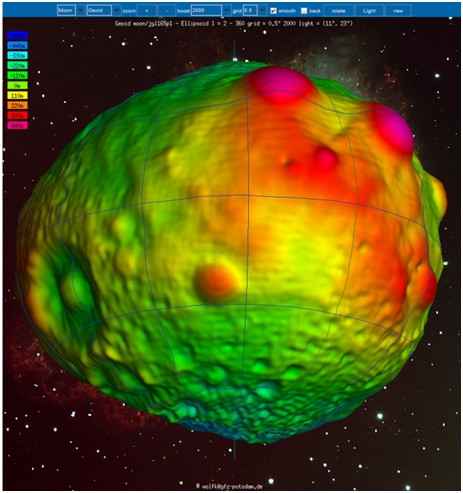
Geodesy is the science of the Earth’s shape, gravity and rotation, including their evolution in time. A number of different techniques are used to observe the geodetic properties of the Earth including the space-geodetic techniques of Very Long Baseline Interferometry (VLBI), Satellite Laser Ranging (SLR), Global Navigation Satellite Systems (GNSS) like the US Global Positioning System (GPS), and the French Doppler Orbitography and Radio-Positioning by Integrated Satellite (DORIS) system. These space-geodetic observations also provide the basis for the reference frame that is needed in order to assign coordinates to points and objects and thereby determine how those points and objects move over time. See SGP Science

See Also:

Posted in Grace, Grace Satellite, LRO, Moon, VLBI | Tagged , , , , | Leave a comment

Merging Galaxy Cluster Abell 520

Merging Galaxy Cluster Abell 520

This composite image shows the distribution of dark matter, galaxies, and hot gas in the core of the merging galaxy cluster Abell 520, formed from a violent collision of massive galaxy clusters. 

The natural-color image of the galaxies was taken with NASA’s Hubble Space Telescope and with the Canada-France-Hawaii Telescope in Hawaii. Superimposed on the image are “false-colored” maps showing the concentration of starlight, hot gas, and dark matter in the cluster. 

Starlight from galaxies, derived from observations by the Canada-France-Hawaii Telescope, is colored orange. The green-tinted regions show hot gas, as detected by NASA’s Chandra X-ray Observatory. The gas is evidence that a collision took place. The blue-colored areas pinpoint the location of most of the mass in the cluster, which is dominated by dark matter. Dark matter is an invisible substance that makes up most of the universe’s mass. The dark-matter map was derived from the Hubble Wide Field Planetary Camera 2 observations by detecting how light from distant objects is distorted by the cluster of galaxies, an effect called gravitational lensing. 

 The blend of blue and green in the center of the image reveals that a clump of dark matter resides near most of the hot gas, where very few galaxies are found. This finding confirms previous observations of a dark-matter core in the cluster. The result could present a challenge to basic theories of dark matter, which predict that galaxies should be anchored to dark matter, even during the shock of a collision. Abell 520 resides 2.4 billion light-years away. See: Dark Matter Core Defies Explanation in Hubble Image

See Also:

Posted in Uncategorized | Leave a comment

EO: Earth Observatory

Twelve years after the Earth was buffeted by one of the more potent Sun storms in modern history, our nearest star crackled with activity again. A solar flare erupted on July 12, 2012, followed closely by a companion coronal mass ejection (CME)—a cloud of magnetically charged particles and energy that can disturb Earth’s magnetic field, disrupt satellites and ground-based electronics, and provoke auroras.

The Atmospheric Imaging Assembly on NASA’s Solar Dynamics Observatory (SDO) captured these views of the flare in the Sun’s southern hemisphere on July 12, 2012. The top, global image shows the Sun as viewed at 131 Angstroms; the lower, close-up view is 171 Angstroms. Both ultraviolet wavelengths help solar physicists study the fine magnetic structures in the Sun’s super-heated atmosphere, or corona. The yellow and teal are false colors chosen by the science team to distinguish between the spectral bands. Download the movies linked beneath each image to see the active region develop and erupt. See:The Sun Erupts

 An X1.4 class flare erupted from the center of the sun, peaking on July 12, 2012 at 12:52 PM EDT. It erupted from Active Region 1520 which rotated into view on July 6.

This video uses SDO AIA footage in 131(teal), 171(gold) and 335 (blue) angstrom wavelengths. Each wavelength shows different temperature plasma in the sun’s atmosphere. 171 shows 600,000 Kelvin plasma, 335 shows 2.5 million Kelvin plasma, and 131 shows 10 million Kelvin plasma.

 This video is public domain and can be downloaded at: http://svs.gsfc.nasa.gov/goto?11043

See Also:

Posted in SDO, Sun | Tagged , | Leave a comment