Tiny Blackholes in Cosmic Observations?

205th Meeting of the American Astronomical Society 9-13 January 2005 — San Diego, CA

I am kind of interested to find further information on how microstate blackholes might have been generated and looking at the concentration of minds, I wonder if this topic was brought up, or will be brought up?

The Pierre Auger Observatory, currently being constructed in Argentina to study cosmic rays, could examine the structure of spacetime itself, say physicists in the United States.

If, as some suspect, the Universe contains invisible, extra dimensions, then cosmic rays that hit the atmosphere will produce tiny black holes. These black holes should be numerous enough for the observatory to detect, say Jonathan Feng and Alfred Shapere of the Massachusetts Institute of Technology in Cambridge, Massachusetts1.

The observatory will consist of two 3,000-square-kilometre arrays – one in Argentina, one somewhere in the Northern Hemisphere – each containing 1,600 particle detectors. Scheduled for completion by 2004, scientists hope that the equipment will help to solve the mystery of cosmic rays. These rays consist of extremely high-energy particles that stream into the Earth’s atmosphere from space – from where, exactly, no one knows.

Lubos has mention Steve Giddings and I have also mentioned himearlier inmy blogs on the topic of Mini blackholes as well.

In theories with large extra dimensions at sub-millimetre distances, for example, and/or high energies of the order of 1 TeV or more, gravity may become a strong force. Thus, hypothetically, the energy required to produce black holes is well within the range of the LHC, making it a “black-hole factory”. As Stephen Hawking has taught us, these mini black holes would be extremely hot little objects that would dissipate all their energy very rapidly by emitting radiation and particles before they wink out of existence. The properties of the Hawking radiation could tell us about the properties of the extra spatial dimensions, although there are still uncertainties in the theory at this stage. Nevertheless, astroparticle and collider experiments should provide useful input to the theoretical work in this area. Indeed, the signatures are expected to be spectacular, with very high multiplicity events and a large fraction of the beam energy converted into transverse energy, mostly in the form of quarks/gluons (jets) and leptons, with a production rate at the LHC rising as high as 1 Hz. An example of what a typical black-hole event would look like in the ATLAS detector is shown in figure 2.

If mini black holes can be produced in high-energy particle interactions, they may first be observed in high-energy cosmic-ray neutrino interactions in the atmosphere. Jonathan Feng of the University of California at Irvine and MIT, and Alfred Shapere of the University of Kentucky have calculated that the Auger cosmic-ray observatory, which will combine a 6000 km2 extended air-shower array backed up by fluorescence detectors trained on the sky, could record tens to hundreds of showers from black holes before the LHC turns on in 2007.


Cosmic rays in ATLAS

The flux of cosmic ray muons through the ATLAS cavern can be utilized as a tool to “shake down” the ATLAS detector prior to data taking in 2007.

Additionally, a thorough understanding of the cosmic ray flux in ATLAS will be of great use in the study of cosmic ray backgrounds to the search for rare new physics processes in ATLAS.

Posted in Black Holes, Cosmic Rays, Gravity, LHC, Microstate Blackholes, Particles, Pierre Auger, Quarks, Stephen Hawking, Steve Giddings | Tagged , , , , , , , , , | Leave a comment

The Emergence of Time, What Lies Beneath?

The intuitive classical space-time picture breaks down in quantum gravity, which makes a comparison and the development of semiclassical techniques quite complicated.

Taken in context of how supersymmetrical levels could have ever been reached, is really a wonderful thnng to consider. If singularities were to be devised in methods that would experiementally bring forth blackholes at the microstates. Then what value is derived from learning about high energy and the levels we must go through to speak about these singularities?

From classical discritpion of GR to the understanding that supergravity could have ever been devised as a method to live in supersymmetrical worlds, would have been a challenge indeed, and we might ask where would time would begin, and what was below time?

The conclusion of this lecture is that the universe has not existed forever. Rather, the universe, and time itself, had a beginning in the Big Bang, about 15 billion years ago. The beginning of real time, would have been a singularity, at which the laws of physics would have broken down. Nevertheless, the way the universe began would have been determined by the laws of physics, if the universe satisfied the no boundary condition. This says that in the imaginary time direction, space-time is finite in extent, but doesn’t have any boundary or edge. The predictions of the no boundary proposal seem to agree with observation. The no boundary hypothesis also predicts that the universe will eventually collapse again. However, the contracting phase, will not have the opposite arrow of time, to the expanding phase. So we will keep on getting older, and we won’t return to our youth. Because time is not going to go backwards, I think I better stop now.

by Stephen Hawking

It becomes very difficult then for anyone to accept that Robert Laughlin might have “wondered” about about condensed matter physics to have wonder what the building blocks shall be at such levels? That he might have wanted to stay to discrete structures for explanations as far as he could tell experimentally?:)


Likewise, if the very fabric of the Universe is in a quantum-critical state, then the stuff that underlies reality is totally irrelevant-it could be anything, says Laughlin. Even if the string theorists show that strings can give rise to the matter and natural laws we know, they won’t have proved that strings are the answer-merely one of the infinite number of possible answers. It could as well be pool balls or Lego bricks or drunk sergeant majors
.

You see this is okay. That one can direct their attention to such infrastructures to ask, what the ultimate building block shall be, that we constantly refocus our mind to the finer things(abstract mathematical forays into these fine building blocks), only to find, we have progress well into the cosmological view, of such microstates?

The path integral is taken over metrics of all possible topologies, that fit in between the surfaces. There is the trivial topology, the initial surface, cross the time interval. Then there are the non trivial topologies, all the other possible topologies. The trivial topology can be foliated by a family of surfaces of constant time. The path integral over all metrics with trivial topology, can be treated canonically by time slicing. In other words, the time evolution

(including gravity) will be generated by a Hamiltonian. This will give a unitary mapping from the initial surface, to the final.

But to follow is this what Peter Woit thinks?

Peter Woit said–?His argument is in Euclidean quantum gravity, which he describes as “the only sane way to do quantum gravity non-perturbatively”, something which some might disagree with. What he seems to be arguing is that, while it is true you get information loss in the path integral over metrics on a fixed non-trivial black hole topology, you really need to sum over all topologies. When you do this you get unitary evolution from the trivial (no black hole) topology and the non-trivial topologies give contributions that are independent of the initial state and don’t contribute to the initial-final state amplitude.

I guess what this means is that he is claiming that, sure, if you knew you really had a black hole, then there would be a problem with unitarity, but in quantum gravity you don’t ever really know that you have a black hole, you also have to take into account the amplitude for not actually having one and when you properly do this the unitarity problem goes away.

You must accept my humble apologies, but to have been given these directions(quotes analogies in reference links and statements, from both Lubos Motl and Peter Woit, I wonder about the difference in their interpretations of the mathematics they are using? Are they so fundamntally at odds with each other, that they do not realize that they are working very close in their idealizations?

Posted in Analogies, Emergence, Gravity, Laughlin, Mathematics, Metrics, Non Euclidean, Quantum Gravity, Stephen Hawking, Topology | Tagged , , , , , , , , , | Leave a comment

Quantum Gravity at Planck Length

It was necessary to bring some of this infomration here while things are getting sorted out elsewhere.

6.4 Spacetime Topology Change

by Joseph Polchinski

This subsection is not directly related to black holes, but deals with another exotic question in quantum gravity. Gravity is due to the bending of spacetime. It is an old question, whether spacetime can not only bend but break: does its topology as well as its geometry evolve in time?

Again, string theory provides the tools to answer this question. The answer is ‘yes’ — under certain controlled circumstances the geometry can evolve as shown schematically in figure 9.

Posted below is Steinhardt informtaion, and his cyclical universe have been highlighted for consideration. The informtaion about the Planck satelitte ready for deployment in 2007 should open our eyes to a few of the issues that are evolving.

Posted in Black Holes, geometries, Gravity, Quantum Gravity, String Theory, Topology | Tagged , , , , , | Leave a comment

Primordial Gravitational Waves

Although I have designated the title above, I want to add current trends for future observations by speaking to this one first.

It is sometimes evident that such comments made by Peter Woit would have to have enormous amounts of data to back up the reasons why research should not be moving in the direction it is. I do not have alot of time right now so I will just put up this for now.

Planck was selected as the third Medium-Sized Mission (M3) of ESA’s Horizon 2000 Scientific Programme, and is today part of its Cosmic Vision Programme. It is designed to image the anisotropies of the Cosmic Background Radiation Field over the whole sky, with unprecedented sensitivity and angular resolution. Planck will provide a major source of information relevant to several cosmological and astrophysical issues, such as testing theories of the early universe and the origin of cosmic structure. The scientific development of the mission is directed by the Planck Science Team.

How would such information force us to consider the subject of gravitational wave generation in microscopic avenues, and all of a sudden dismiss quantum geometrical considerations as revealled on topological forms? Would it?

Max Tegmark and others, current working in this area, will have been provided with a deeper look at what they have been postulating in regards to “topological forms,” in the cosmos. As many know, this relationship is part of my attempts at comprehension of what happens at such quantum levels and why quantum geometry is not relevant to cosmolgical scales for considerations.

For such comments, that would have implied Higher Dimensions to be revealled in the Spacetime Fabric, would have been verified? But like the Cyclical Universe, I could go the way of any model that does not follow the current established trends of thinking.:)It would be consequential, if such speaking is not backed up, but as we know any ear that is lent to discussion, the reasons why before hand, would always be a important one to consider?:)

Posted in geometries, Max Tegmark | Tagged , | Leave a comment

Light Humour From Another

When your feeling all alone in the dimensional world, think about Homer’s triumph:)

Well, it should be obvious to even the most dim-witted individual who holds an advanced degree in hyperbolic topology, that Homer Simpson has stumbled into… the third dimension.

…..and tongued tied, as to how you would explain yourself to others, on these higher dimenisonal realizations, just recognize you are not alone:)

No, you can’t play with it; you won’t

enjoy it on as many levels as I do

Posted in Dimension, Topology | Tagged , | Leave a comment

GR Reduced From Higher Dimensions?

Earlier in my blog, I posted a subject called the Classical discription of the quantum world

Now it was a big leap of faith on my part that I saw these events as distilliations of a larger and more dynamic universe that cooled to proportionl views that I had related in that post. But now, this might be rejected based on the work done on this cosmological observatory, that is not mirrored from a larger proportional view of that early universe? What does this mean?

If planck epoch arises to expansitory features revealled in our cosmos, then, early universe detection is a valid assumption of this earlier design?

That the comments posted by Arun in the blog entitled crackpotism, contrasted to my statement, has much more discussion behind it to consider.

Arun said: So, string theory embraces both General Relativity and not-General Relativity!!!! In other words, string theory says nothing definite.

Plato said: And about Arun’s comment about GR. Phase transitions would be reduced holographcally from higher dimensions( the standard model would have been decribed from earlier states ), would finally show up there?:)

If one did not recognize earlier states of existence and just accepted the cosmological playground sight seen, it always existed in this form then:) That is, if we take the standard set by observation:)

I for one thought, topological considerations would have been formulated from earlier cosmic designs, but apparently this might have been subject to scrutiny, and thought out. Rejection of the soccer ball design as well?:)

So I guess I’ll get to it here and post the following for consideration.

The significance of the largest scale CMB fluctuations in WMAP:

Now of course, we must remember that the way in which I am looking at this universe is that we see it in it’s earlier state, as spread out(higher dimensional attributes), much like we see the discription of the early computerize version shown here .

Computerized Model of Andrey Kravtsov.

The current state of the universe, globally, would be a derived from some view point that represents the current shape and size of the universe. Represents its current age, to design? At least, this is what would have been derived from the sources I am considering in light of the assumption I am making, has some realistic version, that would hold to such spherical considerations. Hold on Peter Woit:)

So such a point although subject to these phase transitions are in the end understood on the other end of the scale of consideration from that early universe to today. To what passes us by? We are attempting to measure at this point in time, what “rings true” through all of us?:)

Posted in General Relativity, geometries, Non Euclidean, Nothing, Phase Transitions, Standard model, String Theory, Topology, WMAP | Tagged , , , , , , , , | Leave a comment

Induction and Deduction

Our attempt to justify our beliefs logically by giving reasons results in the “regress of reasons.” Since any reason can be further challenged, the regress of reasons threatens to be an infinite regress. However, since this is impossible, there must be reasons for which there do not need to be further reasons: reasons which do not need to be proven. By definition, these are “first principles.” The “Problem of First Principles” arises when we ask Why such reasons would not need to be proven. Aristotle’s answer was that first principles do not need to be proven because they are self-evident, i.e. they are known to be true simply by understanding them.

The interesting thing about developing vision is of course recognizing the framework with which you will make deductions about the world, and the structures with which you will deal. If held to pre-establish routes, and leading indicators of geometrical design, leading to higher dimensional attributes revealled in topological discourses, then such vision would have required the mind accept higher dimensional attributes first?

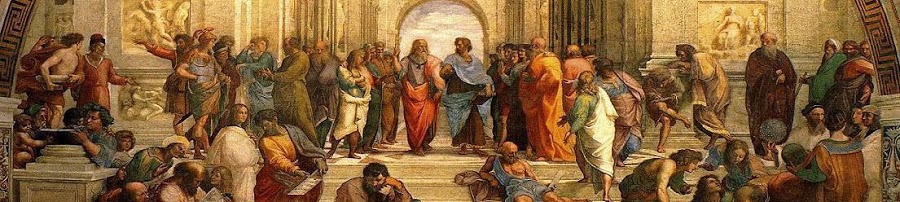
Often the very idea, of distilling information, inductively looking at the object of consideration, would have been like sitting in front of a picture and realizing that the very ideas about inductive and deductive reasoning would have made them self know in some way or form. So for me, recognizing the piecing that has gone on with the royal road to geometry, Plato’s discourse with Aristotle at the top of this web page, part of deciphering this global village of ideas, is to soak up the picture of Rapheal.

So what I have done here is brought together another idea(the arch), in the comprehension of this picture for consideration. That in model comprehension( and just for the sake of it accept string theory for a moment) it is always much easier to accept the picture as it is, without really understanding the deeper implications of it.

Now in my research, and looking at what happened with Lenny Susskind and the work he was doing, such a inspirative insight of the string vibration in his head would have been a recognition and culmination of other things, before, this image materialized in his brain.

If we understand the topic of this thread, inductive and deductive modelling would have helped one recognize that the model acceptance would have immediately forced the mind to consider inductive and deductive features, as topological expressions of the roads leading from this geometry of expression to higher dimensinal attributes no less then what John Baez describes for us in using Platonic Solids for comparison.

In order to get to what is self-evident, such realizations of higher dimensions would have asked the mind to exercise it’s ability to move in these higher abstract worlds, by looking at differents model comprehensions and acceptances, to prepare it for extensions and realizations of those same realities we live in?

We hold these truths to be self evident

Should have been emblazoned on the American mind, and the realization of the way in which such truths once accepted, help us to move on and further develope the models we would want of the society as recognition of this whole picture. Simplified, such realizations signify the grokking and acceptance of the model and the ability, to play with other avenues of consideration, and in this case, strings as an example.

It could be Loop or Penrose as well and recognition, that the standard model is part and parcel of the whole view. One would have recognized this if they had understood that to go beyond the standard model and include gravity they had already bypassed this idea and formulation in a conprehensive whole.

From the planck epoch in cosmological understanding, grand unification, made this implicite in the design as part of a comprehensive whole of the dimensional significance of the developing cosmos.

Posted in Aristotelean Arche, Brain, deduction, geometries, Gravity, Induction, Standard model, String Theory, Susskind | Tagged , , , , , , , , | Leave a comment

Roger Penrose and the Quanglement


Order and Chaos, by Escher

(lithograph, 1950)

I will give Peter Woit and the group time to formulate the topic that should present itself shortly on their blog gathering. How the integration and question presented by Penrose was very helpful in how we digest early universe information. I will speak more on that, and universe clumping then.

Penroses Influence on Escher

During the later half of the 1950’s, Maurits Cornelius Escher received a letter from Lionel and Roger Penrose. This letter consisted of a report by the father and son team that focused on impossible figures. By this time, Escher had begun exploring impossible worlds. He had recently produced the lithograph Belvedere based on the “rib-cube,” an impossible cuboid named by Escher (Teuber 161). However, the letter by the Penroses, which would later appear in the British Journal of Psychology, enlightened Escher to two new impossible objects; the Penrose triangle and the Penrose stairs. With these figures, Escher went on to create further impossible worlds that break the laws of three-dimensional space, mystify one’s mind, and give a window to the artist heart.

If one does not comprehend the way in which the images can set up the mind for other things, then it becomes extremely difficult for it to accept any other models for consideration in the mathematical realm leading to issues of quantum gravity?

Posted in Gravity, Quanglement, Quantum Gravity | Tagged , , | Leave a comment

A Sphere that is Not so Round

Of course the most basic shape for me would be the sphere, but in our understanding of the earth and the images that we see of earth, our view is shattered by the first time we seen this enormous object, from the eyes of those who had always been earth bound and restricted to the calculation of a abstract world.

Now it is not so round, and the views we recieve of this information help us to understand a few things about the way in which we will look at the earth and its weak field manifestation, as one extreme of the whole gravitational framework we like to understand over this complex perspective of our cosmos from the very strong gravitational foreces, to the very weak.

Gravity is the force that pulls two masses together. Since the earth has varied features such as mountains, valleys, and underground caverns, the mass is not evenly distributed around the globe. The “lumps” observed in the Earth’s gravitational field result from an uneven distribution of mass inside the Earth. The GRACE mission will give us a global map of Earth’s gravity and how it changes as the mass distribution shifts. The two satellites will provide scientists from all over the world with an efficient and cost-effective way to map the Earth’s gravity field.

The primary goal of the GRACE mission is to map the Earth’s gravity field more accurately than has ever been done before. You might ask, how will GRACE do this? Two identical spacecraft will fly about 200 kilometers apart. As the two GRACE satellites orbit the Earth they are pulled by areas of higher or lower gravity and will move in relation to each other. The satellites are located by GPS and the distance between them is measured by microwave signals. The two satellites do not just carry science instruments, they become the science instrument. When mass moves from place to place within the Earth’s atmosphere, ocean, land or frozen surface (the “cryosphere”), the gravity field changes.

Highlighting in bold, it would not be necessary to go into a full explanation if we considered in context the cosmic string and clumping in our universe? But I have moved to far from the point of reference of our two systems of consideration here so back to the next point.

NASA’s Earth Science Enterprise funded this research as part of its mission to understand and protect our home planet by studying the primary causes of climate variability, including trends in solar radiation that may be a factor in global climate change.

One of the interesting ideas in these shapes is understanding what can cause disturbances within their fields and how we might look at these issues if we move our consideration from the normals views of measure stick and straight lines, to variations we have demonstrated on earth(hills and valleys). To how we would percieve “resonance” created in the sun, and use this, to determine the volatile solar coronas that would be ejected into space but of weather systems affected as well. This is a good monitoring tool fore warning system that could affect communication within the sphere of our own influence.

But let me take this one step further, in that we consider both these frames, in context of each other and ask the connection in lagrangian way. How would we see gravitational points of consideration related to each other? Would this help those less inclined to understand the variations in perspective of gravity to comprehend the value Einstein lead us through, to take us to a much more dynamical view of the cosmos?

So in the one sense to take what we know of the formulation at a euclidean level and move it accordingly, to cosmological perspectives. This is a apprehenson of Gr that we are geometrically lead through, to perspectives of the space we would now enjoy of Gauss. Having Reimann views here of spherical consideration, we understand well, the developing roads to mathematical perspective debated and shunned by Peter?:)

So looking at the way in which we entertain the earth view, and how we interpret the sun, we do not limit our views just to the spherical balls one might like to say is self evident, but having the knowledge of what we are lead through geometrically as well as toplogically, it becomes a much more interesting reality to entertain.

A Happy News Years to all those who visit:)

Posted in Climate, Earth, Einstein, Gauss, Grace, Grace Satellite, Gravity, lagrangian, Satellites, Space Weather, Sun | Tagged , , , , , , , , , , | Leave a comment

Where to Now?

Once you see parts of the picture, belonging to the whole, then it becomes clear what a nice picture we will have?:) I used it originally for the question of the idea of a royal road to geometry, but have since progressed.

If you look dead center Plato reveals this one thing for us to consider, and to Aristotle, the question contained in the heading of this Blog.

It is beyond me sometimes to wonder how minds who are involved in the approaches of physics and mathematics might have never understood the world Gauss and Reimann revealled to us. The same imaging that moves such a mind for consideration, would have also seen how the dimensional values would have been very discriptive tool for understanding the dynamics at the quantum level?

As part of this process of comprehension for me, was trying to see this evolution of ordering of geometries and the topological integration we are lead too, in our apprehension of the dynamics of high energy considerations. If you follow Gr you understand the evolution too what became inclusive of the geometry developement, to know the physics must be further extended as a basis of our developing comprehension of the small and the large. It is such a easy deduction to understand that if you are facing energy problems in terms of what can be used in terms of our experimentation, that it must be moved to the cosmological pallette for determinations.

As much as we are lead to understand Gr and its cyclical rotation of Taylor and hulse, Mercuries orbits set our mind on how we shall perceive this quantum harmonic oscillator on such a grand scale,that such relevance between the quantum and cosmological world are really never to far apart?

As I have speculated in previous links and bringing to a fruitation, the methods of apprehension in euclidean determinations classically lead the mind into the further dynamcis brought into reality by saccheri was incorporated into Einsteins model of GR. Had Grossman not have shown Einstein of these geoemtrical tendencies would Einstein completed the comprehsive picture that we now see of what is signified as Gravity?

So lets assume then, that brane world is a very dynamcial understanding that hold many visual apparatus for consideration. For instance, how would three sphere might evolve from this?

Proper understanding of three sphere is essential in understanding how this would arise in what I understood of brane considerations.

Spherical considerations to higher dimensions.

Spheres can be generalized to higher dimensions. For any natural number n, an n-sphere is the set of points in n-dimensional Euclidean space which are at distance r from a fixed point of that space, where r is, as before, a positive real number.

a 1-sphere is a pair of points ( – r,r)

a 2-sphere is a circle of radius r

a 3-sphere is an ordinary sphere

a 4-sphere is a sphere in 4-dimensional Euclidean space

However, see the note above about the ambiguity of n-sphere.

Spheres for n ≥ 5 are sometimes called hyperspheres. The n-sphere of unit radius centred at the origin is denoted Sn and is often referred to as “the” n-sphere.

INtegration of geometry with topological consideration then would have found this continuance in how we percieve the road leading to topolgical considerations of this sphere. Thus we would find the definition of sphere extended to higher in dimensions and value in brane world considerations as thus:

In topology, an n-sphere is defined as the boundary of an (n+1)-ball; thus, it is homeomorphic to the Euclidean n-sphere described above under Geometry, but perhaps lacking its metric. It is denoted Sn and is an n-manifold. A sphere need not be smooth; if it is smooth, it need not be diffeomorphic to the Euclidean sphere.

a 0-sphere is a pair of points with the discrete topology

a 1-sphere is a circle

a 2-sphere is an ordinary sphere

An n-sphere is an example of a compact n-manifold without boundary.

The Heine-Borel theorem is used in a short proof that an n-sphere is compact. The sphere is the inverse image of a one-point set under the continuous function ||x||. Therefore the sphere is closed. Sn is also bounded. Therefore it is compact.

Sometimes it is very hard not to imagine this sphere would have these closed strings that would issue from its poles and expand to its circumference, as in some poincare projection of a radius value seen in 1r. It is troubling to me that the exchange from energy to matter considerations would have seen this topological expression turn itself inside/out only after collapsing, that pre definition of expression would have found the evoltuion to this sphere necessary.

Escher’s imaging is very interesting here. The tree structure of these strings going along the length of the cylinder would vary in the structure of its cosmic string length based on this energy determination of the KK tower. The imaging of this closed string is very powerful when seen in the context of how it moves along the length of that cylinder. Along the cosmic string.

To get to this point:) and having shown a Platonic expression of simplices of the sphere, also integration of higher dimension values determined from a monte carlo effect determnation of quantum gravity. John Baez migh have been proud of such a model with such discrete functions?:) But how the heck would you determine the toplogical function of that sphere in higher dimensional vaues other then in nodal point flippings of energy concentration, revealled in that monte carlo model?

Topological consideration would need to be smooth, and without this structure how would you define such collpases in our universe, if you did not consider the blackhole?

So part of the developement here was to understand where I should go with the physics, to point out the evolving consideration in experimentation that would move our minds to consider how such supersymmetrical realities would have been realized in the models of the early universe understanding. How such views would have been revealled in our understanding within that cosmo?

One needed to be able to understand the scale feature of gravity from the very strong to the very weak in order to explain this developing concept of geometry and topological consideration no less then what Einstein did for us, we must do again in some comprehensive model of application.
Posted in Cosmic Strings, deduction, Dimension, Einstein, Gauss, geometries, Giovanni Girolamo Saccheri, Gravity, Hulse, imagery, Imagery dimension, KK Tower, Mathematics, nodal, Non Euclidean, Quantum Gravity, School of Athens, Taylor, Topology | Tagged , , , , , , , , , , , , , , , , , , | Leave a comment