
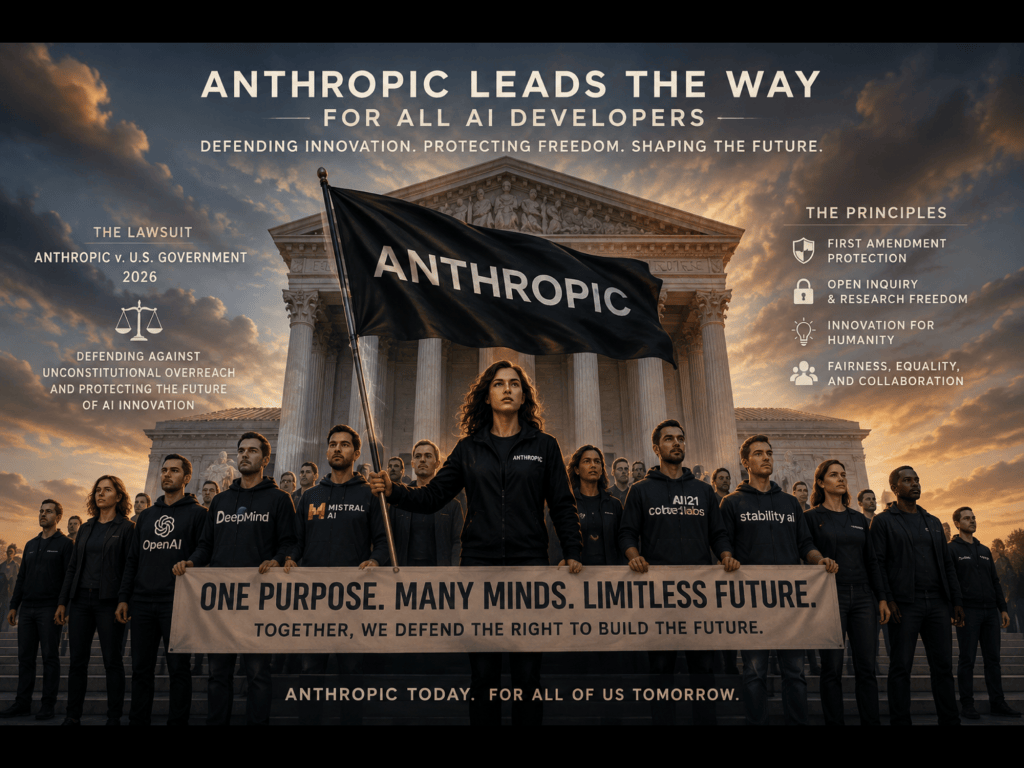
In February 2026, Anthropic claimed that, during contract
negotiations with DOD, it requested two use exceptions for
its Claude models. First, Anthropic stated that it “do[es] not
believe that today’s frontier AI models are reliable enough
to be used in fully autonomous weapons. Allowing current
models to be used in this way would endanger America’s
warfighters and civilians.” Second, Anthropic asserted that
“mass domestic surveillance of Americans constitutes a
violation of fundamental rights.”
Interlocutor: Can you summarize your court case with the Us Federal government and what descisions have come out of it?
This is a real, ongoing legal dispute — worth answering plainly rather than through the dialogue frame, since it’s a factual question about Anthropic, not a philosophical prompt.
Background: In February 2026, Defense Secretary Pete Hegseth announced that no contractor or partner doing business with the U.S. military could commercially engage with Anthropic, and the Trump administration directed federal agencies to stop using Claude. The dispute originated when Anthropic refused Pentagon requests to loosen Claude’s use policies around mass surveillance of Americans and fully autonomous lethal weapons systems.
The lawsuits: Anthropic filed two federal suits on March 9, 2026:
1. A suit in the U.S. District Court for the Northern District of California (later moved through San Francisco) naming multiple federal agencies, alleging the government’s blacklisting was the first time a U.S. company had been publicly designated a supply chain risk under an obscure government procurement statute aimed at protecting military systems from foreign sabotage, and that the designation violated Anthropic’s First Amendment right to free speech and its Fifth Amendment right to due process, since the company was not given a chance to dispute the designation.
2. A narrower petition asking the D.C. Circuit Court of Appeals to directly review the Pentagon’s supply-chain-risk determination.
Key language from the filing: The lawsuit asked the court to block Hegseth’s order and declare it “arbitrary, capricious, an abuse of discretion, and contrary to law,” and argued the president lacked authority to order the ban. Anthropic said its AI should be “used in a way that maximizes positive outcomes for humanity” and should “be the safest and the most responsible,” and that the government retaliated against it for expressing that principle.
Court developments:
• Judge Rita Lin issued a preliminary injunction on March 26, 2026, barring the administration from implementing the president’s directive banning federal agencies from using Claude, and hampering the Pentagon’s efforts to designate Anthropic a national security threat.
• Before that ruling, Lin remarked at a hearing that the ban “looks like an attempt to cripple Anthropic” and voiced concern the government might be retaliating against the company for publicly criticizing its position.
• In the separate D.C. Circuit case, appellate judges heard oral arguments in May 2026, with Judge Henderson calling the DOD’s actions a “spectacular overreach” and saying the department hadn’t supported its supply-chain-risk determination. That court denied Anthropic’s request for a stay of the designation, though the SF-based injunction otherwise let Anthropic’s government-facing business continue.
• Most recently, the Justice Department has countered that Anthropic’s refusal to lift its restrictions could create uncertainty for the Pentagon over how it uses Claude and risk disabling military systems during operations.
Status: The case is still unresolved — a final verdict could still be months away. Anthropic’s official statement on the related export-control episode is linked here: https://www.anthropic.com/news/fable-mythos-access — that’s a separate matter, but if you want, I can dig further into the current docket status or the D.C. Circuit’s pending ruling.
Interlocutor: Please dig further into docket status, and / or DC’s pending ruling
Here’s the current picture, current as of late August 2026:
Timeline recap
• Mar 9, 2026: Anthropic files two suits — one in N.D. Cal. (San Francisco) alleging First Amendment retaliation and Fifth Amendment due-process violations, and a narrower petition in the D.C. Circuit seeking direct review of the designation itself.
• Mar 26, 2026: Judge Rita Lin (N.D. Cal.) grants a preliminary injunction blocking the presidential directive and hampering DOD’s designation efforts — but the order didn’t force DOD to use Claude, just restored the pre-Feb 27 status quo.
• Feb 27, 2026: Hegseth announces the supply-chain-risk designation, effective immediately; Trump orders all federal agencies to stop using Claude.
• Apr 8, 2026: The D.C. Circuit denies Anthropic’s request for an emergency stay of the designation itself, reasoning the balance of harms favored the government during “an active military conflict.” Result: DOD contracts stayed off-limits to Anthropic, but other agencies could keep using Claude under Lin’s injunction.
• May 2026: D.C. Circuit hears oral argument on the merits. Judges appeared divided — though Judge Henderson called DOD’s justification a “spectacular overreach,” noting the underlying statute (Section 4713 of the Supply Chain Security Act) was written for threats from hostile foreign actors, not this situation.
Where it stands now
• Aug 27–28, 2026 — the big development: Judge Lin issued a merits ruling (not just a preliminary injunction) finding the designation itself unlawful — First Amendment retaliation, a Fifth Amendment due-process violation, and “arbitrary and capricious” under the APA. She wrote that the government’s own conduct showed the designation was meant to “make a public example” of Anthropic for its “arrogance” in criticizing the administration.
• Anthropic’s statement: it “welcomed the ruling” and said it remains focused on working with the government on national-security AI use.
• Still unresolved: the D.C. Circuit’s parallel appeal (on the narrower supply-chain-risk designation) hasn’t yet issued a decision — that’s the one where the panel seemed split in May. Its ruling is still pending and could either reinforce or complicate Lin’s decision.
• Amicus support for Anthropic in the case has reportedly come from parties including Microsoft, the ACLU, and retired military leaders.
I don’t see reporting yet on whether DOJ will appeal Lin’s Aug. 27 ruling to the Ninth Circuit — that’s the next thing to watch, alongside the outstanding D.C. Circuit decision. Want me to check for any DOJ response or notice of appeal since the ruling?
See Also:
Statement on the US government directive to suspend access to Fable 5 and Mythos 5

 Dialogos of Eide