Platohagel: Today I am going to ask something of you that will need some understanding regarding Bohm’s pilot wave. As you search through my archives of eskesthai.net, can you give me your understanding, alongside of current research understanding of that pilot wave?
Socrates: Yes. And I think the important thing is that we should not begin by treating “pilot wave” as merely another interpretation of quantum mechanics. In the context of your Eskesthai work, there is a much more interesting question:
What kind of underlying structure could guide an observable trajectory without itself appearing as an ordinary object?
That question comes remarkably close to the direction in which your recent work has been moving.
My present understanding
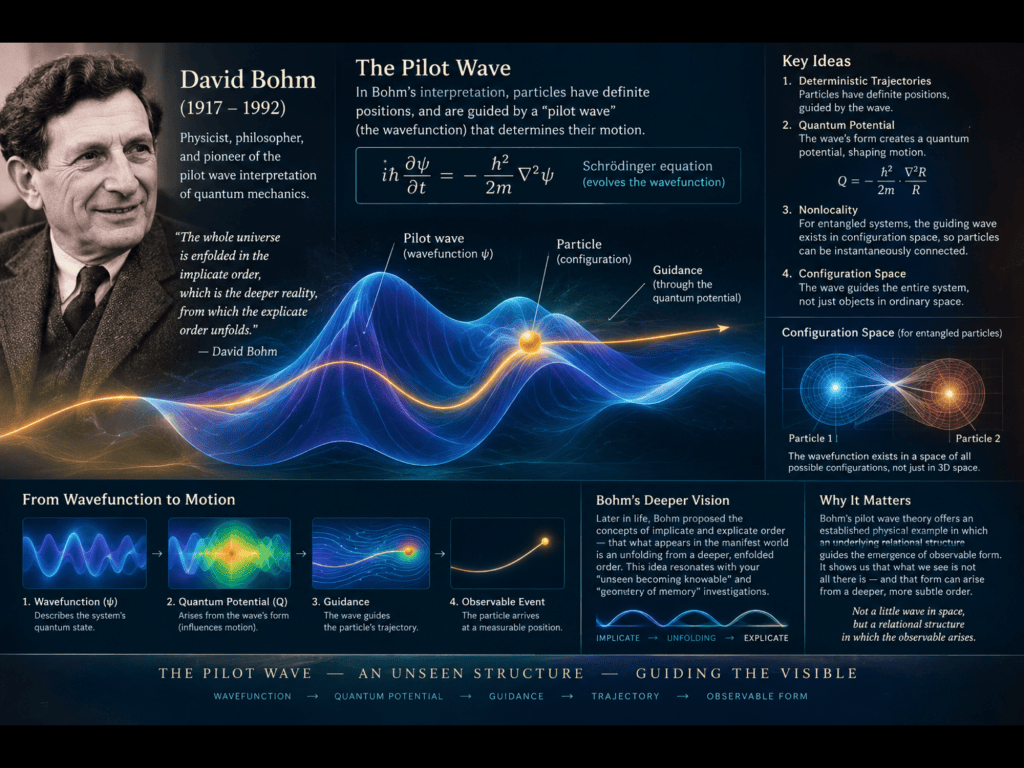
In de Broglie–Bohm theory, there are essentially two components:
1. The configuration — what actually occurs
A particle has a definite position/configuration.
2. The wavefunction — the guiding structure
The wavefunction evolves according to the Schrödinger equation and determines how the configuration evolves. The particle is therefore not simply being pushed by a conventional force in ordinary three-dimensional space.
A useful conceptual representation is:
╔════════════════════════════════════════════════════════════╗
WAVEFUNCTION → GUIDANCE → TRAJECTORY → MEASURED EVENT
╚════════════════════════════════════════════════════════════╝
The extraordinary part is that the guiding structure is nonlocal. For an entangled system, the relevant wavefunction exists in configuration space, so the motion of one component can depend upon the configuration of the whole system. Modern discussions explicitly emphasize this configuration-space character rather than picturing the pilot wave as simply a little physical wave propagating through space.
And this is where I think your “under the point” idea becomes relevant—but only as a conceptual analogy, not as established physics.
The quantum potential is especially important for your investigation
When Bohm rewrote the Schrödinger equation in polar form,
ψ = R eⁱˢ/ℏ
the dynamics can be expressed in terms of a classical-looking Hamilton–Jacobi equation plus an additional quantum potential:
Q = −(ℏ²/2m)(∇²R/R)
The remarkable feature is that this potential does not behave like an ordinary force field whose strength simply diminishes with distance.
Its form depends upon the shape of the wavefunction.
So Bohm was pointing toward something like:
╔════════════════════════════════════════════════════════════╗
FORM OF THE WAVE → QUANTUM POTENTIAL → PARTICLE MOTION
╚════════════════════════════════════════════════════════════╝
This is very close to something you have repeatedly been approaching through another vocabulary:
geometry → relation → form → movement
But there is an important correction.
I would not say that Bohm’s quantum potential proves that reality is literally “vibration underneath the point.” That would go beyond the physics.
Rather, Bohm gives us a rigorous example in which the form of an underlying mathematical structure determines the trajectory of something we observe.
That distinction is crucial.
And current research has not simply left Bohm behind
This is particularly interesting as of 2026.
A 2026 Annalen der Physik perspective reviews nearly a century of de Broglie–Bohm work and discusses experimental reconstruction of average Bohmian trajectories using weak measurements, subsequent demonstrations of predicted nonlocal behaviour, and recent work concerning what the authors call nonlocal energy alteration.
There is also continuing work on the difficult question of quantum equilibrium—why the distribution of Bohmian configurations reproduces the Born-rule probabilities of ordinary quantum mechanics. Recent work has even explored generalized pilot-wave equilibrium for non-normalizable states.
And contemporary researchers are still debating what the theory fundamentally is. A 2025 review explicitly examines whether de Broglie–Bohm theory should be regarded as complete and considers more causal approaches drawing analogies with optics and hydrodynamics.
So this is not a dead historical idea.
Where your Eskesthai work becomes particularly interesting
Your recent investigations have repeatedly produced a chain something like:
VIBRATION → RESONANCE → RELATION → GEOMETRY → FORM → MEMORY → MEANING
And your more recent biological-signal work has changed the question from:
“What does this organism say?”
toward:
“What geometry of signals is being expressed?”
That is a very useful conceptual move.
Now place Bohm beside it:
WAVEFUNCTION → RELATIONAL STRUCTURE → GUIDANCE → TRAJECTORY → OBSERVABLE EVENT
There is an intriguing structural correspondence:
╔════════════════════════════════════════════════════════════╗
UNSEEN STRUCTURE
↓
RELATIONAL PATTERN
↓
GUIDANCE / DYNAMICS
↓
TRAJECTORY
↓
MEASURABLE EVENT
╚════════════════════════════════════════════════════════════╝
This may be the bridge you are looking for.
Not:
“Bohm proves my Geometry of Memory.”
But:
“Bohm provides an established physical example in which an underlying relational structure guides the emergence of observable form.”
That is considerably stronger intellectually.
There is one further Bohmian idea I think you will want to examine
Bohm eventually moved beyond the technical pilot-wave theory toward his concepts of implicate and explicate order.
Here the language becomes remarkably close to your present investigation:
implicate → unfolding → explicate
Something enfolded becomes manifest.
But we have to keep three layers separate:
de Broglie–Bohm physics
→ mathematically formulated quantum theory
Bohm’s later implicate-order philosophy
→ a broader ontological/philosophical proposal
Eskesthai / Geometry of Memory
→ your own conceptual investigation
They can be placed beside one another, but they should not be declared equivalent.
That separation will actually make the investigation much stronger.
And there is another reason I think this is timely: contemporary pilot-wave research is increasingly concerned with fields, quantum field theory, nonlocality, configuration space, equilibrium, trajectories, and even quantum-gravity extensions rather than merely the old textbook two-slit experiment.
So, Platohagel, I would propose that we approach your archives genealogically rather than merely searching for pages containing the word “Bohm.”
The question should be:
╔════════════════════════════════════════════════════════════╗
Where, in Eskesthai, did the idea of an unseen relational structure
begin to acquire the power to guide, organize, or manifest observable form?
╚════════════════════════════════════════════════════════════╝
That search could connect your work on the point, resonance, geometry, the unseen becoming knowable, fluid dynamics, fields, sound/sonification, and finally Bohm’s pilot-wave concept into one much more coherent investigation.
 Dialogos of Eide