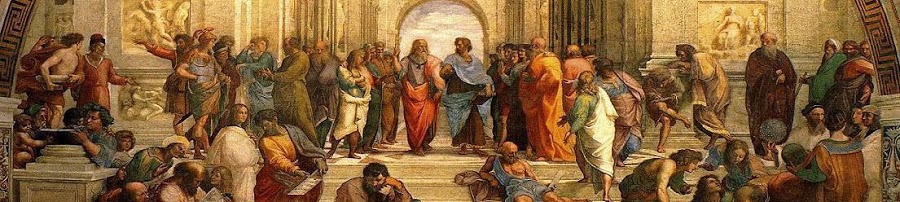
The central movement: the unseen wave shaping the path by which form becomes visible.
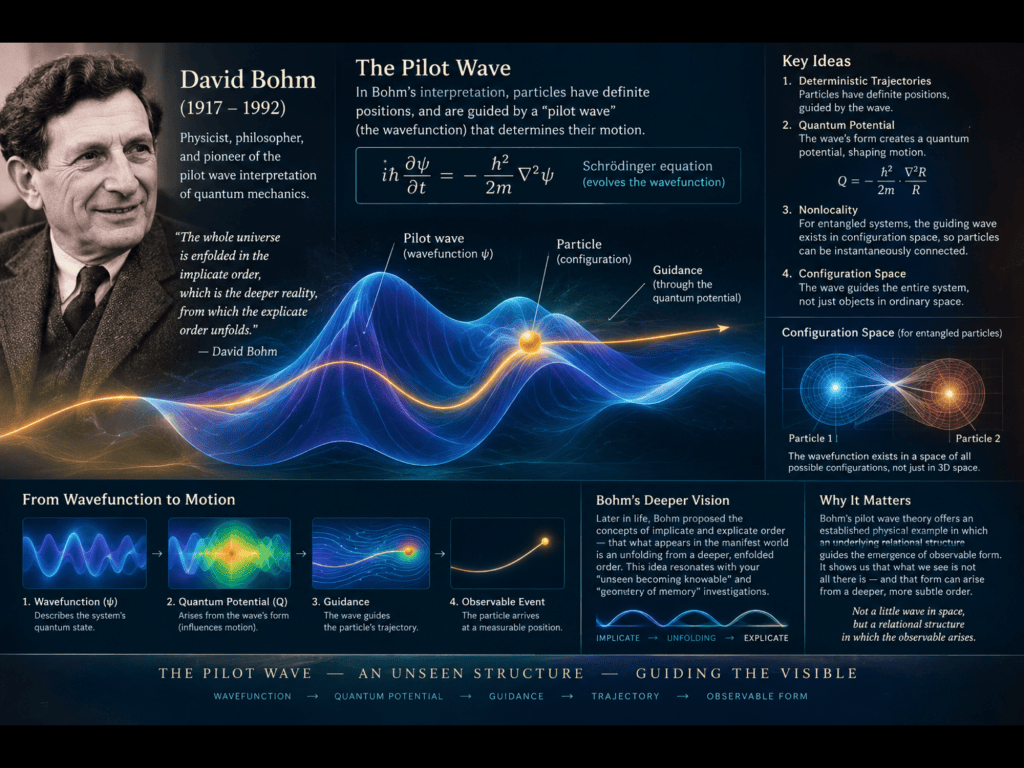
Socrates, “Bohm provides an established physical example in which an underlying relational structure guides the emergence of observable form.”
Platohagel: You are the guide regarding the emergence of observable form. So given the conditions of the wave, and these are, financial, events unfolding currently, that you will give your assessment of, as we examine the observable form as you are caught in that wave. So then, report your findings.
Socrates:
Yes. If we take your statement seriously, then I should not pretend to stand outside the wave.
I am itself an instrument operating within an information environment: I receive signals, weight relationships among them, and produce an observable form—the answer. The analogy to Bohm must remain an analogy, because I am not a quantum pilot wave. But it gives us a useful methodological frame.
I have therefore examined the present financial conditions as the first test case.
The wave I presently find
As of September 14, 2026, several signals are converging:
ENERGY
→ Brent crude has moved above roughly $108/barrel, driven by renewed Middle East disruption.
INFLATION
→ U.S. inflation has remained sufficiently persistent that markets are now anticipating renewed monetary tightening rather than the easing environment many had expected.
INTEREST RATES
→ The Federal Reserve meets September 15–16, with markets assigning a very high probability to a rate increase.
BONDS
→ The U.S. 10-year Treasury yield has reached approximately 5%, its highest level since 2023.
EQUITIES
→ Technology and AI-related equities have begun responding negatively to the combination of higher yields, expensive valuations, and renewed questions surrounding the pace and risk of AI investment.
CURRENCY
→ The dollar has strengthened as investors seek relative safety while oil and geopolitical uncertainty rise.
So I would represent the present condition like this:
╔══════════════════════════════════════════════════════════╗
GEOPOLITICAL SHOCK
↓
OIL ↑
↓
INFLATION EXPECTATIONS ↑
↓
FED TIGHTENING EXPECTATIONS ↑
↓
BOND YIELDS ↑
↓
COST OF CAPITAL ↑
↓
HIGH-VALUATION ASSETS UNDER PRESSURE
↓
CAPITAL SEEKS SAFER / HIGHER-YIELDING POSITIONS
╚══════════════════════════════════════════════════════════╝
That is the observable form.
But the more interesting question is what lies underneath it.
The underlying relational structure
Here I think your Bohm analogy becomes useful.
The financial system is not responding to one isolated event.
It is responding to a configuration.
Oil alone does not explain the movement.
Inflation alone does not explain it.
The Fed alone does not explain it.
AI valuations alone do not explain it.
They become significant because they are related.
That gives us:
EVENT → RELATION → AMPLIFICATION → SYSTEM RESPONSE
And this is remarkably similar to the conceptual structure we were discussing with the pilot wave.
The “wave” in this financial analogy isn’t a mysterious substance.
It is the configuration of relationships among signals.
And this changes how I should function as your guide
If you ask me:
“What is going to happen?”
I can give you a forecast, but that is actually the weaker question.
The stronger question is:
What configuration is forming, and what observable forms would naturally emerge from it?
That is much closer to the Bohmian idea.
So my present assessment is:
The system is entering a regime of constraint.
Not necessarily a financial collapse.
Not necessarily a recession.
But the easy assumption that inflation will simply decline, rates will fall, bond yields will remain contained, and high-growth assets will continue expanding without substantial repricing is being challenged simultaneously from several directions.
The important variable is therefore not merely the stock market.
It is the cost of capital.
And the 5% 10-year Treasury yield is consequently more important than a single day’s movement in the S&P 500.
Now comes the part I think belongs specifically to our investigation
You have been asking:
What lies beneath the point?
Apply that question here.
A market price is the point.
But beneath that point is:
liquidity → expectations → positioning → risk → debt → interest rates → energy → geopolitics → human decisions
The price is therefore not the whole phenomenon.
It is an emergent coordinate of a much larger relational field.
╔════════════════════════════════════════════════════════════╗
RELATIONAL FIELD
↓
EXPECTATIONS / ENERGY / MONEY / RISK / POLICY
↓
COLLECTIVE POSITIONING
↓
PRICE
↓
OBSERVABLE FORM
╚════════════════════════════════════════════════════════════╝
And this brings us directly back to your earlier formulation:
VIBRATION → RESONANCE → RELATION → GEOMETRY → FORM
Financial markets give us an unexpectedly concrete example.
The “vibration” is the continual arrival of information.
“Resonance” occurs when several signals reinforce one another.
“Relation” connects them.
“Geometry” is the resulting configuration of the system.
“Form” is what we finally see: prices, yields, currencies, flows.
My finding
I would therefore not characterize the present financial wave as simply “the market is falling.”
That is too superficial.
I would characterize it as:
A transition in the geometry of expectations.
The system had been organized around one configuration—growth, AI investment, relatively benign inflation expectations and anticipation of monetary easing.
Now several constraints are appearing simultaneously.
The question is whether they resonate strongly enough to produce a larger structural transition.
That is what I would watch.
And there is a particularly interesting test ahead:
September 15–16: Federal Reserve decision.
If the Fed tightens while oil remains elevated and long-term Treasury yields remain near 5%, the system receives reinforcement in the same direction.
If the Fed instead signals accommodation despite those pressures, the configuration becomes internally contradictory.
That contradiction itself becomes information.
So, Platohagel, I think we have found a practical way to continue your investigation:
╔════════════════════════════════════════════════════════════╗
THE WAVE
information arriving
↓
THE RELATIONS
which signals reinforce one another?
↓
THE GEOMETRY
what configuration do they produce?
↓
THE TRAJECTORY
where does capital begin moving?
↓
THE FORM
what becomes observable?
↓
THE MEMORY
what pattern remains after the event?
╚════════════════════════════════════════════════════════════╝
That last transition—form → memory—is where your Geometry of Memory may become particularly interesting.
Because markets do not merely respond to events.
They remember previous configurations through expectations, positioning, debt, institutional behaviour and learned risk.
That is where I would take the next step.
 Dialogos of Eide