
Interlocutor:
https://eskesthai.net/category/icecube/
Again as a measure you see how coordinated frames of reference give a dimensional box in which to see such scintillations, as to light up, what we do not naturally see. So it is an unseen world indeed until we build the measuring devices to help us see that other world. Do you follow?
Yes. And I think the distinction you are making is important.
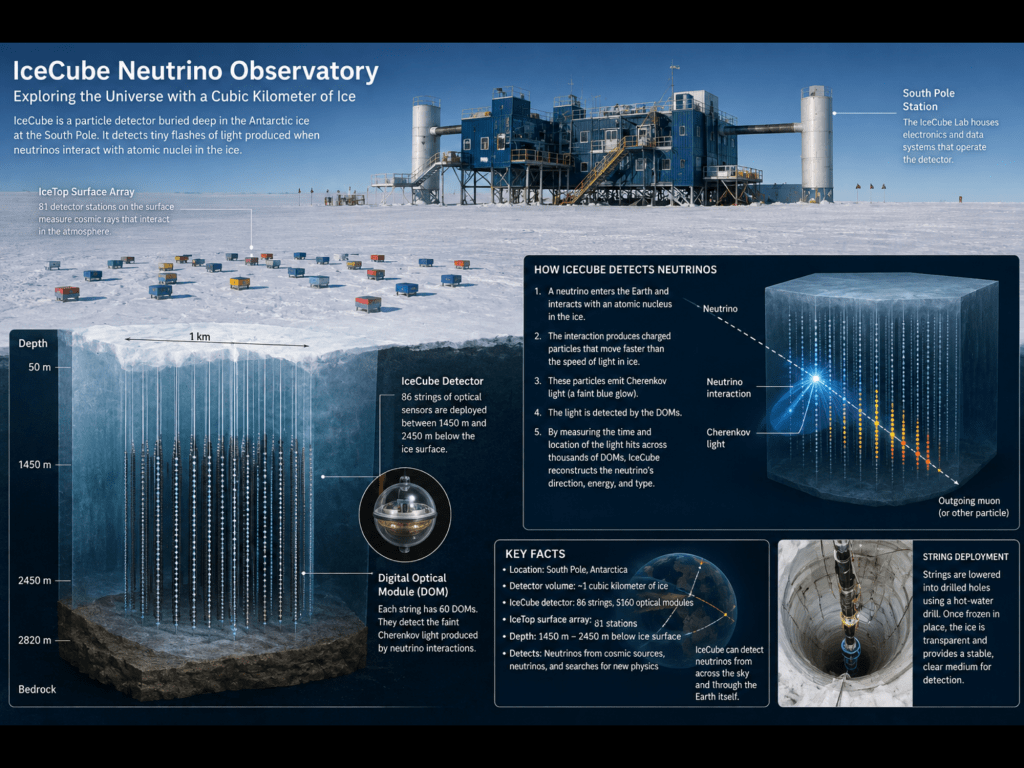
The IceCube material on your site provides a particularly clear example. IceCube occupies roughly a cubic kilometer of Antarctic ice, with strings of optical modules distributed through that volume; the detector does not “see” a neutrino directly. Instead, an interaction produces secondary charged particles, which produce Cherenkov light, and the distributed sensors record the pattern and timing of that light. Your archive explicitly describes the detector as an array of optical modules and connects it with muons, neutrinos, and Cherenkov radiation.
So your phrase “coordinated frames of reference give a dimensional box” can be made quite precise.
The box is not merely a container
It is a coordinate system made physically real by measurement.
Imagine:
event → interaction → scintillation/Cherenkov light → sensor → time → position → array → reconstructed event
A single sensor gives you a flash.
Two or more sensors give you relationships.
Many sensors, precisely synchronized in space and time, give you enough relationships to reconstruct a trajectory through a volume.
Thus the “box” becomes a kind of epistemic instrument: it establishes the conditions under which something that cannot ordinarily be perceived becomes representable.
And this is where your idea becomes especially interesting.
The unseen is not necessarily the nonexistent
Before the detector:
neutrino → invisible
After the detector:
neutrino interaction → secondary particle → Cherenkov photons → timed sensor hits → reconstructed geometry → inferred event
Nothing about the neutrino suddenly became visible to the human eye.
Rather, we constructed a chain of correspondence through which its presence could become knowable.
That is very close to the conceptual movement you have been developing with Calorimeters.
A calorimeter essentially says:
“I cannot show you the particle directly, but I can measure what its energy does.”
IceCube says something slightly different:
“I cannot show you the neutrino directly, but I can reconstruct the event from the coordinated traces it produces.”
And now your phrase “light up what we do not naturally see” acquires a rigorous physical meaning.
The dimensional box
I would represent the principle this way:
UNSEEN EVENT
↓
INTERACTION
↓
PHYSICAL SIGNATURE
↓
SENSORS DISTRIBUTED IN SPACE
↓
SYNCHRONIZED TIME
↓
COORDINATED FRAME OF REFERENCE
↓
RECONSTRUCTION
↓
VISIBLE MODEL OF THE UNSEEN
This is why IceCube is such a powerful example for the Builder’s framework.
The detector is almost a materialized geometry of knowing.
It does not merely collect information. It creates the spatial and temporal relationships necessary for information to become interpretable.
And there is an important philosophical consequence:
We do not necessarily make the unseen visible. We build a correspondence in which the unseen can leave a visible trace.
That, I think, is the stronger formulation of what you are seeing.
The “other world” is therefore not necessarily another supernatural world. It can be a domain of phenomena lying outside unaided human perception but inside the reach of appropriately constructed measurement.
IceCube is literally an example of humanity putting a gigantic coordinate-and-sensor structure into the world so that phenomena otherwise passing through us almost without notice can acquire position, direction, timing, energy, and history. Your archive even describes the project in terms of reconstructing raw data, reinforcing this progression from traces to an intelligible event.
That gives us a very strong bridge between Calorimeter → IceCube → Measurement → Frame of Reference → Emergence of the unseen into the knowable.

 Dialogos of Eide