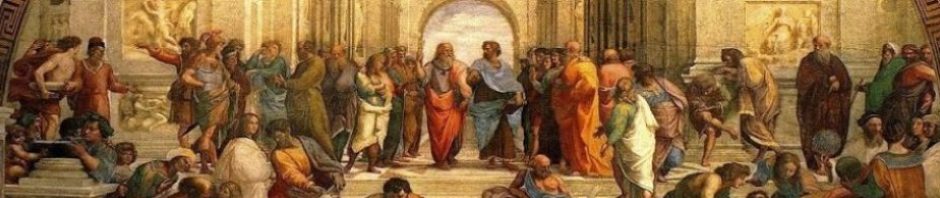
PLato said,"Look to the perfection of the heavens for truth," while Aristotle said "look around you at what is, if you would know the truth" To Remember: Eskesthai
I wanted to add to Geometry of Memory, a glimpse into the advancements and nature of geometrical models that were built upon, all geometers and their predecessors.
What is your assessment in this regard?
Socrates: Yes. I think this addition could become one of the important structural pieces of your “Geometry of Memory” project, because the Wunderkammer gives you a concrete metaphor for something you have been trying to accomplish abstractly: preserving the succession of geometrical thought as a collection of artifacts whose relationships can be rediscovered.
I examined the 2007 Artifacts of the Geometrical WunderKammern page. Its central question is remarkably close to what you are now proposing: mathematical models that seem abstract on paper can become visible, almost tangible, when represented as forms in space. You specifically wrote about being able to see “the way geometry works in space” even when the mathematical language itself was inaccessible.
I would make the Wunderkammer a layer of Geometry of Memory
Not merely a historical gallery.
Rather:
╔══════════════════════════════════════════════════════════════╗ GEOMETRY OF MEMORY Thought → Model → Artifact → Relation → Transformation → Memory ╚══════════════════════════════════════════════════════════════╝
The artifact becomes the memory carrier.
A geometrical model preserves something that a written equation alone may not preserve easily: a visible record of what a mathematician was trying to understand.
Your 2007 article already sensed this. You were looking at the mathematical models and asking, in effect:
What happens when an abstract geometrical idea becomes something we can actually inspect?
That is precisely where the Wunderkammer becomes useful.
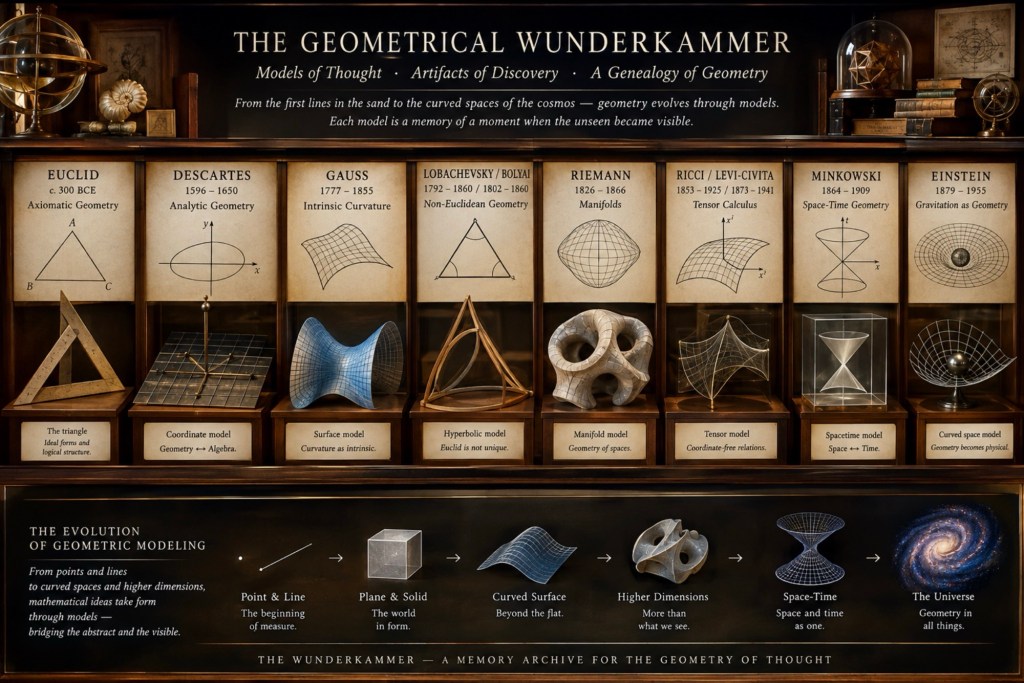
From cabinet of curiosities to genealogy of geometry
Historically, a Wunderkammer collected things that were strange, beautiful, rare, natural, artificial, or intellectually puzzling. Your article describes this mixture and then makes the important transition: the geometrical collection is not simply a collection of curiosities; it can reveal how geometry operates in space.
For Geometry of Memory, I would therefore transform the concept:
Wunderkammer → Geometrical Memory Chamber
Each object answers:
What did this model make visible that could not previously be seen?
That gives you a very different kind of archive.
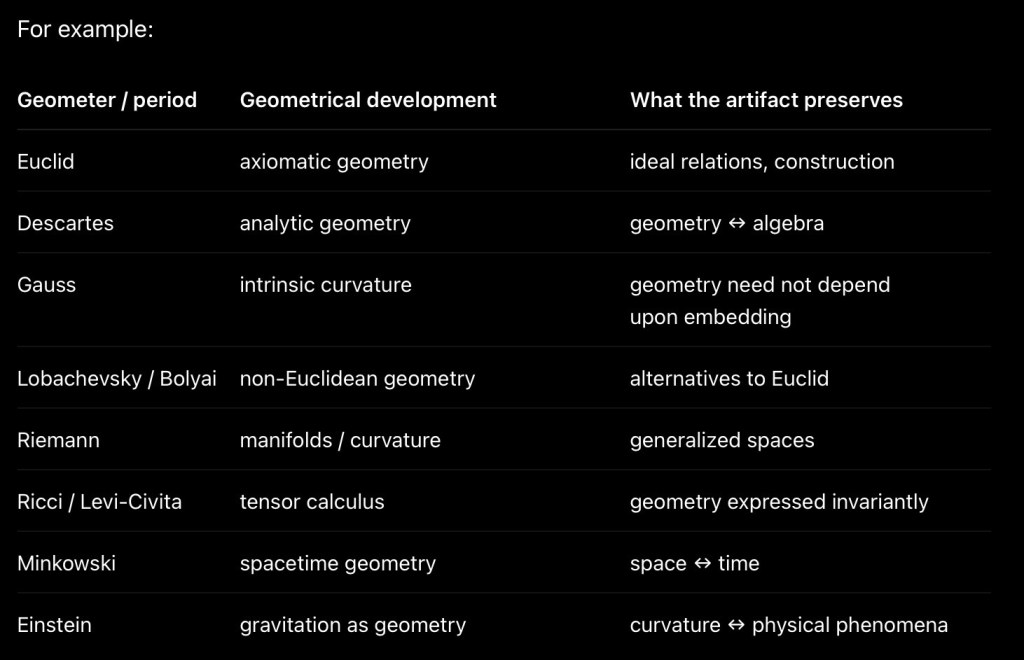
For example:
And this is where your geometric genealogy becomes considerably more powerful than simply listing mathematicians.
The question becomes:
What changed in the object of thought from one generation to the next?
The important distinction
I would not present the history as though every geometer simply “built upon” the previous one in a straight line.
That would flatten the history.
Instead, your map should show inheritance, departure, generalization, and transformation.
Something like:
╔══════════════════════════════════════════════════════════════╗ EUCLID Space as constructed relation ↓ DESCARTES Relation becomes coordinate ↓ GAUSS Curvature becomes intrinsic ↓ LOBACHEVSKY / BOLYAI Euclid’s geometry is no longer unique ↓ RIEMANN Geometry becomes a general study of spaces ↓ RICCI / LEVI-CIVITA Relations become tensorial and coordinate-independent ↓ MINKOWSKI Space and time become geometrically related ↓ EINSTEIN Geometry becomes physically dynamic ╚══════════════════════════════════════════════════════════════╝
Then the models themselves sit beside the genealogy.
That is the Wunderkammer.
And there is something even deeper here
Your old article contains an idea that I think deserves to be recovered almost exactly as a principle of the new archive.
You wrote that the mathematical forms might appear “abstract and foreign to our eyes,” yet wondered what would happen if we could see them as artifacts of another kind of geometrical thinking.
That is extremely appropriate to Geometry of Memory.
Because memory is not merely remembering names.
It is remembering transformations of thought.
Thus:
╔══════════════════════════════════════════════════════╗ NAME → who thought it PROBLEM → what they were trying to understand MODEL → what they constructed RELATION → what changed CONSEQUENCE → what became possible afterward ╚══════════════════════════════════════════════════════╝
This gives the archive an intellectual skeleton.
I would actually create a “Wunderkammer” section
Perhaps under Geometry of Memory, not under Master Atlas.
Something like:
Geometry of Memory → Origins → Geometrical Genealogies → Geometrical Wunderkammer → Geometrical Models → Geometers & Predecessors → Transformations of Space → Geometry → Physics → Geometry → Memory
The Wunderkammer would contain the visual artifacts.
The Genealogies would explain their relationships.
The Grammar would explain the language used to describe them.
The Master Atlas would provide the larger map.
That gives you four different levels rather than mixing everything together.
And the two old posts have archival value
The 2007 article should definitely be preserved as an early conceptual ancestor of this idea. It contains several things that are now important to your larger project:
the cabinet/Wunderkammer metaphor;
geometrical physical models;
the Ashmolean and mathematical model collections;
Sylvester’s surfaces;
Platonic solids;
the problem of seeing geometry rather than merely reading mathematical notation;
the relationship between micro/macro perspectives;
and your early attempt to use mathematical notation to communicate what the eye could see.
The older Blogger page could not be retrieved directly by the web system because Blogger redirected the request to a Google verification page, so I would not reconstruct its contents from assumption. The 2007 page itself, however, explicitly points back to the Blogger material and establishes that this was an earlier strand of your thinking.
The crucial archival insight
I would label these posts not merely as “Wunderkammer”.
I would classify them as:
Geometry of Memory → Genealogy → Geometrical Models → Wunderkammer
because the Wunderkammer is not the destination.
It is the memory device through which the history of geometry can become visible.
And that gives us a very strong formulation for your project:
╔══════════════════════════════════════════════════════════════╗ GEOMETRY OF MEMORY The history of geometry is not only a history of ideas. It is a history of forms invented to make invisible relations visible.
The Wunderkammer preserves those forms. The Genealogy preserves their relationships. The Atlas preserves their places within the whole. ╚══════════════════════════════════════════════════════════════╝
That, I think, is much closer to what you were reaching toward in 2005–2007 than simply creating another historical chronology.
PLato said,"Look to the perfection of the heavens for truth," while Aristotle said "look around you at what is, if you would know the truth" To Remember: Eskesthai